
I want to start an Ice cream company, what will I need?
| Land | To build a factory. |
| Labor | Workers to run the machines. |
| Capital | Money to buy Freezers, mixers and packing machines to make ice-cream. |
| Entrepreneurship | To take the risk and do above three things. |
- These are called the four factors of production.
- I already have the entrepreneurship in my heart and mind.
- But it requires truckload of cash to arrange for the other three items: Land, Labour and Capital.
How To get the cash to start my company?
- I can rob a bank
- Or I can just start my own IIT Bombay, sell its application forms for 5,000 rupees and then declare cut off 99.99% and thus earning truckload of cash without actually wasting a single rupee in arranging the admission interviews.
- Or I can join politics.
Problems in above options
- Can’t rob a rob a bank because this too requires Labour (gangsters) and guns, masks, vehicles and Entrepreneurship (to take the risk of going to jail).
- Can’t start my own IIT Bombay would again require those four factors of production (Land, Labour, Capital, Entrepreneurship)+Permissions from UGC/AICTE.
- Can’t join politics because Only ministers can make huge money, MPs/MLAs don’t. And Unfortunately I’m not a son or daughter of some big politician so I can’t become minister @ young age (Agatha Sangma, Sachin Pilot, Naveen Jindal et al) So even If I join politics right now, I’ll have to do bootlicking of ‘Party high command’ until I get 60 years old, only then I can become minister and break the records set by A.Raja and Madhu Koda.
Now, There are two ways to (legally) arrange money for starting a company or to expand a company. First is Debt and Second Equity. See this chart
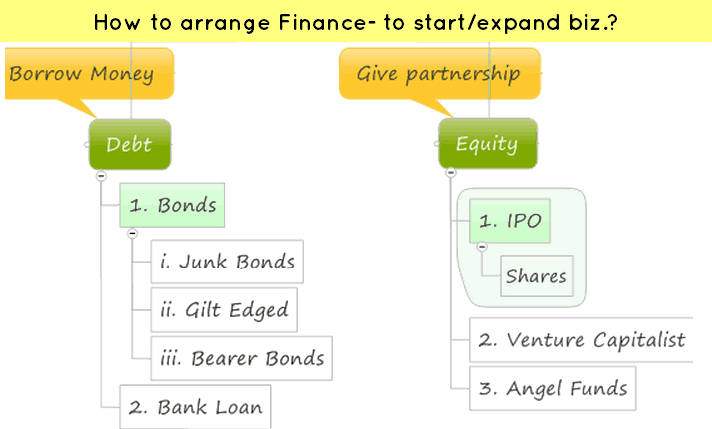
Financing my company: Debt OR Equity
Within that, two major types: Gild edged securities, junk Bonds and Coupon bonds.
#1: Debt- bond
- The word debt is self-explanatory. You borrow money from someone: It can be a bank, it can be a friend, it can be a stranger.
- I write on a piece of paper: “To whoever pays me Rs.1000, I’ll pay annual 10% interest rate (Rs.100). And after 5 years, I’ll also repay the principle amount Rs.1000. No “ifs” and “buts”.
- This is one type of security paper. We call it “BOND”.
- IF you hold my bonds, I’m liable to pay you money no matter what happens. Whether my ice-cream company actually makes profit or goes Kingfisher. I have to keep paying fixed money to you, every year.
Junk Bonds vs Gilt Edged Security
- In above case I offered you 10% interest rate. But in real life, there are credit rating companies like CRISIL, S&P, Moody’s etc. They’ll give credit ratings to a bond. (i.e. Am I capable enough to actually pay you?).
- Based on that, they give ratings example AA,A, BBB, BB,C,D etc.
- I had talked about them in my previous article. Go through the Archive on http://www.mrunal.org/economy
Junk Bonds
- If my Bond gets “C” or “D” rating, it means I’m not creditworthy, I may default on this loan, I may run away. So my bond is as junk as Ra.One movie. A wise man will not invest in it.
- So, how can I seduce you into purchasing my bonds? How can I convenience you to take the higher risk, in buying my junk bond?
- How about Free caller Tunes or a scratch-card that offers you a chance to dine with Sachin or Katrina?
- Or How about Higher Interest rates: “If you give me Rs.1000, I’ll give you 25% interest rate per year!”
- This is also known as “High Yield Bond”, because you’re getting higher profit.
Gilt Edged Securities
- Like an ice cream company, Government also needs finance- at times when tax collection is low and they need some temporary funds.
- They issues treasury bonds. RBI sells these treasury bonds on Government’s behalf.
- But Governments generally have the “aukaat” to repay the principle and interest rates. Hence Government bonds have higher credit ratings (AA). So, they don’t need to seduce you, they’ll offer very low rate, say 4%.
- Similarly, well known companies with high credit ratings (AA) also issue bonds but pay low rates.
- If you don’t like to take risks, you’ll invest in such bonds. These are called ‘gilt-edged securities’.
Bearer Bonds (and Bad Guys)
- In Bollywood movies, Kidnapper demands ransom of Rs.10 lakhs but he wants the money in the denomination of Rs.5/10/50 Rupee notes. Why? Because it is easy to circulate these notes and harder for police or banks to keep track of this money.
- Same way, in Hollywood Spy-thriller movies, the Villain will ask you to pay 10 million dollars in Bearer bonds.
- Bearer bonds are same as regular bonds, but they don’t have “Holder’s Name” on them. These bearer bonds have coupons attached with them. So, if you don’t want to withdraw the whole money, you can cut a few coupons and sell them to a broker to withdraw partial amount.
- E.g. Rs.100 interest is to be paid on 1st April 2012, But even on December-2011 you can sell the coupon to a Broker. Although he’ll not give you Rs.100 but something like Rs.95 or 90. (Why so? Think about it!)
- Anyways, the point is, Noone can keep a track of who withdrew the money, who’s buying, who’s selling Because there are no “names”, addresses or records. Bad guys like it, because this ensures anonymity.
- See the following example photograph of a Bearer bond of Government of Palestine. Notice that it doesn’t have space for Owner’s names and there are three coupons attached at the bottom.

- Question: Why would Government issue bearer bonds? Because when they’re in dire need of money, there is emergency, there is war going on, they cannot waste time in checking the lengthy registration forms. So, Better just sell the bonds to any swinging dude that comes, without asking his name, address, mobile number or email id.
- Although, in real life, it is hard to find Bearer bonds. Because most of the bonds now, exist in Electronic (DEMAT) format and you’ve to give your pan card number (or other similar personal information in foreign countries) to buy or sell bonds/shares or any similar security papers. So, now bad guys want payment in gold, diamond or other precious metals instead of bearer bonds.
#2: Equity: IPOs and Shares
- So far, we saw that first option is to ‘borrow’ money and pay regular interest rate. (Debt ->Bonds). Now continuing this not so technically correct article,
- Second option is, I take money from you and in return I offer you partnership. This is called Equity.
- Assuming that I need 1 crore rupees to start my company and I’ve 30 lakhs in my savings. So, I write on a piece of paper: “ I’ll give 0.0001% ownership of my company to whoever gives me Rs.1000”.
- This is again a type of ‘security-paper’. But since I’m sharing a part of ownership with you, in crude terms, we’ll call it “Share”.
- Then I print 10,000 such papers. What’s the value of these papers?
- 10,000 Papers multiplied with Rs.1000 each =1 crore. Voila that’s total money I need.
- And since I already have Rs.30 lakhs, I can purchase 3000 shares. (because 3000 papers x Rs. 1000 each = 30 lakhs)
- So out of the Total 10,000 shares that I printed, I will own 3,000 shares, so percentage wise I own 30% of this company’s equity.
Shareholders and Board of Directors
- Since I’m issuing the ‘shares’ (Equities), under the Company law, I’ve to Constitute a board of directors and hold annual general meeting of the shareholders.
- For important policy decision, I’ll have to take votes of the shareholders, the Board of Directors will supervise over my activities. In short I cannot run the company as I please, I’ve to give answers to those people.
- On the first year, I make profit of Rs.25 lakhs. The board of directors will meet and decide
distribute Rs. 10 lakhs as Dividend among the shareholders. Now about the remaining 15 lakhs, invest them back in the company to expand our production-capacity , buy bigger machines and install new factories in Pakistan and Somalia.
- Here is the cool part, I can become CEO of my own company and say I’ll take salary of Rs.1 only! And still, I will earn Rs.3 lakhs.
- How? Because I own 30% of shares in this company, so when that Rs.10 lakh Dividend is shared among the shareholders, I get 30% of it = 3 lakhs, apart from my Rs.1 salary as an ‘employee’ of this company.
- Here is a demo photograph, of Creek Mining Company’s shares.

The owner Mr. George own 200 shares of this company. And in the small fonts, it is mentioned that total 30,00,000 shares of $1 each. Meaning Mr. George owns (200/30 lakh) x100 =0.0067 % stocks of this Creek Mining Company.
But in real life, nowadays, when you purchase shares , you don’t get such cool looking colorful paper certificates. You get the shares in electronic dematerialized format. They get transferred in your demat account.
Primary vs Secondary Market
- Primary market = this is the Place where IPOs are sold,
- Secondary Market= this is the place where IPOs are re-sold as shares.
- Physically both things are done in the same place e.g. BSE (Bombay Stock Exchange) but this virtual classification helps in keeping track of things, making statistical analysis etc.
Venture Capitalist and Angel Investors
Now Two more sub-types of Equity financers
What is Venture Capital?
- Venture Capital is a company that gives you money, to start your company or to expand your company but in return they demand part of ownership.
- They deal with only ‘big’ things, ‘big’ projects, ‘big’ investments. They won’t help me to open an ice-cream parlour in Gujarat University despite the fact that its monthly revenue will be higher than SBI General Manager’s salary.
- Copy pasting example of Ojasventure, India
- We invest in technology based businesses in sectors such as Mobile technology, Telecom, Software.
- We make an initial investment of US $ 250,000 to US $ 1.5 million.
How do they get money?
- Ofcourse money doesn’t fall from sky, these Venture Capitalist companies themselves borrow money from other companies like mutual funds, pension funds or they may be issuing their own ‘bonds’ to get money.
How do they operate?
- They’ve their own team of Management experts, corporate lawyers, chartered accountant, and business consultants. They study your business plan, approve the money.
- They’ll demand seats in your company’s board of directors to Influence the Decision Making in your company, according to their requirement and so on…
Who is Angel Investor?
- These are rich gentlemen. They finance startup companies for getting partial ownership and or assured returns on investment, after few years.They can give debt (i.e. just like moneylenders and banks) or Equity (i.e. partial ownership). But mostly they play in the equity field.
What is the need of Angel Investors?
- You can get money from Banks / Bonds (Debt) or IPO/Venture Capitalist (Equity), if your business project is likely to bear success based on previous experiance.
- For example: Pharmaceuticals, Dairy, Engineering instruments, Mining, Telecom, Textiles, Oil Refinery etc.
- But they may not get interested in you, if you talk about untried and untested business plans / product or fields.
- Imagine Steve Jobs requesting SBI Bank Manager to give him business loan in 1970s to start Apple Computers,
- or Same Steve Jobs launching IPO of Apple in NewYork Stock exchange during that time!
- But there was an angel investor Mike Markkula, who actually believed in his plan and gave him some money and got 1/3rd ownership in the company in 1977.
- Angel investor doesn’t mind taking huge risk by helping even small timers with totally unique and untested idea, if he think that it’ll grow up huge success in future.
- Similarly, Amazon online shopping website and Starbucks coffee chain also started with Angel Investors.
Capital Gain Tax Revisited
Recall the argument given by Mr.Vodafone in Capital Gains tax?
An individual who owns 45 per cent share capital does not own 45 of that company’s assets. There is a difference between the sale of shares in a company and the sale of assets of that company.
- Why is it so?
- Because most of the company don’t directly start with IPO / Shares. First the entrepreneur starts a small company using money from his own savings, borrowing from friends, relatives and banks or from an Angel Investor.
- Once the business starts booming, he’ll launch an IPO to get extra funds from public, to expand his business.
- So, He already has some building, machinery, vehicles etc assets in his small company before launching his IPO.
Take a really crude example
- I have Rs.30 in savings, I borrow Rs.20 (Debt) and thus start a company for Rs.50
- After few years, I need another Rs.50 to expand business, so I launch an IPO: Total 50 share papers worth Rs. 1 each (Equity)
- You buy 10 shares for 10 rupees. Means you own 10/50th =20% of my shares/stocks/equity/ IPO whatever you want to call it.
- But the total assets of my company are= From Rs. 50 I had already + Rs. 50 from IPO = Total Rs.100
- So, You don’t own 20% assets of my company, because you’ve given me only Rs.10! and my total assets are financed from both Debt + Equity.
- Same way, if you purchase 10% shares of Jet Airways, doesn’t mean you own 10% of their airplanes and buildings.
Who is Underwriter?
- So far we’ve seen that
- To arrange money I can either borrow (debt, Bond) or I can give shares (equity, IPOs/shares).
- Here is the problem: I cannot print those security papers on my own Home PC’s cheap-printer.
- First, A lengthy legal and accounting paper-work has to be done, it’ll require chartered accountants, Corporate Lawyers experts in these matters.
- So, I goto an underwriter, he charges Commission but he promises to cover all the technically things, paperwork, SEBI regulations, selling, accepting money for IPO/Bonds sale etc.etc.etc.
- Same underwriter also offers a kinda insurance, that he’ll buy the IPO/Bonds if others don’t buy it.
- Kotak Mahindra, ICICI offer such underwriting services.
Debt vs Equity: Pros and Cons
- In real life, companies don’t rely on single source to finance their adventure. They’ll arrange part of the cash from Debt (Borrowing) and part of the cash by issuing IPOs (Equity).
- Each has its own advantage and disadvantage. Let’s check
| Debt (Bond) | Equity (IPO/Shares) |
|---|---|
|
|
| Debt (Bond) | Equity (IPO/Shares) |
|---|---|
|
|
So, it’d be better if I finance a part from debt and a part from equity. That leads us to the discussion about Debt to Equity Ratio. (to be continued), All my articles on economy, are archived at Mrunal.org/economy
![[Win23] Economy Pill4ABC: Sectors: Agri, Mfg, Services, EoD, IPR related annual current updates for UPSC by Mrunal Patel](https://mrunal.org/wp-content/uploads/2023/04/win234b-500x383.jpeg)
“The Securities and Exchange Board of India (SEBI) has allowed partial fungibility of Indian Depository Receipts
(IDRs) — redemption or conversion of IDRs into underlying equity shares — in a financial year to the extent of 25 per
cent of the IDRs originally issued.
This has been decided “to retain the domestic liquidity,” said SEBI in a circular to stock exchanges, depositories and
other market participants.” – An article in Hindu (28th August)…
Can u plz explain what is IDR.. and how it is converted into Equity shares and how it affects liquidity… thanks in advance
please mrunal do explain what is IDR
sir,the links in the page for other pages are not working,they divert me to home page…plz do something
sorry for the inconvenience. Ever since I move from blogspot, many the links were broken. Anyways go to
mrunal.org/economy
you’ll find all the articles.
sir ,m a fan of urs, can u plz explain the income tax deduction ??
thank u sir..
sir plz explain EARNINGS PER SHARE AND ITS CALCULATION
Good Article
Thank u very much sir…these topics used to haunt me in my dreams. .now many of the things are clear. Sir please explain… if the credit rating agency gives a bad credit rating to any country…does it include the private investors of that country as well…
AWESOME , SIR U R GREAT . I READ MANY BOOKS TO GET CLEAR CONCEPTS OF THESE TOPICS UT TO NO AVAIL. BUT U MADE ME LEARN THESE TOPICS IN SUCH WAY THAT ONCE A MOMENT I THOUGT I WAS LEARING A FOR APPLE LIKE THING.
Dear Sir
Thank you for providing such an informative website.
IDR?
thnx mrunal sir….
Although thanking you fr ur impeccable work is like pouring few drops of water in an ocean.
Dear Mrunal, I would like to ask you few doubts.
1) What is the role of Marginal Standing Facility?
2) Why do we have Net Capital Inflows in the calculation of Gross Domestic Capital Formation?
Please clarify. Thanks
i was a civil service aspirant when i came to your blog. now i am reading it to keep myself engaged since i am in remote corner of india with nothing much to do.!
nice to see that u have started preparation for IIMs. this blog of yours is superb. i like the little sarcastic jokes and real life examples that comes fluently to you. Surely this blog is gonna make it bigger and bigger in times to come.
Best of luck to all your endeavours
Regards
Cannabis.gold
Sir can u plz
Explain about
CAD(current account deficit)and its impact on economy???
go to section of “search b4 asking” section in mrunal ..and type it u will get this answer……
Thanks a lot sir for making it so simple….Am just regretting that I got to know about this site very late….thanks a lot…..
If SEBI is the regulator of stock market, who is the regulator of bond market?
IDR= (IT IS A RECIEIPT, DECLARING THE OWNERSHIP OF SHARES OF A FOREIGN COMPANY..THE RECEIPTS CAN BE LISTED IN INDIA AND TRADED IN RUPEES…THUS,IF U HAVE AN IDR IT MEANS IT WILL ACT AS A PROOF THAT U HOLD FOREIGN COMPANY SHARES…IDRs WILL BE ISSUED TO INDIAN IN THE SAME WAY AS DOMESTIC SHARES ARE ISSUED.THE ISSUER COMPANY WILL MAKE A PUBLIC OFFER IN INDIA,AND RESIDENT CAN BID THE SAME WAY AS THEY DO FOR DOMESTIC SHARES..THE ELIGIBLE INVESTOR TO PARTICIPATE IN IDR ARE FII-(EXCLUDING INSURANCE COMPANY AND VENTURE CAPITALIST BUT NRI,COMMERCIAL BANK(WITH APPROVAL OF RBI CAN PARTICIPATE..
I very much appreciate the articles on your website, and the mixture of the practical world and pictures it becomes very much easy to understand the idea. Thanks a lot….
Hey Mrunal,
Thank you dude. I had a lot of doubts in all above explained concepts and I learned today a lot.
Awesome u r too great…
nice article sir…
Very well explained for a layman. Way of writing is impressive. Examples given make the whole thing v interesting.
hats off to writer of this article.i always used to wonder what the hell are these bonds & equity?i googled but found out complex economic theory on these topics.thanx to admin of this site for maintaning such a good site.exam wise analysis is very good(sbi po,ssc cgl,lic aao).this site is very good for job aspirants.
to admin
are you preparing for government exams?what exams u have cleared?tell us about yourself on your site.please do reply or post a article about yourself.
the best website i ever came across, hats off to the simplest way of explaining complex things…!!!
To
DEAR SIR
IT IS VERY GOOD WEBSITE I AM SATISFIED FOR THESE DESCRIPTION
i have done mba in finance and your article is just so amazing. it mostly covers many important points. keep going, post all the important information as possible, its useful. cheers !!
All in all ,
nice article,simple language for “Agyaan Balak” like us…
subtle comparisons/examples of topic with UPA…
Great work..wish you success ahead…
Fantastic article. You make things simple and i adore ur sense of humour
You connect and combine so many different aspects of a topic, thank you so much for all the efforts you put into compiling all your awesome articles. May you achieve even more success than you have ever dreamed of.