
- What is IUCN?
- Limitation IUCN red-list
- What is CITES?
- How does CITES work?
- Appendix
- Criticism, limitation of CITES
- Mock questions for CSAT
What is IUCN?
- International Union for Conservation of Nature and Natural Resources (IUCN)
- also known as the World Conservation Union.
- The IUCN is the world’s oldest global environmental organization. (WWF in 60s, UNEP in 70s, IPCC in 80s, Kyoto etc in 90s) Observe this Timeline

Click to Enlarge
- IUCN includes both Nations and NGOs.
- HQ=Gland, Switz.
- The IUCN enjoys “observer status” at the United Nations General Assembly.
What is IUCN Red List?
- It is a system of classifying plants, animals etc on basis of their likelihood of extinction.
- This classification contains total 9 groups. Observe following chart.
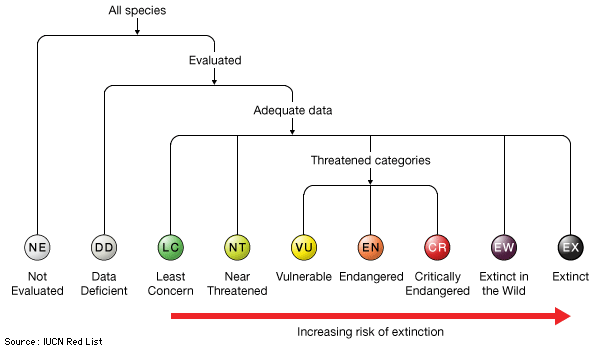
Taken From Encyclopedia Britannica
- Each year thousands of scientists around the world assess or reassess species. The IUCN Red List is subsequently updated. Latest updated list was released @RIO +20 summit.
- This list helps Governments and NGOs prioritize their efforts to save the particular plant, animal etc. For example more money and manpower should be spent on red species compared to orange or green species in the list. And the sale of red species products must be banned under CITES.
- The IUCN Red List has listed 132 species of plants and animals as Critically Endangered from India.
Limitation IUCN redlist
- Red list/ Red Data book contains 9 groups.
- 9th Group is NE (Not Evaluated) species, it also contain thousands of species.
- It is likely that many of these species have become or are in the process of becoming extinct, but not receiving Government/NGO efforts and public funding because they’re in the 9th group.
What is CITES?
- CITES= Convention on International Trade in Endangered Species of Wild Fauna and Flora.
- CITES is an international agreement, brainchild of IUCN, Made in 70s.
- HQ=Geneva, Switzerland. (Secretariat administered by UNEP.)
- CITES aims to stop illicit trade of wildlife.
Why illegal trade of wildlife?
- According to the World Health Organization (WHO), 80 percent of the world’s population uses traditional medicines derived from animals and plants.
- In traditional Chinese and Asian medicine systems the bones, tissues, blood of tigers, bears, elephants, rhinos etc= used to treat arthritis, impotence, Cancer and AIDS(!)
- Rapid Growth of human population without rapid growth of education = increased demand for (stupid) medicines.
- So, animals are hunted not only for their hides but also for their bodyparts, to make those (stupid) medicines.
- Mobiles, Internet, online money transfer, faster modes of transports= good for illegal trade.
- Experts believe this is a multibillion dollar industry just like narcotic drugs trade.
- International cooperation is necessary because illegal wildlife trade involves involves import and export between countries.
How does CITES work?
- CITES has no enforcement authority (i.e. doesn’t have its own police force or militia).
- CITES classifies species into three categories Appendix I, II and III and regulates their trade via cooperation of various nations.
What is Conference of Parties?
- The countries that have ratified the CITES are called “parties”.
- Although CITES is legally binding on the Parties, it does not take the place of national laws. Rather it provides a framework respected by each Party. So These parties have to do two things
- Make laws to regulate import and export of wildlife species.
- Establish licenseing authority for trade of wildlife species and their products.
These Parties meet @regular interval. Such meetings are called Conference of Parties (COP).
In COP, they contemplate about progress, achievement; need to update the species appendix etc.
Criticism, limitation of CITES
#1: No police of its own
- CITES has no enforcement authority, but rather depends on the voluntary development of laws and enforcement procedures within each nation.
- However, laws among nations vary greatly, and even when strong laws exist, many national authorities lack the resources, political will, or both to enforce them.
- Many believe that CITES has become a battleground between developed nations, which typically promote bans on endangered species trade, and developing nations, which often seek such trade as a viable economic strategy.
#2: Non-Native Species
- Confiscated endangered species in some countries have been released into nature preserves without adequate consideration of potential ecological impacts.
- For example, Malayan pangolins, does not naturally occur in China, but have been released into China, where they can compete with native animals. (Non-Native Species)
#3: Appendix are Counterproductive
- The inclusion of a species in Appendix I can drive up black-market prices for that species, encouraging more poaching and stockpiling of commodities, including rhinoceros horn, elephant ivory, and tiger bone.
- Sometimes it is hard to distinguish parts of an endangered species from parts of a nonendangered species. For example, all bear gallbladders look to that of nonendangered animals as domestic pigs= problem in legit trading of domestic pigs’ bodyparts.
#4: Not Comprehensive
- Major threats to endangered species come from deforestation, Habitat destruction, and other environmentally destructive policies.
- But they’re are outside the scope of CITES.
Mock questions on Environment and Biodiversity
Q. What is the correct Chronological order (older to younger)?
- IUCN, IPCC, UNEP, UNFCC
- IUCN, UNFCC, UNEP, IPCC
- UNEP, IPCC, UNFCC, IUCN
- None of Above.
Q. Which of the following is correct about Red List of Endangered species?
- It is jointly prepared by IUCN and UNEP under UNFCCC.
- It classifies species in 3 categories only.
- Only 1
- Only 2
- Both
- None
Q. Which of the following is correct about CITES?
- It contains provisions to protect wildlife species from illegal trade, habitat destruction and climate change.
- It releases Red List of Endangered species with the help of IUCN.
- Only 1
- Only 2
- Both
- None
Descriptive questions:
- Steps taken by India, to stop illegal trade of wildlife. 10m
- What do you understand by the term CITES? What steps, apart from those mentioned in CITES, should be taken to protect the wildlife? 15m
- Name any three critically endangered species in India, according to the IUCN Red list. Enumerate the measures taken to protect them. 25m
![[Environment] Mangrove Species Conocarpus banned in Gujarat & Telangana](https://mrunal.org/wp-content/uploads/2023/09/edp-conocarpus-500x383.png)
![[Environment] Floating Solar Farms, Banni Grassland, Nairobi flies & more Weekly Mrunal Digest from Jul week1-2022 (WMD)](https://mrunal.org/wp-content/uploads/2022/07/Floating-Solar-Farm-500x383.webp)
![[Environment WMD] Single use plastic ban, ESZ, Surya Nutan Cooker, & more from Jun week3-2022](https://mrunal.org/wp-content/uploads/2022/07/single-use-plastic-main-500x383.jpg)
![[T25] UPSC Mock Round#43: Environment & Geography Practice Questions- Global Climate Risk Index 2020, Bog wetland and More](https://mrunal.org/wp-content/uploads/2018/12/c-t25-taimur-500x383.jpg)
1.d
2.d
3.d
1-a,2-d,3-a
Bhai CITES mein kewal illegal trade ki baatein kahe gai hai
So 3-(d)
thanks,appendix in cites is a useful information.
Rapid Growth of human population without rapid growth of education = increased demand for (stupid) medicine.
Well said.
can u pl tell which are the threatened/vulnerable animals under the list..
list is huge, you can find it on wikipedia.
awesome again.u r a landmark.mains questions and essay are perfect jst like upsc.though few objective questions still novice.God bless u.u r doing grt job though u know u r helping ur competitors.i m speechless n wordless 2 thank u. ur articles are full of knwledge 4m scratch till latest :-)
thank u sir
HI MRUNAL THIS IS MY FIRST POST.U DISSECT ANY COMPLEX TOPIC TO SIMPLE ONE YET WITH OUT LOSING ITS MAIN ATTRIBUTES&FACTS.GR8 WORK.KEEP IT UP.I THINK CORRECT ANSWERS ARE 1.D , 2.B ,3.B.
Hi mrunal..Thank you for your great work and help to all the students
I guess the answers are 1. D , 2 .D and 3 .B
Thanks
1-D 2-D 3-D
The one horned rhino being killed in Assam in the recent days- can be quoted as illegal trade..
b d a
Can u please upload High Resolution picture? Unable to read letters in chat even through zooming .. Thanx
a d a
Thank u for the information, and i request u to provide information like this so as many other learn.
Please write something on national offset policy
b d b
IUCN(1948)
WWF(1961)
UNEP(1972)
CITES(1975)
IPCC(1988)
UNFCCC(1992)
Ans are : 1)d 2)d 3)d
Well founded site with very simple language which allows idiots like me to understand even complex topics without stressing forehead lines too much. Amazing to observe the kind of knowledge level , Mr Mrunal has.
1. D
2. D
3. D
Write on project tiger please sir.
Thank u for the info Mr.Mrunal. Can you please provide us with the latest RED LIST-Critically endangered species from India…there was a question in last year prelims….
answer d d d …please confirm
thanks
answers-
1. B-because IPCC formed under UNFCC and constituted by UNEP and WMO.
2. D
3. D
Sir please publish correct answers..
Really an excellent information related to Global Environmental Conservation issues.
Thanks a lot – sir , provide the list of main animals and birds according to state and geographical areas as upsc demands in prelim. Examination-2013
hi Mrunal.. in the point Criticism, limitation of CITES : developing nations often seek such trade as a viable economic strategy.. cud u explain how ??
katl ki subah galat time bata rahi hai………..
Mrunal bhai big thanks for fantastic article but here is a advise to upload articles of writting competition.
On a railway route btwn two places A and B there are ten stations on d way if 4 new stations are added, how many types of new tickets will b required if each ticket is issued for a one way journey.?
@Sakshi
When there were only 10 stations between A and B
1st lets find Tickets required while moving from A ——> B
For passenger travelling from station A to any of the station in onward journey, the maximum possible no of tickets he can buy = 11 ( 10 + 1) ( 10 because in the question it is mentioned for each station diff ticket is issued, hence 10 tckts for stations between A and B and 1 ticket for journey from A directly to B)
Similarly if a passenger starts his onward journey from 1st station after A ( just next station after A) he has to buy = 9+1 tickets (same logic as above)
So continue this series till a passenger starts his journey from station just before B , in this case he has to buy only 1 ticket for his onward journey
So maximum no of tickets a passenger can buy in his onward journey from A ——–> B = 11 + 10 + 9 ……+1
now to sum these up ( shortcut: apply formula of addition of 1st n natural numbers ; in this case n=11)
formula used : n(n+1) / 2
putting in formula values: 11(11+1)/2 = 66
Total tickets for an onward journey from A ——–> B = 66 tickets
Now that same passenger can start his onward journey from station B also ( as it has not been mentioned in the question that a passenger mandatory travels from A to B only)
So by same logic No of max tickets on can buy for onward journey from B –> A = 66 tickets
So total tickets = 66 *2 = 132 tickets
Now no of middle stations increased to 14 so now in above logic where we have put (10+1) put (14+1)
so by that logic again tickets from A ——–> B = 15(115+1)/2 = 120
Similarly tickets from B ——–> A = 15(115+1)/2 = 120
So total tickets = 120 *2 =240 tickets
Extra tickets required = 240 – 132 = 108 tickets ( Answer)
thanks:-)