
Introduction
- Concept of LCM, HCF important for number theory and remainder based problems (generally asked in SSC CGL, CAT.)
- LCM is important for time and speed, time and work problems.
- LCM is also important for circular racetracks, bells, blinking lights, etc.
- HCF is important for largest size of tiles, largest size of tape to measure a land etc.
But before getting into LCM, HCF, let’s understand
What is Prime number?
- Consider this number : 12. This number can be found in many multiplication tables for example
- 1 x 12=12.
- 2 x 6 =12
- 3 x 4=12
- That means, 12 has many factors (1,2,3,4,6,12). Such number is called a composite number.
- On the other hand, consider this number: 29. You cannot find it in any table except 29 x 1 =29. Such number is called a prime number.
- Let’s make a shortlist from exam point of view
| Prime | Non-prime (composite) |
| 2,3,5,7,11,13,17,19,23,29 | 4,6,8,9,10,12,14,15…. |
Now hold this prime number thought in your mind for a while.
What is LCM?
First, let’s create multiplication tables of 4 and 6.
| 4’s table | multiple | 6’s table | multiple |
| 4 x 1 = | 4 | 6 x 1 = | 6 |
| 4 x 2 = | 8 | 6 x 2 = | 12 |
| 4 x 3 = | 12 | 6 x 3 = | 18 |
| 4 x 4 = | 16 | 6 x 4 = | 24 |
| 4 x 5 = | 20 | 6 x 5 = | 30 |
| 4 x 6 = | 24 | 6 x 6 = | 36 |
| 4 x 7 = | 28 | 6 x 7 = | 42 |
| 4 x 8 = | 32 | 6 x 8 = | 48 |
| 4 x 9 = | 36 | 6 x 9 = | 54 |
- Do you see any common numbers in the multiples of 4 and 6?
- Yes I see 12, 24 and 36 are common in both tables. Let’s isolate them.
| 4 x 3 = | 12 | 6 x 2 = | 12 |
| 4 x 6 = | 24 | 6 x 4 = | 24 |
| 4 x 9 = | 36 | 6 x 6 = | 36 |
- Ok so 12, 24 and 36 are common multiples of 4 and 6. But what is the smallest of these multiples? Ans 12 is smallest.
In the exam, we’ve no time to make such ^big tables to find LCM. So how to quickly find LCM of two or three numbers? There are many tricks, the easiest one is prime-factorization. We’ll learn that in a bit, but before that:
LCM4 EXam
- Suppose there is a circular race track. Tarak Mehta takes 4 minutes to finish it and Jethalal takes 6 minutes to finish it. Now both of them start running from the same point at the same time in the same direction. They’ll continue running on this track forever. So after how many minutes will they meet for the first time on the starting point? Ans. LCM of time = LCM (4,6)=12 minutes. They’ll meet again on the starting point after 12 minutes.
- Two bells ring at an interval of 4 and 6 minutes respectively. After how many minutes will they ring together? Ans LCM (4,6)
- Two traffic lights blink at an interval of 40 and 60 seconds respectively. After how many minutes will they link together? Ans LCM (40,60).
- HCF is also important for remainder related questions. but I’ll cover that in a separate article.
- How to apply LCM in time-speed-distance/work, pipes-cistern etc questions, is already covered in old articles. (Mrunal.org/aptitude)
How to find LCM using Prime-Factorization?
Suppose in the exam, we need to find LCM of 4 and 6.
Make a table like this
| Number | Factors |
| 4 | |
| 6 |
Now you need to find the prime factors of 4 and 6.
| Number | Factors |
| 4 | 2 x 2 |
| 6 | 2 x 3 |
Express it in terms of “powers”. For example 2 x 2 =22
| Number | factors |
| 4 | 22 |
| 6 | 2 x 3 |
Now make the third row called “LCM”.
| Number | factors |
| 4 | 22 |
| 6 | 2 x 3 |
| LCM |
Now write all prime numbers in this “LCM row”
| Number | factors |
| 4 | 22 |
| 6 | 2 x 3 |
| LCM | 2, 3 |
Write maximum power of each prime number
| Number | factors |
| 4 | 22 |
| 6 | 2 x 3 |
| LCM | 22, 3 |
As you can see, maximum power of 2 was 22 (in 4’s row).
Now multiple the numbers given in LCM row
| Number | factors |
| 4 | 22 |
| 6 | 2 x 3 |
| LCM | 22 x 3 =12 |
That’s our answer. LCM (4,6)=12.
If I plot this LCM situation on a Venn Diagram, it’ll look like this:
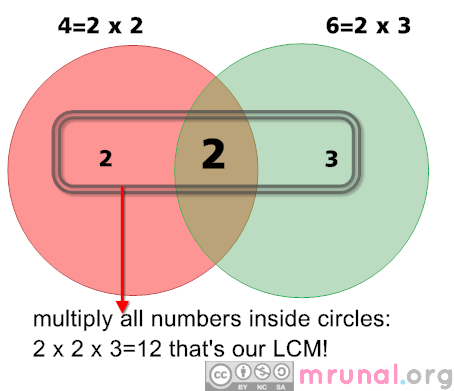
Anyways, Let’s try a difficult one: 56 and 96.
LCM of two numbers (56, 96)
| Numbers | Factors |
| 56 | |
| 96 |
First recall, in which tables do they come? Well 56 comes in 8’s table and 96 comes in 12’s table.
| Number | Factors |
| 56 | 8 x 7 |
| 96 | 12 x 8 |
- but we need factors in “prime number” format. 12 and 8 are not prime numbers. So let’s Simplify further.
- 56 = 8 x 7 = 23 x 7 (; because 8 = 4 x 2 = 2 x 2 x 2)
- 96 = 12 x 8 = (4×3)x(4×2)=( 22x3) (23)=25x3 (please note you have to do this things in your head, if you start making every calculation on a piece of paper, you’ll run out of time in the exam).
| Number | Factors |
| 56 | 23 x 7 |
| 96 | 25x3 |
Now let’s make the LCM row. Write all prime numbers (2,3 and7) in ascending order.
| Number | Factors |
| 56 | 23 x 7 |
| 96 | 25x3 |
| LCM | 2 3 7 |
Now write maximum powers of each prime number.
| Number | Factors |
| 56 | 23 x 7 |
| 96 | 25x3 |
| LCM | 25 3 7 |
Multiply these numbers
| Number | Factors |
| 56 | 23 x 7 |
| 96 | 25x3 |
| LCM | 25 x3x7=32×21=672 |
So LCM (56,96)=672
let’s try finding LCM of three numbers.
LCM of three numbers: (12,15,20)
Approach is same. Make prime factors
| Number | Prime factors |
| 12 | 22 x 3 |
| 15 | 3 x 5 |
| 20 | 22 x 5 |
Make a new row, write all prime factors in ascending order.
| Number | Prime factors |
| 12 | 22 x 3 |
| 15 | 3 x 5 |
| 20 | 22 x 5 |
| LCM | 2,3,5 |
In the last row, Write the maximum power of those prime numbers.
| Number | Prime factors |
| 12 | 22 x 3 |
| 15 | 3 x 5 |
| 20 | 22 x 5 |
| LCM | 22, 3, 5 |
Now multiple the numbers in last row
| Number | Prime factors |
| 12 | 22 x 3 |
| 15 | 3 x 5 |
| 20 | 22 x 5 |
| LCM | 22x3x5=60 |
Therefore LCM (12,15,20)=60.
You can also look at it in following way:
- 12 x 5 = 60
- 15 x 4 = 60
- 20 x 3 = 60.
So 60 is the least common multiple.
LCM of prime numbers
Find LCM of 7,11,13
We already know these are prime numbers. So they’ll not have any common factors. We just have to multiply them together and we’ll get LCM. But for the sake of conceptual clarity
| Numbers | Factors |
| 7 | 7 x 1 |
| 11 | 11 x 1 |
| 13 | 13 x 1 |
| LCM | 1x 7 x 11 x 13 =1001 |
So 1001 is the answer.
LCM of co-prime numbers
- Co prime numbers are those numbers that donot have any common factors. For example, 14 and 15.
- Individually none of them is prime number because 14=2 x 7 and 15 = 3 x 5.
- But they (14 and 15) donot have any common factors. So they’re called co-prime numbers (when they’re given together).
- Any two consecutive numbers are co-prime numbers. (e.g. 11,12 or 1548,1549).
- In case of co-prime numbers, just multiply them and you will get LCM. There is no need to find factors. example
| 6 | 2 x 3 |
| 7 | 7 |
| LCM | 2 x 3 x 7 = (6)x7 =42 |
Advantages of this method?
- Extremely fast when you’ve to find LCMs of two digit numbers for example 12,15,96.
- And usually in time speed work, pipe-cistern type questions have number in two digits (e.g. 12, 15, 96)…so it is very easy to recall in which multiplication tables do they come.
Disadvantages?
- Becomes tedious, as the number grows bigger, for example LCM (235, 512). There are other methods to solve those LCMs, but let’s not complicate this article any further. Let’s stick to this Prime-Factorization method for a while.
Ok so far we know what is LCM and how to find HCF/GCD?
What is HCF or GCD?
- HCF= Highest common factors.
- GCD= Greatest common divisor. Names are different otherwise they’re one and same.
- Suppose you’ve to find the HCF of (4 and 6).
- I’ll write the tables of numbers that come before 4 and 6 (i.e. 1, 2 and 3.)
| 1 x 1 = | 1 | 2 x 1 = | 2 | 3 x 1 = | 3 |
| 1 x 2 = | 2 | 2 x 2 = | 4 | 3 x 2 = | 6 |
| 1 x 3 = | 3 | 2 x 3 = | 6 | 3 x 3 = | 9 |
| 1 x 4 = | 4 | 2 x 4 = | 8 | 3 x 4 = | 12 |
| 1 x 5 = | 5 | 2 x 5 = | 10 | 3 x 5 = | 15 |
| 1 x 6 = | 6 | 2 x 6 = | 12 | 3 x 6 = | 18 |
| 1 x 7 = | 7 | 2 x 7 = | 14 | 3 x 7 = | 21 |
| 1 x 8 = | 8 | 2 x 8 = | 16 | 3 x 8 = | 24 |
| 1 x 9 = | 9 | 2 x 9 = | 18 | 3 x 9 = | 27 |
Ok, in which number’s table (1, 2 or 3) do you see both 4 and 6 reappearing?
There are two such tables 1’s table and 2’s table.
| 4 and 6 are common in 1’s table. | 4 and 6 are common in 2’s table. |
| 1 x 4=4 | 2 x 2=4 |
| 1 x 6=6 | 2 x 3=6. |
What does ^this mean?
- If I divide 4 by 1, I get zero remainder. Similarly if I divide 6 by 1, I get zero remainder. In other words, 1 is the factor of both 4 and 6. In other words, 4 and 6 come in the table of 1.
- Similarly, If I divide 4 by 2, I get zero remainder. Similarly if I divide 6 by 2, I get zero remainder. In other words, 2 is the factor of both 4 and 6. In other words, 4 and 6 come in the table of 2.
- Thus, 4 and 6 have two common factors (1 and 2) but highest of these common factors is 2. Therefore HCF of (4,6)=2.
HCF 4 EXAM?
- What is the highest number that’ll divide 4 and 6 evenly. Ans HCF (4,6)
- There is a 4 x 6m rectangular farm. Find the length of longest tape that can measure this field. Ans HCF (4,6)
- There is a 4x 6cm floor. Find the length of largest square tile that can be evenly laid on it. Ans HCF (4,6)
- Two drums contain 400 and 600 liters of desi and foreign liquor respectively. What is the biggest measure (cup) that can measure both of them exactly? Ans. HCF (400, 600).
- A teacher has 40 pens and 60 pencils. Find maximum number of students among whom she can distribute these items evenly.
- HCF is also important for remainder related questions. but I’ll cover that in a separate article.
HCF finding: Prime Factorization
In the exam, we can’t make multiplication tables of every number preceding the given numbers! So here is the shortcut technique. We’ll use the same approach we’ve used in LCM method: prime factorization.
HCF of two numbers (4, 6)
First make prime factors of given numbers.
| 4 | 22 |
| 6 | 2 x 3 |
Now, make third row: HCF and write the prime numbers that are common in both numbers.
| 4 | 22 |
| 6 | 2 x 3 |
| HCF | 21 |
Therefore, HCF (4,6)=2
If I’ve to plot the HCF of 4 and 6 on a Venn diagram, it’ll look like this:
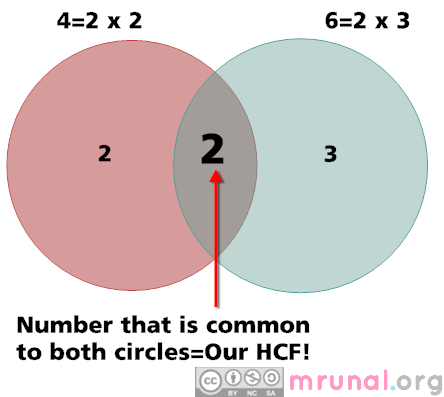
HCF of three numbers (12,24,36)
| 12 | 2 x 6 |
| 24 | 3 x 8 |
| 36 | 6 x 6 |
But I want them in prime format. So I’ll further simplify.
| 12 | 2 x 2 x 3=22 x 3 |
| 24 | 3 x 2 x 2 x 2=23 x 3 |
| 36 | 3 x 2 x 3 x 2=22 x 32 |
In the exam you’ve to do this in your ^head.
| 12 | 22 x 3 |
| 24 | 23 x 3 |
| 36 | 22 x 32 |
Now make a new row, write the prime numbers that are common in all of above.
| 12 | 22 x 3 |
| 24 | 23 x 3 |
| 36 | 22 x 32 |
| HCF | 22x3 |
^in case you’re confused, let me rewrite and do it again
| 12 | 22 x 3 |
| 24 | 22 x 2 x 3 |
| 36 | 22 x 3 x 3 |
| HCF | 22x3 |
The numbers highlighted in bold are common. Therefore HCF = 22 x 3=12.
HCF of prime numbers (13,29)
Prime numbers donot have any common factors. So HCF of such numbers is always 1. But for the clarity let’s do it
| 13 | 13 x 1 |
| 29 | 29 x 1 |
| HCF | 1 (because 1 is common in both) |
HCF of co-prime numbers (12,25)
Again same: 1, because co prime numbers donot have common factors.
Similarly consecutive numbers (like 456,457) donot have common factors either.
Therefore, in all such cases, HCF =1.
HCF vs LCM: #1 multiplication
If we’ve two numbers a and b. and their HCF and LCM are given then
HCF x LCM = a x b.
But this relation only work for TWO numbers and not for more than two numbers.
Let’s understand this with an example.
You know that LCM (4,6)=12 and HCF (4,6)=2.
| Left hand side (LCM x HCF) | Right hand side (multiplication of given numbers) |
| 12 x 2 | 4 x 6 |
| =24 | =24 |
So both sides match. Therefore, in case of two numbers (a and b)
LCM X HCF = a x b.
But this is not always true for three numbers. For example, Find LCM and HCF of 12,15,20. You’ll get HCF=1 and LCM=60.
| Left hand side (LCM x HCF) | Right hand side (multiplication of given numbers) |
| 60 x 1 | 12 x 15 x 20 |
| =60 | =3600 |
In this case, both sides donot match.
HCF vs LCM: #2 Magnitude
For any given numbers, their LCM is always greater than or equal to the biggest number. For example
| Numbers | LCM |
| 12,15,20 | 60 so greater than biggest number (20) |
| 15,30 | 30. which is equal to the biggest number (30). |
Similarly, for HCF, the HCF of given numbers is always less than or equal to the smallest number. For example
| Numbers | HCF |
| 12,15,20 | 1 so it is smaller than smallest number 12 |
| 15,30 | 15. so it is equal to the smallest number 15. |
Ok this is just the basic overview. In the next article, we’ll see the application of these concepts. In the mean time, try finding LCM and HCFs of following numbers
| Question | Answer (LCM, HCF) |
| 91, 12 | 1092, 1 |
| 46, 69 | 138, 23 |
| 69, 97 | 6693, 1 |
| 63, 33 | 693, 3 |
| 72, 58 | 2088, 2 |
| 5, 84 | 420, 1 |
| 91, 41 | 3731, 1 |
| 65, 57 | 3705, 1 |
| 74, 12 | 444, 2 |
| 44, 55 | 220, 11 |
| 8, 28, 175 | 1400, 1 |
LCM, HCF of fractions
Just observe the color pattern in following image:
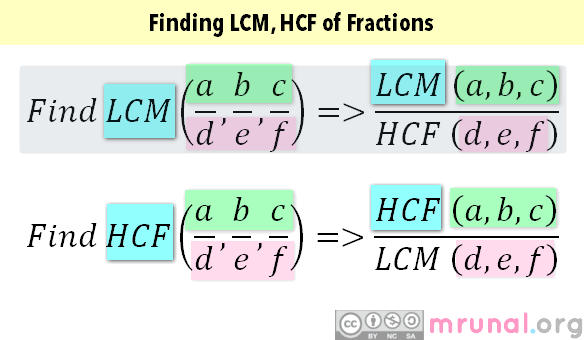
for more practice on LCM, HCF
| Book | Chapter no. |
| Quantitative Aptitude, R.S.Agarwal | 2 |
| Fast track Arithmetic, Rajesh Verma | 2 |
| Quantam CAT, Sarvesh Kumar | Ex.1.3, 1.4 |
| Arun Sharma (CAT) | 1 |
In all such books, the authors first give 5-6 illustration examples and then exercises. I suggest you solve the the illustration examples as well. After all aptitude is all about practice.
![[Reasoning] Calendar Questions: Finding day or date, concepts, shortcuts explained](https://mrunal.org/wp-content/uploads/2013/01/i-lr-500x383.png)
helped a lot! thanks!
Got conceptual clarity after reading this. Thanks a lot..!!
thumbs up
thanks for guide me and other person
Nicely Explained Sir.
Thanks a lot
For the first time i clearly understood the concept of LCM and HCF………Thank u for ur time and knowledge.
Well the above method takes more than a min if you are not good in calculations.
So here I am giving another method which is too short and easy to understand..and most imp very fast…!!!!
For example:- if you want to calculate HCF of 3,4,7?
Answer:- step1:- take the difference of any two numbers, lets say 3 & 4=1.
Step2:- now do the factors of 1 and we know factors of 1 is 1 itself.
Step3:- now divide every no.(3,4,7) with 1…if all the required no. Get divisible by 1 then 1 is the HCF….
Lets take a two digit no. 12,17,24
Now hcf of 12,17,24 will be also 1…
Lets take even no. Cz in odd we all know hcf will be 1.
So even no. 12,56,48
Difference betwn any two no.s but i am taking the smallest i.e. 56-48=8,
Then factors of 8= 1,2,4,8
Divide (12,56,48) from factors nd check which factor divide comletly after dividing u will see dat 1,2 &4 r the only no.s nd within 1,2 &4—{4} is the highest no. Hence the HacF will be 4.
Hope u like it…
Wow ……..I salute. to this magic man of mathmatics.
your teaching is good
it was extremely helpful sir..i hope that that i may not come across problems related to HCF and LCM again as it was such a great lesson…
thankyou very much..
explained in a very nice way.. thanks
THREE CONTAINERS CONTRAIN 12 LITRES,16 LITRES AND 24 LITRES OF MILK
A BOTTLE IS FILLED WHOLE NUMBER OF TIMES FROM EACH CONTAINER. WHAT IS THE GREATEST CAPACITY OF THE BOTTLE.
PLS SOLVE THE PROBLEM
First calculate the H.C.F of 12,16 and 24 i.e 4. Now substrate the H.C.F from the sum of the numbers i.e 12+16+24=52-H.C.F (52-4)=48
Since the bottle is. filled whole number of times, the capacity of the bottle must divide capacity of containers. And as, the largest capacity is required, the answer must be the HCF of capabilities of all the containers.
Thus, required capacity =HCF(12, 16, 24) =4 Litres
we wand hcf only so the ans is 48
thank u sir
Very much simplified & short technique..thnxx for the author
god may bless you……… :)
thank u sir
Mrunal,
Could you please tell if there is article pertaining to shortcuts for quadratic equations like-
20×2 – 79x + 77 = 0
We get atleast 2 or 3 quad equation in ibps exams which are bit lenghthy.
please assist with this..
thanks.
its 20X^2 (20 x square)
The HCF and LCM of two numbers is 4 and 288. What are the two numbers? Please sir.
32 and 36
Ans: Lets assume the two number is 4X and 4Y: We write 4X and 4Y because 4 is common factor
Now; HCF*LCM= Product of number
So; 4 * 288= 1152
hence, 4X * 4Y= 1152
X*Y= 1152/16= 72
X*Y=72
72= uncommon factor: So the Number would be (8,9)
and final answer would be (32, 36)
thank you very much sir. explained in best way
easily undrstood by anyone
keep it up.
if LCM of three number is 120, then which of the following cannot be their HCF?
Option 37 , 12 , 24 , 8
thanks
plz undrstand me to solving the division method of hcf in three or more number s like-9,12,18,21 etc.
The HCF oF TWO NUMBER(each greater than 13) be13 and LCM. 273. Then the sum of the number will be
A) 286
B)130
C)288
D)290
130
aman,can u give me an explanation for the answer ‘130’
286
thanks a lot… sir
i didnt even know how solve LCM nad HCF..
sir im preparing for NIFT entrance for UG(B.DES)
pease mail me few more problems and tricks ( if possible)
thank you
Thnx for the tips…they are very useful :)
can you give online exercise on LCM and hcf or gcf . if you have please tell where
thank you sir it clear my confusion it is so easy to understand
What is your Message? Search before asking questions & confine discussions to exams related matter only. thanks a lot for given your ideas sirji
thanks a lot for given your ideas sirji
thank you sir