
Prologue
The ACIO-2013 general-awareness answerkey (history, geography etc.) was given separately click me. This article contains the answerkeys for Aptitude portion (Maths, Reasoning, English.)
- Two MCQs in the english portion :debatable, because I’m unable to locate the rules.
- other than that, if you have any correction/faster techniques/shortcuts/ for the same MCQs, do share it as well.
and my thanks to Manu Jha, Palas Nuwal, Shiva Ram and Rohith for their valuable inputs.
Maths questions
| % | Percentage | 1 |
| AVG. | Wine-Water | 1 |
| NUMBERSYSTEM | Remainder | 2 |
| Prime Number | 1 | |
| Base System | 1 | |
| STD | Time-Speed-Distance | 1 |
| PCP | Permutation Combination | 3 |
| Probability | 1 | |
| APGP | Arithmetic Progression | 1 |
| Total | 12 |
Percentages
- If increasing 20 by p% gives same result as decreasing 60 by p%, then what is p% of 70?
- 50
- 140
- 14
- 35
p%=p/100;
| Increase 20 By P% | Decrease 60 By P% |
| (100% of 20 + p% of 20)=(20+ 20p/100) =20 (1+p/100)…….eq1 |
60 (1-p/100)…eq2 |
but as per the question, eq1=eq2
(1+p/100)*20=(1-p/100)*60
When you simplify this equation, you get p=50.
But question requires you to find p% of 70
Meaning 50% of 70=>half of 70=35. Answer (IV).
Wine-water (Alligiation)
- In what ratio should a 20% methyl alcohol solution be mixed with a 50% methyl alcohol solution so that the resultant solution has 40% methyl alcohol in it?
- 1:2
- 2:1
- 1:3
- 2:3
Make the table
| conc.% | 20 | 40 | 50 |
| volume | a | b |
apply the “visual” move
(50-40)=a, hence a=10
(40-20)=b, hence b=20
a:b=10:20=1:2, so answer is (i).
Number System
Prime number
- The difference between ages of two brothers is a prime number. The sum of their ages is also a prime number. If elder brother is 28 years old, how many values can age of younger brother take?
- 2
- 3
- 4
- 1
(I’m going by trial and error method, but if you know a faster method, please do share in the comment.)
Prime numbers between 1 to 28= 2,3,5,7,11,13,17,19,23
Now go by trial and error
| columnA | columnB | col.C=ColA-ColB | col.D | yes/no |
| elder bro’s age | difference is prime number | younger bro’s age | elder bro+younger bro | is col.D a prime number? |
| 28 | 2 | 26 | 54 | no |
| 28 | 3 | 25 | 53 | yes |
| 28 | 5 | 23 | 51 | no |
| 28 | 7 | 21 | 49 | no |
| 28 | 11 | 17 | 45 | no |
| 28 | 13 | 15 | 43 | yes |
| 28 | 17 | 11 | 39 | no |
| 28 | 19 | 9 | 37 | yes |
| 28 | 23 | 5 | 33 | no |
from this table, we can see three possible numbers for younger brother’s age: 25,15 and 9.
hence answer is (ii): 3 possible numbers.
Remainder
- Find the least five digit number, which when divided by 12, 18, 21 and 28, leaves the same remainder.
- 11019
- 10081
- 10059
- 10289
for this type of question, you need to find LCM of given numbers first
LCM (12, 18, 21, 28)=252
meaning, if I divided 252 with any of the given number (12,18,21,28) then it’ll give remainder zero.
similarly, if I divided 252+1 =253 with any of those given numbers, I’ll get remainder 1.
now by trial and error, try to find first “five digit” multiple of 252
first do approximation (in your head)
25 x 4=100
250 x 4=1000
250 x 40=10,000
Meaning 252 x 40 will be higher than 10,000.
252 x 39 try karo: 9829 but this is four digit. so
252 x 40= 10080 is our first “five digit” multiple of 10080.
observe the options: (ii)=10081. Meaning 10080+1 so this number will give same common remainder “1” when divided by 12,18,21 or 28.
Excel
just for timepass (and for IBPS computer awareness) try to find remainders using excel. The cell formula will be =MOD(number,divisor). you’ll see that our answer is correct.
- A number when divided by a divisor, leaves a remainder of 24. when twice the original number is divided by same divisor, the remainder is 11. what is the value of divisor?
- 13
- 59
- 35
- 37
Suppose the number is “N”, division is “D”, quotient is “Q” and remainder is “R”. then we can write
N=DQ+R
N=DQ+24….first case given.
Twice of that number
2xN= 2 (DQ+24)=2DQ+(24 x 2)=2DQ + 48…..eq1
Question says when 2N is divided by “D”, then 11 remainder is obtained.
But 2N=(2DQ+48)
Imagine what will happen if we divide (2DQ+48) by “D”
(2DQ+48)/D
(2DQ/D) + (48/D)
First bracket will give zero remainder because D/D will cancel each other. Meaning whatever remainder is obtained- that we got from (48/D).
48/D=new remainder. But as per the question, new remainder was 11.
Think about this: when 48 divided by “D” gives 11 remainder. Meaning, when 48-11(=37) is divided by “D” then we get zero remainder. Hence “D”=37. (Since 37 is a prime number, D has to be 37. Suppose we got 32, then we might need to think about some smaller factors of 32 e.g. 16, 2 etc.)
Thus answer is 37. (choice iv)
let’s verify:
Original number when divided by 37 leaves remainder 24. One such number could be 37+24=61
if we’re correct then twice of 61, when divided by 37, should leave remainder 11. Try it in excel: =MOD(2*61,37) and you’ll get 11 as remainder. Meaning 37 is correct.
Base system
- What will be the expression for 567 in binary system?
- 1010111001
- 1000110001
- 1000011101
- 1000110111
Method is explained here:
http://www.wikihow.com/Convert-from-Decimal-to-Binary
| DIVIDED BY TWO | NUMBER OR QUOTIENT | REMAINDER |
| 2 | 567 | 1 |
| 2 | 283 | 1 |
| 2 | 141 | 1 |
| 2 | 70 | 0 |
| 2 | 35 | 1 |
| 2 | 17 | 1 |
| 2 | 8 | 0 |
| 2 | 4 | 0 |
| 2 | 2 | 0 |
| 2 | 1 | 1 |
now write those remainder from bottom to top
1000110111
Hence (567)10=(1000110111)2
TSD (Time Speed Distance)
- A train covers certain distance between two places at a uniform speed. If the train moved 10 km/hr faster, it would take 2 hours less. And, if the train were slower by 10 km/hr, it would take 3 hours more than the scheduled time. Find the distance covered by the train.
- 300 kms
- 600 kms
- 800 kms
- 1200 kms
Shortcut (cross multiplication)
Inspired from Sarvesh Kumar’s cross multiplication method, from his example 8 in chapter on Time, Speed and distance.
First, draw a regular STD table.
| normal case | faster case | slower case | |
| speed | s | +10* | -10 |
| time | t | -2 | +3 |
| distance | d |
*here we should be writing s+10 but instead just write +10. Same approach for other cells.
Now, speed x time = distance. So in faster case: +10 x -2=(-20) but distance cannot be negative, so write +20
| normal case | faster case | slower case | |
| speed | s | +10* | -10 |
| time | t | -2 | +3 |
| distance | d | 20 | 30 |
Now cross multiply speed and time from first two columns
-2s+10t=20…..eq1
Similarly cross multiple speed time from column 1 and column 3
+3s-10t=30….eq2
Add eq1+eq2, you get
(-2s+10t)+(3s-10t)=30+50
s=50kmph. plug this value back in eq1
-2(50)+10t=20
10t=120, hence t=12 hours.
And we know that speed x time = distance. Therefore 50 x 12=600km was the total distance. Answer (ii)
Longer method:
| normal case | faster case | slower case | |
| speed | s | s+10 | s-10 |
| time | t | t-2 | t+3 |
| distance | d | d | d |
here you’ve 3 variables (s,t,d) and 3 columns:
speed x time = distance and distance is same in all three cases. from the first column we get s x t=d.
So instead of “d”, I can write “st” everywhere.
| normal case | faster case | slower case | |
| speed | s | s+10 | s-10 |
| time | t | t-2 | t+3 |
| distance | st | st | st |
now observed:
| column | speed x time = distance |
| first column | s x t =d |
| second column | (s+10)(t-2)=styou simplify it further, you get -s+5t=10…eq1 |
| third column | (s-10)(t+3)=styou simplify it further, you get 3s-10t=30….eq2 |
-s+5t=10…eq1
3s-10t=30….eq2
now if I multiply eq1 with x2 and add in eq2, it’ll cut -10t.
-2s+10t=20
3s-10t=30
from this we get
s=50kmp. plug it back in eq1, you get t=12 hrs.
and distance = st=50×12=600km. Answer choice (ii)
Permutation Combination Probability
Men and task
- 6 tasks and 6 persons. task 1 can’t be assigned to either person 1 or 2. task 2 must be assigned to either person 3 or 4. Every person has to be assigned a task. How many ways can the assignment be done?
- 144
- 180
- 192
- 360
Imagine these are not ‘tasks’ but chairs. And we’ve to pick candidate for each chair.
| chair | person choice (number of candidates) | choice |
| 1 | 4 persons (because 1 and 2 out) | 4 |
| 2 | 2 person (either 3 or 4) | 2 |
| 3 | previous two chairs took away “2” people, so remaining 4 candidates | 4 |
| 4 | 3 candidates | 3 |
| 5 | 2 candidate | 2 |
| 6 | 1 candidate | 1 |
total choice
=choice for chair#1 AND chair#2 AND…..
but “and” means multiplication
=4 x 2 x 4 x 3 x 2 x 1
=192 ways
Another approach:
| chair 1 | chair 2 | chair number 3 to 6 |
| one chair four candidates | one chair two candidates | four chairs remaining four candidates |
| 4P1 | 2P1 | 4P4 |
4p1 x 2p1 x 4p4
=4 x 2 x 24
=192 ways. Choice iii.
word arrangement
- In how many ways can the letters of the word ASSASSINATION be arranged so that all the S are together?
- 10!
- 14!/(4!)
- 1,51,200
- 36,28,800
given word has 13 letters
| letter | occurs __ times |
| A | 3 |
| S | 4 |
| I | 2 |
| N | 2 |
| T | 1 |
| O | 1 |
| TOTAL | 13 |
As such there are 13 candidates and 13 seats. but we want 4 s’ to be together. And 13-4=9.
Imagine there are 10 seats: 9 seats for those other letters and 1 seat where those 4 “S” will sit together.
So first, out of those 10 seat, pick this one seat where four “S” can sit together.
Total ways
=(Pick one out of 10 seats for that S group) AND (arrangement for remaining 9 seats)
=10C1 x (arrangement for 9 seats)….eq1
Now let’s just focus on those 9 seats
| A | 3 |
| I | 2 |
| N | 2 |
| T | 1 |
| O | 1 |
| total | 9 |
=9!/(3! x 2! x 2!)
^why this way? Because A repeats 3 times, I repeats 2 times, N repeats 2 times. (Theory was explained in separate article long time ago.)
anyways, back to eq1. total ways
=10C1 x (9!/(3! x 2! x 2!)
=(10) x [9!/(3! x 2! x 2!)]
=151200 hence answer is (iii).
Round table
- In how many ways can 15 people be seated around two round tables with sitting capacities 7 and 8 people.
- 15!/8!
- 7!x8!
- (15c8)x6!x7!
- 15c8 x 8!
circular arrangement of “n” objects= (n-1)! Ways.
what are we supposed to do here?
=(out of given 15, pick any 8 people) AND (arrange those 8 in a round table) AND (arrange remaining 7 in the second round table)
=15C8 AND (8-1)! AND (7-1)!
=15C8 x (8-1)! x (7-1)! (because AND means multiplication)
=15c8 x 7! x 6! Hence (iii) is the answer.
Probability
- In a lottery 10,000 tickets are sold and ten prizes are awarded. What is the probability of not getting a prize if you buy one ticket ?
- 9/10,000
- 9/10
- 999/1000
- 9999/10,000
Favorable outcomes meaning out of those 10 tickets, one is yours=10C1=10
Total outcomes= out of those total 10000 tickets, one is yours=10000C1=10000
Hence probability of winning
=favorable outcomes / total outcomes
=10/10000
And probability of NOT winning
=1 MINUS probability of winning
=1-10/10000
=9990/10000
=999/1000 hence answer (iii)
AP-GP
- What is the sum of all positive integers lying between 200 and 400 that are multiples of 7?
- 8729
- 8700
- 8428
- 8278
Think in your head
7 x 3 =21
7 x 30=210
Therefore 7 x 29 has to be 210-7=203. This is the first number in our series.
so far our series is 203, 210,….. last multiple of “7” before 400
What could be the last number?
7*50=350? Nope, it has to be higher. how about we add another 49 to 350, that could be very close to 400.
7*50 + 7*7=350+49=399 this is the closest multiple of 7, near 400.
And, 7*50 + 7*7=7 (50+7)=7*57
It means our series is going in this fashion:
(7 x 29) + (7 x 30) + …. + (7 x 57)
If I take “7” common then
sum=7 (29 + 30 + …+57)…..eq1=(this will be our final answer)
Now, just focus on the () bracket part. This is a continuous series in arithmetic progression.
Sum of AP
=[average of first and last term] x number of terms
=[(29+57)/2] x 29*
=1247
Plug this value back in eq1
= 7 x 1247 = 8729 hence answer is #1 (8729)
*how did I find number of terms is 29? => because this is a continuous number series: 29-30-31-32….-57
In such series, number of terms will be (last term minus first term + 1)=57-29+1=29 terms.
longer approach:
By trial error you find first term and last term (203 and 399)
after that use “last term”= a+(n-1)*d
where “d”=7 and “a”=203. So you get number of terms “n”
finally sum of AP=n/2 x [2a+(n-1)d].
^but this method will require lengthy calculations. The first method is quicker, slimmer.
Reasoning: Internal Breakup
| Direction Sense Test | 1 |
| Sitting Arrangement | 1 |
| Blood Relation | 1 |
| Missing Numbers | 2 |
| Coding Decoding | 2 |
| Calendar | 2 |
Direction Sense Test
- Rajnikanth left his home for office in car. He drove 15 kms straight towards north and then turned east-wards and covered 8 kms He then turned to left and covered 1 km. He again turned left and drove for 20 kms and reached office. How far and in what direction is his office from the home?
- 21 kms west
- 15 kms north east
- 20 kms north west
- 26 kms north west
follow direction, make diagram, you’ll get a right side angle whose two sides measure 16km and 12km. Then apply Pythagoras,
AB2+BC2=AC2
Hypotenuse=square root of (162+122)=square root of 400=20km. hence answer (iii)
Sitting arrangement
- There are five different houses, A to E, in a row. A is to the right of B and E is to the left of C and right, of A. B is to the right of D. Which of the houses is in the middle?
- A
- B
- C
- D
Do the arrangement:
- A is to the right of B.
- B is to the right of D
From this two statement, we can make D-B-A
E is to the left of C and right, of A
Apply this in above arrangement
D-B-A-E-C.
Hence “A” is in the middle. Answer (i)
Blood relation
- A’s mother is sister of B and daughter of C. D is the daughter of B and sister of E. How is C related to E?
- Sister
- Mother
- Father
- Grandmother or Grandfather
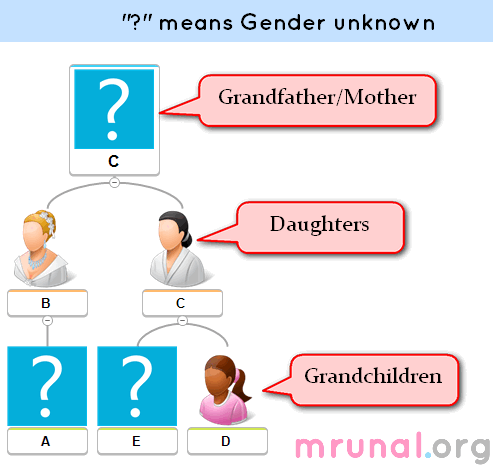
- Arun/Aruna’s mom is sister of Bina.(because we don’t know whether A is male/female).
- Arun/Aruna’s mom is daughter of Chandu/Chameli. (because we don’t know the gender yet)
- It means Bina is also the daughter of Chandu/Chameli. (because Bina is sister of Arun/Aruna’s mom)
- Divya is daughter of Bina. And Sister of Elisha/Ehsan (because we don’t know E’s gender yet)
- But either way Chanu/Chameli (C) => their daughter Bina (B)==> their son/daughter Elisha/Ehsan (E)
- Meaning Chandu/Chameli(C) is grandfather or grandmother of E. Answer (iv)
Missing Numbers
- Find the missing number in this series: 4, 18, ??, 100, 180, 294
- 32
- 36
- 48
- 40
The pattern is: n(n+1)2
Put n=1, n=2,n=3,n=4 and so on
since missing term “??” is at third place in this series. So, Put n=3 then
3(3+1)2= 3*16=48
- Which number should replace the question mark?
| 17 | 8 | 5 | 5 |
| 13 | 7 | 5 | 4 |
| 6 | 12 | 6 | 3 |
| 10 | 6 | 4 | ?? |
- 4
- 5
- 6
- 7
The pattern is: (from right cell towards left cell in each row)
5*5=25 and 25-8=17.
5*4=20 and 20-7=13
6*3=18 and 18-12=6
like this ans will be 4, because 4*4-6=10
Coding decoding
- ACEG : DFHJ:: QSUW
- TVNZ
- TVZX
- TVXZ
- XVTZ
Pattern is: Skip one alphabet and start the 2nd analogy after the 2nd alphabet of the 1st word that means 2bd word starts with D which comes after C which is the 2nd alphabet of 1st word.
ABCDEFG : DEFGHIJ :: QRSTUVW : TUVWXYZ .
Answer (iii)
- 165135 is to peace as 1215225 is to
- lead
- love
- loop
- Aura
the approach:
A =1
B = 2
E = 5
. . .
Z = 26
accordingly: P = 16 , E = 5 A =1 C =3 E = 5
Hence Peace = 16| 5|1|3|5
Now question is: what does 1215225 mean?
And since the options are only 4 letter words
We have to choose with cancelling the options
last two numbers: “25”
It could be |5 OR 25.
- if last number is “25”, then “Y”. but there is no word ending with “Y” among given choices.
- it means last number is |5=”E”. Meaning E is the last letter.
so eliminate all options that don’t have “E” as last letter.
- lead
- love
- loop
- Aura
thus we’re left with answer (ii) Love. But we should verify:
LOVE = L =12 || O = 15 || V = 22 || E =5 =>1215225 correct.
Calendar
- The day before the day before yesterday is three days after Saturday. What day is it today?
- Tuesday
- Wednesday
- Thursday
- Friday
Start from end part of the sentence.
| this part | equal this part |
| day before the day before yesterday | three days after Saturday. |
| 3 days before today. | =Three days after Saturday=Sun, Mon, Tuesday. |
| 3 days before today= | Tuesday |
Meaning Today MINUS 3 days=Tuesday.
Then today has to be Friday.
- If the republic day of India in 1980 falls on Saturday. X was born on March 3 1980 and Y is older than X by four days. then Y’s birthday fell on?
- Thursday
- Friday
- Wed.
- None of these
first understand the calendar technique from this article click me
- X born on March 3
- Y is four days older=>March 3 + 4= 7th March.
- In short, we’ve to find the day on 7th March 1980.
- As per the information: Republic day (26th March) 1980= on Saturday.
find the odd days
| remaining days in January= 27 to 31 | 5 |
| February (leap) but b’day is on 28th. | 28 |
| total days | 33 |
divide total days (33) by 7= you get 5 as remainder.
Required day (28th Feb)
=Saturday (on 26t Jan) + 5 days 28th Feb
=Saturday+ 5 days
=Thursday.
Verification:
There is site called “dayoftheweek.org”, you enter the date and it’ll tell you its day.
So, as per www.dayoftheweek.org/?m=January&d=26&y=1980&go=Go , 26th Jan 1980 was indeed Saturday
And 28th Feb, 1980 was indeed Thursday.
English internal breakup
| sentence correction/meaning | 4 |
| idioms-phrases | 3 |
| vocabulary/ fill in the blanks | 4 |
| total | 11 |
Sentence correction / meaning
- Choose the correct sentence among the following
- The danger will continue its growth
- The danger will continue to grow
- The danger will continue its growing
- The danger will continue growth
“Continue” should following with “to-infinitive”. Hence Danger will continue to grow. Answer (ii)
- Complete the following sentence, This is the best book __
- of all others on History
- of any other on History
- of all on History
- of any other in History
Debatable because I’m unable to locate the rule. Your inputs welcome.
- Choose the correct sentence among the following,
- I have one chance in a thousand of winning tonight
- I have one chance in a thousand for winning tonight
- I have one in a thousand chances to win tonight
- I have one chance in a thousand that I will win tonight
Debatable because I think (iii) but Unable to locate the rule. Your inputs welcome.
- Choose the answer that is closest in meaning to the following sentence, Yeuk Yee had her house painted white yesterday
- She had to paint her house white yesterday
- Her house was not blue last week
- They painted her house white for her yesterday
- She painted her house yesterday
She had her house painted…meaning she didn’t paint is by herself, she got some other person(s) to get house painted. Therefore, choice #3.
idioms and phrases
- Choose the idiom from the following options which means “to be modest about one’s achievements”
- to hide one’s light under a bushel
- to take to the bush
- to hide behind the bush
- to beat about the bush
Oxford dictionary website says to hide one’s light under a bushel = keep quiet about one’s talents or accomplishments. Hence #1 is the answer.
- Choose the idiom from the options, which means ‘a lot of excitement and discussion about a trivial matter’
- A cyclone in the cup
- A flood in the tea-cup
- A storm in the tea-cup
- A flood of air
Storm in the tea-cup= a disturbance or uproar about little or nothing. Hence choice #3.
- “What is bred in the bone will come out in the flesh” Choose the meaning that is closest in the meaning to this proverb
- Pedigree racing horse will always win
- Inherited characteristics cannot be concealed
- Good diet in childhood makes for good health in adulthood
- Brain washing can change the personality
This proverb means “a person’s behavior or characteristics are determined by heredity.” So, #2 is the closest choice.
Vocabulary
- Docility is to surrender as unrest is to —–
- education
- rebellion
- illness
- hospital
Docility= the trait of being agreeably submissive. Meaning docile person likely to surrender, similarly unrestful person likely to rebel. Hence choice #2
- Mitigate is to punishment as alleviate is to
- promotion
- change
- order
- pain
Mitigate punishment = reduce punishment. Alleviate pain = reduce pain. Hence choice #4.
- Choose the pair which represents closest the relationship expressed in the original pair in capital letters: MENDACITY HONESTY,
- Truth Beauty
- Sportsmanship Fortitude
- Courageous Craven
- Turpitude Depravity
Mendacity=The tendency to be untruthful. = this is opposite of honesty.
craven= An abject coward. So it is opposite of courageous. Answer #3.
- Choose the set of words that when inserted in the sentence, best fits the meaning of the sentence as a whole, Unable to ____ his wholehearted distaste for media events and publicity, the miffed minister continued to make ____ comments throughout his speech
- conceal , effusive
- control ; garbled
- disguise, caustic
- express , vitriolic
He was unable to disguise his distaste…..kept making caustic (harsh) comments.
Essay
Write an essay in English language only on any one of the following topics in not more than 400 words. (50 marks)
- A Communal Conflict Scenario
- Causes of Violence in the World
- Divide Between ‘India’ and ‘Bharat’
- Dimensions of Rural Employment
Just listing the essay so if some future ACIO-2014/2015 aspirant comes to search, he can see it. + Similar topic might even be asked in CAPF 2013 Paper II.
The ACIO-2013 general-awareness answerkey (history, geography etc.) was given separately click me

![[Errors/discrepancy] 16 MCQs where UPSC Official Prelims-2020 Answerkey & Coaching classes differ, while 2 MCQs cancelled](https://mrunal.org/wp-content/uploads/2021/11/csp2020-akey-differ-table-500x383.png)
thanks for ut update Mural G
5*5=25
25-8=17
5*4=20
20-7=13
6*3=18
18-12=6
like this ans will be 4
4*4-6=10
Thanks Rohith, answerkey updated.
mrunal sir, please publish answer key of cds
in the pattern question….
sum of 1st and second column is equal to the product of third and fourth column..
ex: 17+8=5*5.
and also in 2nd row 1st column its 13 not 18… and hence the pattern follows…
17+8=25,5*5=25
13+7=20,5*4=20
12+6=18,6*3=18
10+6=16,4*4=16
Hi,
I think there is typing mistake in 2nd row instead of 2 they have printed 7.
otherwise the logic is as follows:
1.5*5-8=17
2.5*4-2=18
3.6*3-12=6
4.4*4-6=10
The ACIO-2013 general-awareness answerkey (history, geography etc.) was given separately click me
here in link “mru” of murnal.org is missing please fix it.. thanks for explanation
For the pattern que….very easy….
5*5=17+8
5*4=18+7
6*3=12+6
4*x=10+6
Hence answer =4
sorry “mur” of of murnal.org
In the P&C Question, in those 192 ways there will be cases in which task1 and task2 are both assigned either to person3 or person4. There4 you need to subtract (4!+4!), hence 192-48=144, should b d answer.
you are absolutely right. answer needs updation
I too think the answer should be 144.
Seat 2 can be occupied only by TWO people. So Seat 2 can have 2C1 ways of sitting………. (1)
For each of the above cases, Seat 1 can be occupied by THREE people only, as person I and II are not eligible and either person III or person IV is already occupying Seat 2. So Seat 1 would have only person IV, V and VI OR person III, V and VI eligible to sit on it, depending on who (person III or person IV) is sitting on Seat 2. So Seat 1 can have 3C1 ways of sitting……… (2)
Once the above steps are completed, we are left with 4 Seats and 4 people, the sitting arrangements of which would be 4! ways……… (3)
Thus, from (1), (2) and (3), we have, TOTAL = 2C1 X 3C1 X 4! = 2 X 3 X 24 = 144 ways
@Mrunal
Small correction Bro…
Question is “Y is older to X by 4 days”
This means Y was born 4 days before(28th Feb) X, not after(7rd March)
Hence Thursday…
u have a small mistake too bro.1980 is leap year feb has 29 days.hence ans is friday
No i did not…
I know 1980 is a leap year and it has 29 days
the 28th Feb i mentioned is for the “Four” days older part…
Mrunal mentioned Y’s DOB is 7th March
Older guy is the one who is born before, not after…
If both are born on 3rd March – no age diff
if X is 3rd March & Y is 2nd March – Y is 1 day older
if X is 3rd March & Y is 1st March – Y is 2 days older
if X is 3rd March & Y is 29th Feb – Y is 3 days older
if X is 3rd March & Y is 28th Feb – Y is 4 days older
you’re right. Birthday answer (28th Feb) is Thursday.
Answer updated.
In Calender Q.1::: Y is older than X by four days means his(Y)bdy should be 4 days earlier and not after 4 days that of A’ bdy
This is the best book _==> of all others on History
U r right.. It should be thursday.. reason being 28th Feb 1980 is his birthday.
ya sorry it is thursday indeed
This is the best book __
1)of all others on History
2)of any other on History
3)of all on History
4)of any other in History
ALL OTHER and ANY OTHER are used in Comparative form:
a)comparative + than + all other + plural noun
b) comparative + than + any other + singular noun
e.g. he is better than all other boys in the class.
he is better than any other boy in the class.
further, An SUV can carry the most people.
so i think option (3).
Option (3) is correct. When there is a comparison, we exclude the one we are comparing with others.. ex. This is a better book than any other on history. But with the superlative (ex. Worst, Best) we include the given one with others.. ex. This is the best book of all.
I think 3 is the correct answer
@Mrunal
Regarding Que 91
(i) Article ‘the’ missing between all & other
(iii) & (iv) any other(s) is used for comparative form not superlative
So the best option is option (ii)
Sorry it is option III
gave correct answer mixed up (ii) and (iii) due to the scribbling i did while solving
Base System: we have find equivalent of 567 , which is greater than 512 (2^9).
so 512 256 128 64 32 16 8 4 2 1
1 0 0 0 1 1 0 1 1 1
as given value is greater than 512 , it should be filled with 1.
256 = 0 ( since {512 + 256} > 267)
and so on…
Good 1
Thanks for the Answer key..
In calander question Y is four days older means 3 March-4 days= 29th Feb,,,,?
28 ko y paida hua fir uske char din bad aata hai 3 march jab x ji paida hue…
If both are born on 3rd March – no age diff
if X is 3rd March & Y is 2nd March – Y is 1 day older
if X is 3rd March & Y is 1st March – Y is 2 days older
if X is 3rd March & Y is 29th Feb – Y is 3 days older
if X is 3rd March & Y is 28th Feb – Y is 4 days older
In sentence correction –
2. (iii) This is the best book of all on History.
3. (iv) I have one chance in a thousand that I will win tonight
Hello mrunal sir.first of all thanks a lot for all your stuffs.
I need some study material for Kendriya Vidyalaya PGT computer Science teacher exam.
Please provide me some previous year question papers as well for above stated exam through email as soon as possible.and suggest me good books.
I will be highly obliged to you.
Thanking You
Choose the correct sentence among the following,
1)I have one chance in a thousand of winning tonight
2)I have one chance in a thousand for winning tonight
3)I have one in a thousand chances to win tonight
4)I have one chance in a thousand that I will win tonight
there is a quote:
Only one person in a thousand knows the trick of really living in the present. -Storm Jameson
Further, from a GMAT article :
I have ONE CHANCE IN A THOUSAND OF WINNING tonight. ( right)
I have ONE CHANCE IN A THOUSAND FOR WINNING tonight.( wrong)
>>I have ONE IN A THOUSAND CHANCES TO WIN tonight.(wrong)
>>I have ONE CHANCE IN A THOUSAND THAT I WILL WIN tonight.( wrong)
>>I have ONE CHANCE IN A THOUSAND FOR ME TO WIN tonight.(wrong)
Finally from Collins Cobuild Dictionary:
1. if there is CHANCE of something HAPPENING, it is possible that it will happen
e.g. this partnership has a good chance OF success.
2. if you have a CHANCE TO DO something, you have the opportunity to do it.
e.g. the electoral council announced that all the eligible people would get a chance TO vote.
therefore, safe to conclude option (1) is correct.
It is the right conclusion.. One should read the statement as “I have a chance of winning” other additions are redundant here..
question on permutation..
answer will be 144, coz u should first take the condition which is not affecting other choices.
first fill 2nd position= 2C1=2
now for 1st position der r only 3 guys left=3C1=3
next 4 positions can b filled with 4 guys in 4! ways=24
thus in total= 2*3*24=144
guys ssc cgl tier 2 admit card uploaded..
northern region- http://www.sscnr.net.in (Rajasthan, Delhi, Uttarakhand)
Western Region- http://www.sscwr.net (Maharashtra, Gujrat,Goa)
MP Sub-Region- http://www.sscmpr.org (Madhya Pradesh, Chhattisgarh)
Eastern Region- http://www.sscer.org (West Bengal, Orrisa, Jharkhand, A&N Island, Sikkim)
North Eastern Region- http://www.sscner.org.in (Assam, Arunachal Pradesh, Manipur, Meghalaya, Tripura, Nagaland, Mizoram)
Southern Region- http://www.sscsr.gov.in (Andhra Pradesh, Punduchery, Tamilnadu)
KKR region- http://www.ssckkr.kar.nic.in (Karnataka, Kerla)
North Western Sub-Region- http://www.sscnwr.org (Hariyana, Punjab, J&K, Himachal Pradesh)
Central Region- http://www.ssc-cr.org (Uttar Pradesh & Bihar )
Mrunal Sir,
‘Y‘ 28 feb ko paida hua hai, isliye he is older to ‘x’
Please correct your key !
Seperate cutoff is prepared for both sections or combine cutoff is prepared…?
Guys…Any idea about the cut off….Pleaze give your guesses based on your exp…am getting 52 based on Mrunal key…..What was the cut off last year….and Mrunal tonnes of thanks to you…God Bless U..
Ques 2 answer is FRIDAY..! Sir plz update answer key…
Answer is thursday @ques2
Y 4 days older means (March 3 – four days), i.e on February 29 = Thursday…Thank You sir
Sir please check
Y is older than X by four days.
sir with respect to question no 2 on age…Y is older than X by 4 days that means if X was born on 3rd march then Y was born 4 days earlier ie on 28th feb not on 7th march(as u explained).. becoz if Y was born on 7th march he should b 4 days younger nt older….
Tough and puzzling questions. I think the govt. is trying to put all the aspirants of ACIO gr-2 exe. near the edge of the cliff. Half of the answers of certain questions are doubtful. I think the govt. should not make such tough questions for these type of Group-c post exams. Govt. go to hell!