
Table of Contents
Mains-PYQ-GSM2–2026-Rights-Based-Welfare
- Examine whether the constitutional mandate of rights-based welfare can be effectively realised amid non-integrated governance and minimal public investment. (15m, 250words, CSM’26)
- जांच कीजिए कि क्या अधिकार-आधारित कल्याण के संवैधानिक जनादेश को गैर-एकीकृत शासन और न्यूनतम सार्वजनिक निवेश के बीच प्रभावी ढंग से साकार किया जा सकता है। (15m, 250words, CSM’26)
✍️ Intro
- (Origin) On January 26, 1950, the Indian Constitution came into full effect. Its Fundamental Rights and Directive Principles promise a wide range of rights and welfare for citizens.
- But our global rankings on health, hunger and human development show we are still far from this vision.
🏛️ Body 1 — Non-integrated governance
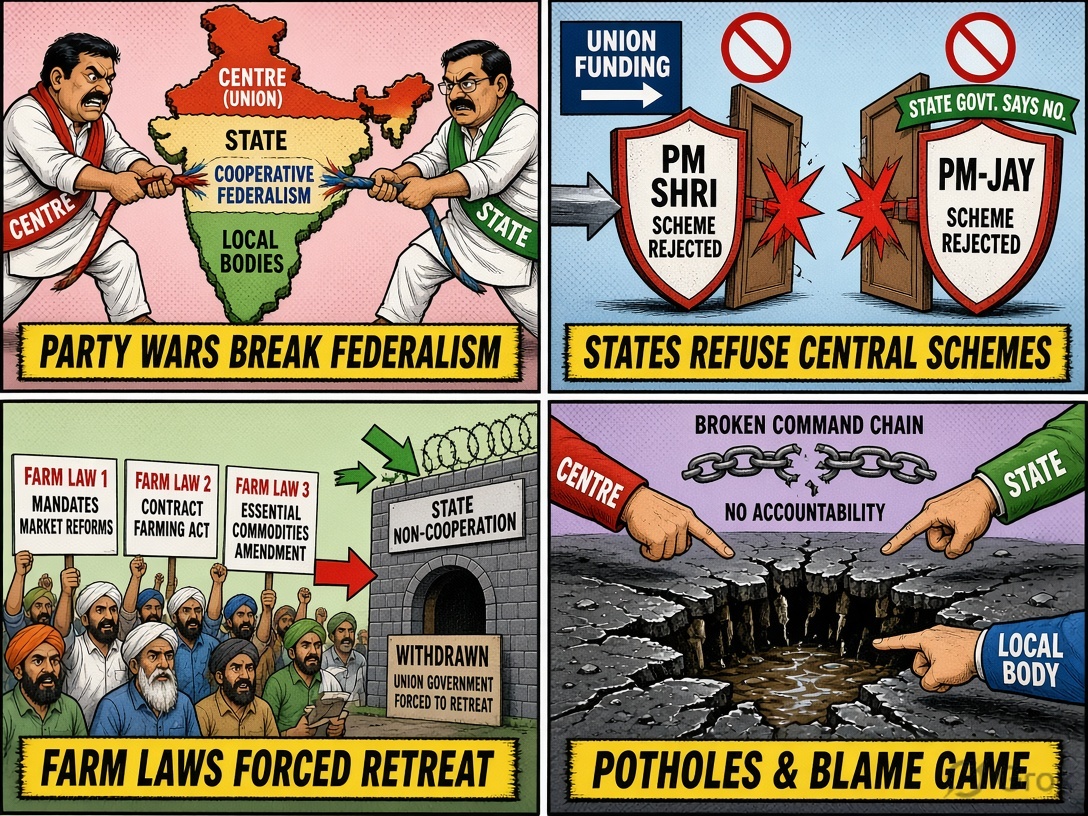
- Constitution provides three layers of governance — Union, State, local bodies.
- Different ruling parties at Centre and State often turn cooperative federalism into a fight.
- Many statutory and autonomous bodies have created areas of vacuum and legal grey zones.
| Rights-based welfare | Federal challenge |
|---|---|
| Right to Education | Kerala refused PM SHRI school scheme, citing “saffronisation” of syllabus. Union threatened to block funding. Similar fights over three-language formula, NEP. |
| Reservation in education | IIM Ahmedabad long denied reservation in PhD admissions, citing institutional-autonomy and merit. |
| DPSP — raise nutrition levels | NFSA gives 5kg free food. But leakages and poor allocation mean our Global Hunger Index rank hasn’t improved. Centre and States blame each other. |
| DPSP — improve public health | West Bengal, Punjab and other opposition-ruled states did not implement PM-JAY (₹5 lakh health cover). |
| FR — freedom of trade; DPSP — decent living standard | Politicised APMC mandis with many middlemen deny farmers fair price. Union tried three farm laws to fix this, but had to withdraw them after protests and state non-cooperation. |
| FR — freedom of trade and commerce | State highways and village roads fall under State/Panchayat control. Union funds them, but a fragmented chain of command lowers accountability. Result: blame-shifting over potholes. |
- Economic Survey 2016 noted an “aid curse” for special category states — decades of Planning Commission and Finance Commission funds, but poor administration & lack of accountability meant the money was siphoned off.
- Consequently, Even after 75 years of independence, these states still face the same poverty, hunger and poor infrastructure as in British times.
- To provide a coherent administrative structure from union to state, we have all-India civil services in the Constitution. But in recent years, there has been a lot of politicisation of services, instances where IAS/IPS are in cahoots with local corrupt leaders instead of following the directives of the union/constitution itself.
💰 Body 2 — Insufficient public investment
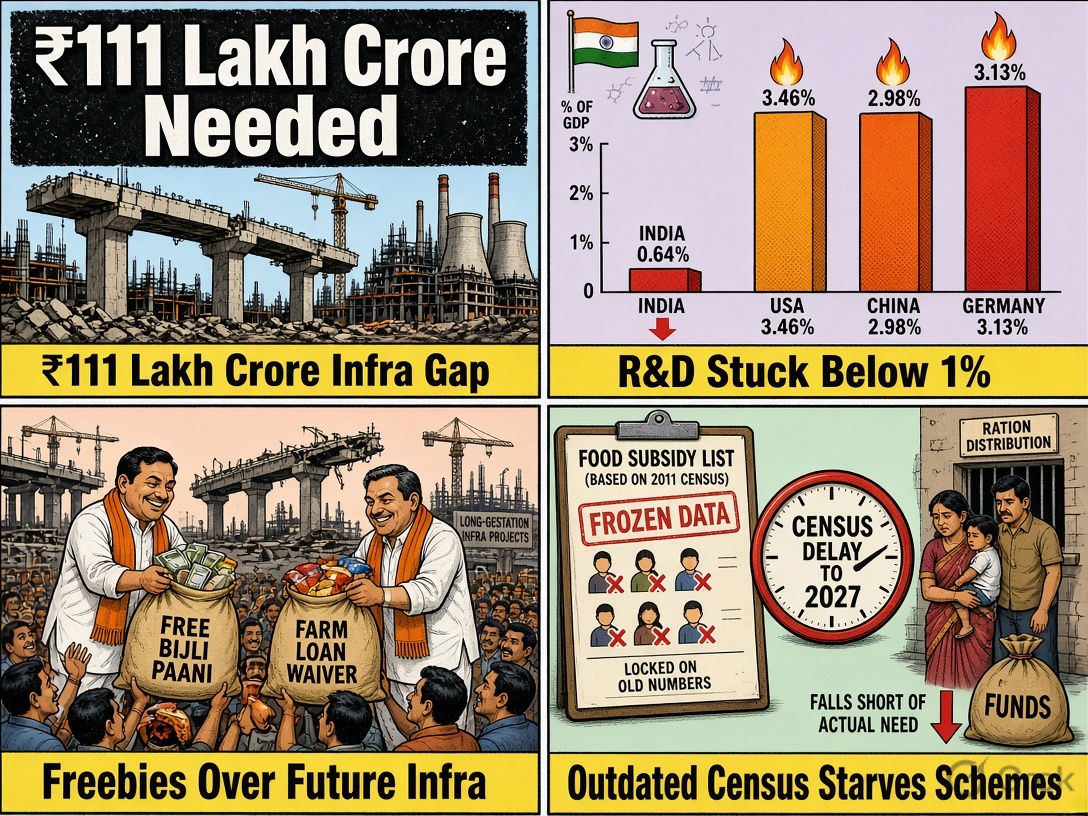
- To become a developed country, we need at least ₹111 lakh crore in infrastructure investment.
- National Infrastructure Pipeline needs Union, State and private sector to all contribute — hard to achieve amid COVID, Ukraine and Iran wars, and the resulting slowdown.
- R&D is key for healthcare, manufacturing and jobs. India spends under 1% of GDP on R&D, against 3% in other top-ten economies.
- We have schemes for free health insurance, food and housing. But funds allocated don’t match the actual number of poor.
- NFSA links food beneficiaries to Census data. But the 2021 Census is delayed till 2027, so beneficiary lists are based on outdated numbers.
- Saliency bias — politicians prefer short-term revdi (freebies) and farm loan waivers, since these win votes faster than long-gestation infrastructure projects.
- India’s per capita electricity production and consumption is much lower than developed nations. Electricity is a key input for education and healthcare.
- SDG Goal#3 Health needs 550 health workers per 1,00,000 population. Many states are still well short, partly due to too few medical colleges.
- Govt has opened enough schools to reach near 100% Gross Enrolment Ratio at primary level. But quality of education is poor, as shown by Pratham’s ASER reports. This needs investment — training teachers, better syllabus, and basics like benches, toilets, smart boards and tablets.
✍️ Conclusion
Indeed, both for SDG Goals and constitutional mandate of welfare, we need (i) a transparent and accountable administrative framework from the top to the bottom (ii) adequate financial resources. Only then we can achieve the goal of Viksit Bharat 2047 vision.
Yes Covered in Mrunal’s Economy Lectures
Click me to Join Mrunal’s courses at Unacademy
📝 हिंदी अनुवाद (Hindi Translation)
✍️ परिचय
- (उत्पत्ति) 26 जनवरी 1950 को भारतीय संविधान पूरी तरह लागू हुआ। इसके मौलिक अधिकार और निर्देशक सिद्धांत नागरिकों के लिए अधिकारों और कल्याण की एक विस्तृत श्रृंखला का वचन देते हैं।
- लेकिन स्वास्थ्य, भूख और मानव विकास पर हमारी वैश्विक रैंकिंग दिखाती है कि हम अभी भी इस दृष्टिकोण से बहुत दूर हैं।
🏛️ मुख्य भाग 1 — गैर-एकीकृत शासन
- संविधान तीन स्तरों की शासन व्यवस्था प्रदान करता है – केंद्र, राज्य, स्थानीय निकाय।
- केंद्र और राज्य में अलग-अलग सत्तारूढ़ पार्टियां अक्सर सहकारी संघवाद को लड़ाई में बदल देती हैं।
- कई वैधानिक और स्वायत्त निकायों ने खालीपन और कानूनी ग्रे जोन के क्षेत्र बनाए हैं।
- शिक्षा का अधिकार: केरल ने पीएम SHRI स्कूल योजना को अस्वीकार कर दिया, पाठ्यक्रम के “सांस्कृतिकीकरण” का हवाला देते हुए। केंद्र ने फंडिंग रोकने की धमकी दी। तीन-भाषा सूत्र, NEP पर समान झगड़े।
- शिक्षा में आरक्षण: IIM अहमदाबाद ने संस्थागत-स्वायत्तता और योग्यता का हवाला देते हुए PhD प्रवेश में आरक्षण को लंबे समय तक अस्वीकार कर दिया।
- DPSP — पोषण स्तरों को बढ़ाएं: NFSA 5 किग्रा मुफ्त खाद्य देता है। लेकिन रिसाव और खराब आवंटन का मतलब है कि हमारी ग्लोबल हंगर इंडेक्स रैंक में सुधार नहीं हुआ है। केंद्र और राज्य एक दूसरे को दोष देते हैं।
- DPSP — सार्वजनिक स्वास्थ्य में सुधार: पश्चिम बंगाल, पंजाब और अन्य विपक्ष-शासित राज्यों ने PM-JAY (₹5 लाख स्वास्थ्य कवर) को लागू नहीं किया।
- FR — व्यापार की स्वतंत्रता; DPSP — सभ्य जीवन मानक: राजनीतिक APMC मंडि कई बिचौलियों के साथ किसानों को उचित मूल्य देने से इनकार करती हैं। केंद्र ने इसे ठीक करने के लिए तीन कृषि कानून आजमाए, लेकिन विरोध और राज्य के गैर-सहयोग के बाद उन्हें वापस लेना पड़ा।
- FR — व्यापार और वाणिज्य की स्वतंत्रता: राज्य राजमार्ग और गांव की सड़कें राज्य/पंचायत नियंत्रण में हैं। केंद्र उन्हें निधि देता है, लेकिन आदेश की एक विखंडित श्रृंखला जवाबदेही को कम करती है। परिणाम: गड्ढों पर दोष स्थानांतरण।
- आर्थिक सर्वेक्षण 2016 ने विशेष श्रेणी के राज्यों के लिए एक “सहायता अभिशाप” नोट किया – दशकों की योजना आयोग और वित्त आयोग निधि, लेकिन खराब प्रशासन और जवाबदेही की कमी का मतलब पैसा गायब हो गया।
- परिणामस्वरूप, स्वतंत्रता के 75 वर्षों के बाद भी, ये राज्य अभी भी ब्रिटिश समय के समान गरीबी, भूख और खराब अवसंरचना का सामना कर रहे हैं।
- संघ से राज्य तक एक सुसंगत प्रशासनिक ढांचा प्रदान करने के लिए, हमारे पास संविधान में अखिल-भारतीय सेवाएं हैं। लेकिन हाल के वर्षों में, सेवाओं का राजनीतिकरण हुआ है, ऐसी घटनाएं जहां IAS/IPS स्थानीय भ्रष्ट नेताओं के साथ मिलीभगत में हैं संघ/संविधान के निर्देशों का पालन करने के बजाय।
💰 मुख्य भाग 2 — अपर्याप्त सार्वजनिक निवेश
- एक विकसित देश बनने के लिए, हमें अवसंरचना निवेश में कम से कम ₹111 लाख करोड़ की आवश्यकता है।
- National Infrastructure Pipeline को केंद्र, राज्य और निजी क्षेत्र सभी को योगदान देने की आवश्यकता है – COVID, यूक्रेन और ईरान के युद्धों के बीच और परिणामी मंदी के बीच हासिल करना कठिन है।
- R&D स्वास्थ्यसेवा, विनिर्माण और नौकरियों के लिए महत्वपूर्ण है। भारत R&D पर GDP का 1% से कम खर्च करता है, अन्य शीर्ष-दस अर्थव्यवस्थाओं में 3% के मुकाबले।
- हमारे पास मुफ्त स्वास्थ्य बीमा, भोजन और आवास के लिए योजनाएं हैं। लेकिन आवंटित निधि वास्तविक गरीब संख्या से मेल नहीं खाती।
- NFSA खाद्य लाभार्थियों को जनगणना डेटा से जोड़ता है। लेकिन 2021 की जनगणना 2027 तक में देरी हुई है, इसलिए लाभार्थी सूचियां पुरानी संख्याओं पर आधारित हैं।
- Saliency bias – राजनेताओं को अल्पकालिक revdi (मुफ्त सामान) और कृषि ऋण माफी पसंद है, क्योंकि ये लंबी अवधि की अवसंरचना परियोजनाओं की तुलना में तेजी से वोट जीतते हैं।
- भारत की प्रति व्यक्ति विद्युत उत्पादन और खपत विकसित देशों की तुलना में बहुत कम है। बिजली शिक्षा और स्वास्थ्यसेवा के लिए एक महत्वपूर्ण इनपुट है।
- SDG Goal#3 स्वास्थ्य को 1,00,000 जनसंख्या पर 550 स्वास्थ्य कर्मी की आवश्यकता है। कई राज्य अभी भी अच्छे से कम हैं, आंशिक रूप से बहुत कम मेडिकल कॉलेजों के कारण।
- सरकार ने प्राथमिक स्तर पर 100% सकल नामांकन अनुपात तक पहुंचने के लिए पर्याप्त स्कूल खोले हैं। लेकिन शिक्षा की गुणवत्ता खराब है, जैसा कि Pratham के ASER रिपोर्ट्स द्वारा दिखाया गया है। इसके लिए निवेश की आवश्यकता है – शिक्षकों को प्रशिक्षित करना, बेहतर पाठ्यक्रम, और बेंचों, शौचालयों, स्मार्ट बोर्ड और टैबलेट जैसी बुनियादी सुविधाएं।
✍️ निष्कर्ष
वास्तव में, SDG Goals और कल्याण के संवैधानिक जनादेश दोनों के लिए, हमें (i) ऊपर से नीचे तक एक पारदर्शी और जवाबदेह प्रशासनिक ढांचा (ii) पर्याप्त वित्तीय संसाधन की आवश्यकता है। तभी हम विकसित भारत 2047 दृष्टिकोण का लक्ष्य प्राप्त कर सकते हैं।
![[Mains Model Ans] What do you mean by Digital Rupee? In this context, explain the working and progress of India’s Central Bank Digital Currency (CBDC). (10m, 150words, CSM’26)](https://mrunal.org/wp-content/uploads/2026/08/PROOF_1A1_GSM3-Eco-Digital-Rupee-CBDC-500x383.jpg)
![[Mains Model Ans] Examine the view that financial inclusion is an integral part of social and economic inclusion in a country like India. Also throw light on the usefulness of the R.B.I.’s Financial Inclusion Index. (10m, 150words, CSM’26)](https://mrunal.org/wp-content/uploads/2026/08/PROOF_1D_GSM3_Eco-Financial-Inclusion-Index-500x383.jpg)
![[Mains Model Ans] “The centre of global trade is gradually shifting from the Atlantic region to the Indo-Pacific region.” Examine this statement. (15m, 250words, CSM’26)](https://mrunal.org/wp-content/uploads/2026/08/PROOF_3A_GSM1-Indo-Pacific-Trade-Shift-500x383.jpg)
![[Mains Model Ans] Explain the factors responsible for inefficiency of agri-produce marketing. How e-commerce helps to reduce inefficiency of agri-produce marketing? Explain. (10m, 150words, CSM’26)](https://mrunal.org/wp-content/uploads/2026/08/PROOF_4A_GSM3-Agri-Agri-Marketing-Ecommerce-500x383.jpg)