
Table of Contents
- Mains-PYQ-GSM1–2026-Indo-Pacific-Trade-Shift
- ✍️ Intro
- 🌊 Body1: How Atlantic became the centre of global trade
- 🌏 Body2: The shift towards the Indo-Pacific
- 🌏 Body3: Counter Arguments- not totally shifted
- ✍️ Conclusion
- Yes Covered in Mrunal’s Economy Lectures
- Click me to Join Mrunal’s courses at Unacademy
- 📝 हिंदी अनुवाद (Hindi Translation)
Mains-PYQ-GSM1–2026-Indo-Pacific-Trade-Shift
- “The centre of global trade is gradually shifting from the Atlantic region to the Indo-Pacific region.” Examine this statement. (15m, 250words, CSM’26)
- “वैश्विक व्यापार का केंद्र धीरे-धीरे अटलांटिक क्षेत्र से हिंद-प्रशांत क्षेत्र की ओर स्थानांतरित हो रहा है।” इस कथन की विवेचना कीजिए। (15m, 250words, CSM’26)
✍️ Intro
- (Origin) Global trade is not a modern phenomenon — Harappan seals have been found in Mesopotamian cities showing that Indian merchants were trading across seas even 4,000 years ago.
- For centuries since, the centre of global trade has kept shifting in following ways:
🌊 Body1: How Atlantic became the centre of global trade
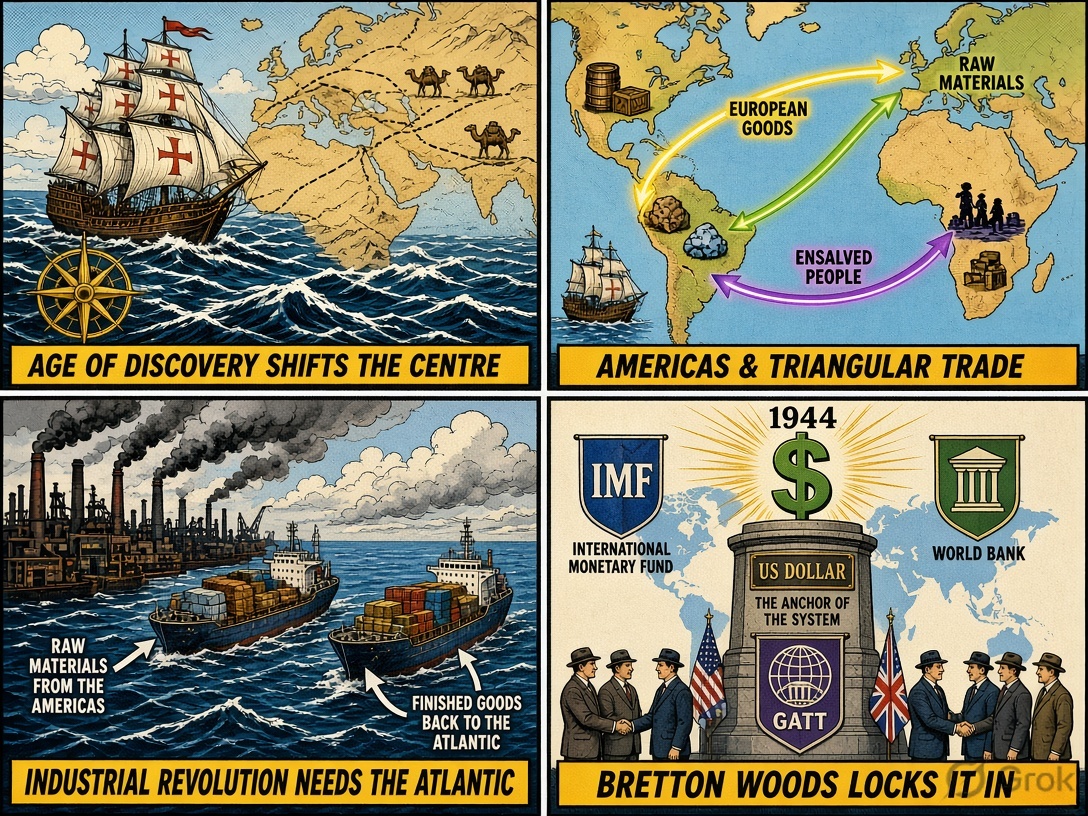
- The Age of Discovery — new sea routes, the compass, and navigation charts — enabled European powers dominate long-distance sea trade.
- India’s trade with China and Central Asia mostly went overland. Except for a few southern kingdoms, most Indian rulers, including the Mughals, never built a strong navy.
- Colonisation of the Americas opened up new land, resources, and markets for European powers.
- “triangular trade” route connecting Europe, Africa, and the Americas from the 16th to the 19th centuries. European goods went to Africa, African slaves sent to Americas to grow raw goods shipped back to Europe.
- Britain’s Industrial Revolution needed shipping of raw material and export of finished goods. the Atlantic was the natural shipping lane for this.
- North America and Europe became the first developed regions, giving them both the manufacturing base and the consumer market. This kept the Atlantic at the centre for centuries.
- Bretton Woods system (1944) after World War II placed the US dollar and US/European institutions (IMF, World Bank, GATT) at the centre of the post-war trade order.
🌏 Body2: The shift towards the Indo-Pacific
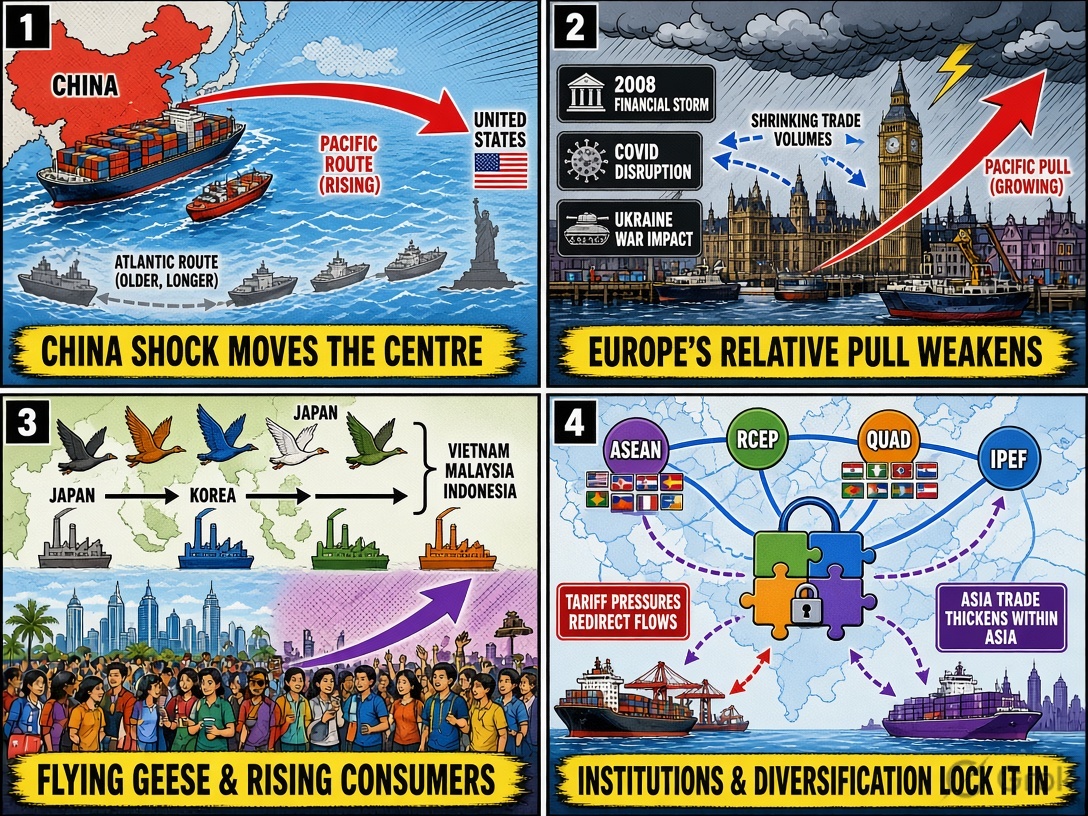
- Sending goods from South Asia to Europe does not require Atlantic. It can be easily transported via, Indian Ocean and Suez Canal towards the Mediterranean Sea.
- Early 2000s “China Shock”: MNCs moved manufacturing to China, and shipping factory goods across the Pacific to the US became shorter and cheaper than the old Atlantic routes.
- Repeated setbacks in the EU economy — the 2008 financial crisis, COVID-19 in 2020, and the Ukraine war in 2022 — slowed European growth and reduced its relative pull in global trade.
- The “Flying Geese” model of East Asian development: Japan led in electronics and automobiles, and as its population aged, manufacturing shifted to South Korea, then to Vietnam, Malaysia, and Indonesia.
- A large, young middle class across South and Southeast Asia is now itself a major consumer market, not just a production base.
- New regional groupings — ASEAN, APEC, BIMSTEC, SCO, BRICS — and agreements like RCEP have deepened trade integration within the Indo-Pacific.
- USA Presidents also realized this shift and also proposed trans Pacific partnership (TPP), Indo-Pacific Economic Framework (IPEF), Quad – where majority of the countries lie in the Pacific region.
- Trump 2.0’s tariff war has reduced the volume of Chinese and Indian exports to the US, pushing both countries to diversify trade within Asia itself, reinforcing the Indo-Pacific’s internal trade network.
🌏 Body3: Counter Arguments- not totally shifted
- The Trade-Centre is not totally shifted because we (Asians) are still dependent on the consumers of America and Europe esp for textile, pharmaceuticals and electronics.
- And therefore, all the Asian giants are proactively chasing trade agreements with USA and Europe.
- but definitely the dependence on Atlantic has gradually water down, then in the past..
✍️ Conclusion
Thus, with the passage of time, the centre of global trade has shifted. India, sitting at the heart of this region, has both the geography and the demographic advantage to benefit. The need of the hour is to provide it with the manufacturing base and trade infrastructure needed to capitalise on this shift to achieve the $5 trillion GDP target.
Yes Covered in Mrunal’s Economy Lectures
Click me to Join Mrunal’s courses at Unacademy
📝 हिंदी अनुवाद (Hindi Translation)
✍️ परिचय
- (उत्पत्ति) वैश्विक व्यापार कोई आधुनिक घटना नहीं है – हड़प्पा की मुहरें मेसोपोटामिया के शहरों में पाई गई हैं, जिससे पता चलता है कि भारतीय व्यापारी 4,000 साल पहले भी समुद्र के पार व्यापार कर रहे थे।
- इसके बाद सदियों तक, वैश्विक व्यापार का केंद्र निम्नलिखित तरीकों से स्थानांतरित होता रहा है:
🌊 मुख्य भाग 1: अटलांटिक व्यापार का केंद्र कैसे बना
- खोज का युग – नए समुद्री मार्ग, कंपास, और नेविगेशन चार्ट – यूरोपीय शक्तियों को लंबी दूरी के समुद्री व्यापार पर प्रभुत्व स्थापित करने में सक्षम बनाया।
- भारत का चीन और मध्य एशिया के साथ व्यापार अधिकतर स्थल मार्ग से होता था। कुछ दक्षिणी राज्यों को छोड़कर, अधिकांश भारतीय शासकों, मुगलों सहित, ने कभी एक मजबूत नौसेना नहीं बनाई।
- अमेरिका के उपनिवेशीकरण ने यूरोपीय शक्तियों के लिए नई भूमि, संसाधन और बाजार खोले।
- 16वीं से 19वीं शताब्दी तक यूरोप, अफ्रीका और अमेरिका को जोड़ने वाला “त्रिकोणीय व्यापार” मार्ग। यूरोपीय सामान अफ्रीका गए, अफ्रीकी दास अमेरिका भेजे गए कच्चे माल उगाने के लिए जो यूरोप वापस भेजा गया।
- ब्रिटेन की औद्योगिक क्रांति को कच्चे माल की शिपिंग और तैयार माल के निर्यात की आवश्यकता थी। अटलांटिक इसके लिए प्राकृतिक शिपिंग लेन था।
- उत्तरी अमेरिका और यूरोप पहले विकसित क्षेत्र बन गए, जिससे उन्हें विनिर्माण आधार और उपभोक्ता बाजार दोनों मिले। इसने अटलांटिक को सदियों तक केंद्र में रखा।
- ब्रेटन वुड्स प्रणाली (1944) द्वितीय विश्व युद्ध के बाद यूएस डॉलर और यूएस/यूरोपीय संस्थानों (IMF, विश्व बैंक, GATT) को युद्ध-संरचनात्मक व्यापार व्यवस्था के केंद्र में रखा।
🌏 मुख्य भाग 2: हिंद-प्रशांत की ओर स्थानांतरण
- दक्षिण एशिया से यूरोप को सामान भेजने के लिए अटलांटिक की आवश्यकता नहीं है। इसे आसानी से हिंद महासागर और स्वेज नहर के माध्यम से भूमध्य सागर की ओर परिवहन किया जा सकता है।
- 2000 के दशक की शुरुआत का “चीन शॉक”: बहुराष्ट्रीय कंपनियों ने विनिर्माण को चीन में स्थानांतरित किया, और प्रशांत महासागर के पार यूएस को कारखाने के सामान भेजना पुरानी अटलांटिक मार्गों की तुलना में छोटा और सस्ता हो गया।
- EU अर्थव्यवस्था में बार-बार झटके – 2008 का वित्तीय संकट, 2020 में COVID-19, और 2022 में यूक्रेन युद्ध – यूरोपीय वृद्धि को धीमा किया और वैश्विक व्यापार में इसकी सापेक्ष खिंचाव को कम किया।
- पूर्वी एशियाई विकास का “उड़ता हुआ हंस” मॉडल: जापान इलेक्ट्रॉनिक्स और ऑटोमोबाइल में अग्रणी था, और जैसे-जैसे इसकी जनसंख्या बूढ़ी हुई, विनिर्माण दक्षिण कोरिया में, फिर वियतनाम, मलेशिया और इंडोनेशिया में स्थानांतरित हुआ।
- दक्षिण और दक्षिण-पूर्व एशिया भर में एक बड़ी, युवा मध्यम वर्ग अब स्वयं एक प्रमुख उपभोक्ता बाजार है, केवल एक उत्पादन आधार नहीं।
- नए क्षेत्रीय समूह – ASEAN, APEC, BIMSTEC, SCO, BRICS – और RCEP जैसे समझौते हिंद-प्रशांत के भीतर व्यापार एकीकरण को गहरा करते हैं।
- अमेरिकी राष्ट्रपतियों ने भी इस बदलाव को समझा और ट्रांस-पैसिफिक पार्टनरशिप (TPP), इंडो-पैसिफिक इकोनॉमिक फ्रेमवर्क (IPEF), क्वाड का प्रस्ताव दिया – जहां अधिकांश देश प्रशांत क्षेत्र में स्थित हैं।
- ट्रम्प 2.0 के टैरिफ युद्ध ने चीन और भारत के अमेरिका को निर्यात की मात्रा को कम किया है, दोनों देशों को एशिया के भीतर ही व्यापार में विविधता लाने के लिए प्रेरित किया, हिंद-प्रशांत के आंतरिक व्यापार नेटवर्क को मजबूत किया।
🌏 मुख्य भाग 3: प्रति-तर्क – पूरी तरह स्थानांतरित नहीं हुआ
- व्यापार-केंद्र पूरी तरह स्थानांतरित नहीं हुआ है क्योंकि हम (एशियाई) अभी भी अमेरिका और यूरोप के उपभोक्ताओं पर निर्भर हैं, खासकर वस्त्र, फार्मास्यूटिकल्स और इलेक्ट्रॉनिक्स के लिए।
- और इसलिए, सभी एशियाई दिग्गज सक्रिय रूप से अमेरिका और यूरोप के साथ व्यापार समझौतों का पीछा कर रहे हैं।
- लेकिन निश्चित रूप से अटलांटिक पर निर्भरता धीरे-धीरे कम हो गई है, जैसा कि अतीत में था।
✍️ निष्कर्ष
इस प्रकार, समय के साथ वैश्विक व्यापार का केंद्र स्थानांतरित हो गया है। भारत, इस क्षेत्र के हृदय में बैठा है, इससे लाभ उठाने के लिए भूगोल और जनसांख्यिकीय लाभ दोनों हैं। वर्तमान समय की आवश्यकता इसे विनिर्माण आधार और व्यापार अवसंरचना प्रदान करना है जो इस बदलाव का लाभ उठाने और $5 ट्रिलियन GDP लक्ष्य प्राप्त करने के लिए आवश्यक है।
![[Mains Model Ans] What do you mean by Digital Rupee? In this context, explain the working and progress of India’s Central Bank Digital Currency (CBDC). (10m, 150words, CSM’26)](https://mrunal.org/wp-content/uploads/2026/08/PROOF_1A1_GSM3-Eco-Digital-Rupee-CBDC-500x383.jpg)
![[Mains Model Ans] Examine the view that financial inclusion is an integral part of social and economic inclusion in a country like India. Also throw light on the usefulness of the R.B.I.’s Financial Inclusion Index. (10m, 150words, CSM’26)](https://mrunal.org/wp-content/uploads/2026/08/PROOF_1D_GSM3_Eco-Financial-Inclusion-Index-500x383.jpg)
![[Mains Model Ans] Examine whether the constitutional mandate of rights-based welfare can be effectively realised amid non-integrated governance and minimal public investment. (15m, 250words, CSM’26)](https://mrunal.org/wp-content/uploads/2026/08/PROOF_2C_GSM2-Rights-Based-Welfare-500x383.jpg)
![[Mains Model Ans] Explain the factors responsible for inefficiency of agri-produce marketing. How e-commerce helps to reduce inefficiency of agri-produce marketing? Explain. (10m, 150words, CSM’26)](https://mrunal.org/wp-content/uploads/2026/08/PROOF_4A_GSM3-Agri-Agri-Marketing-Ecommerce-500x383.jpg)