
Analysis: Polity Answerkey CAPF
- In CAPF 2013, they asked 14 out of 125 questions from Polity. (In 2012 they asked 17 question. so there is slight decline in the importance of this topic.)
- only one question from polity current affairs (JS Verma). (In 2012 they asked two question from current).
- UPSC breaks the sacred oath of not asking about ‘hot’ topics (e.g. Telengana was hot so State creation related MCQ asked, similarly Delhi Gangrape=>JS Verma)
- Within Static->parliament related questions dominate.
- all static question can be solved from Indian Polity by M.Laxmikanth
Polity internal breakup
| Current | JS Verma | 1 |
| Static | parliament related | 5 |
| (Parliament) budget making related | 2 | |
| Fundamental rights/DPSP | 2 | |
| council of ministers | 1 | |
| mother tongue | 1 | |
| tribunals | 1 | |
| creation of new State | 1 | |
| total | 14 out of 125 question. (or ~11% of the total paper) | |
Links to Answerkeys for CAPF-2013 exam
| Polity | 14 | Covered in this article. |
| Geography+EnB+Agro | 14+5+3 | Click me |
| Economy+IR+PIN | 21+4+2 | to be released soon |
| Science | 20 | to be released soon |
| History | 22 | Released. Click me |
| Aptitude | 20 | to be released soon |
| total | 125 |
Anyways, let’s solve. PS: Any corrections / additions: post them in the comments below.
Current
Q1. Which of the following recommendations of J. S. Verma Committee on crime against women was/were accepted by the Government by way of an ordinance?
- Armed force personnel, who commit crime against women, could be tried under ordinary criminal law
- There would be restriction of politicians facing sexual offence charges from contesting elections
- Criminalization of marital rape
- Question regarding moral character will not be put to the victim during cross-examination
Select the correct answer using the code given below.
- 2, 3 and 4
- 2 and 4 only
- 1 , 2 and 3
- 4 only
let’s check
| JS VERMA’S RECOMMENDATIONS | GOVERNMENT ORDINANCE |
|
Government decided against it fearing that it could hamper chances of reconciliation. |
|
rejected |
|
Government rejected the panel’s recommendation to amend the AFSPA where no sanction would be required if armed forces personnel were accused of committing a crime against women. |
Since statement1, 2 and 3 rejected so eliminate options accordingly and we are left with answer (D) only 4.
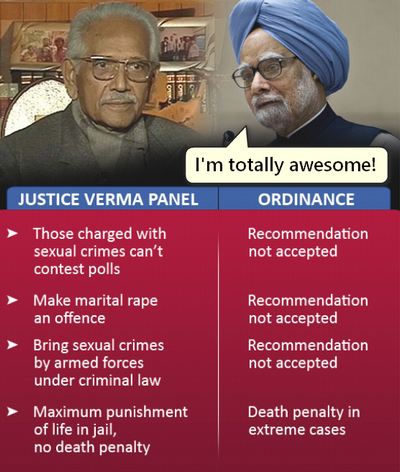
Ref:
- www.thehindu.com/news/national/ordinance-spares-police-armymen/article4373089.ece
- http://www.ndtv.com/article/india/rape-law-ordinance-govt-rejects-js-verma-panel-s-recommendations-on-marital-rape-review-of-afspa-325492
Static/Theory
Creation of New state
1. The Parliament of India, may form a new State by separation of territory from any State or by unifying any territory to a part of any State. Which of the following procedures is /are true in this regard?
- By a simple majority and by the ordinary legislative process
- On the recommendation of the President, who usually has to refer the bill to the legislature of the State(s) which is/are going to be affected by the changes proposed in the bill
- On the advice of the Prime Minister to the President
Select the correct answer using the code given below.
- 1 and 2 only
- 1, 2 and 3
- 2 only
- 1 and 3 only
Laxmikanth Chapter on Union and its territory=>Topic: Parliament’s power to reorganize the states. Accordingly
Art.4: laws made for state reorganization are not amendment to the Constitution= meaning they can be passed by a simple majority and by the ordinary legislative process=>Statement 1 is correct
Art 3: lays down two conditions
- bill can be introduced in parliament only by prior recommendation of President
- President has to refer the same bill to the states concerned. =>Statement 2 is correct
Eliminate choices accordingly
- 1 and 2 only
- 1, 2 and 3
- 2 only (Because doesn’t contain#1)
- 1 and 3 only (because doesn’t contain #2)
Coming to statement #3: On the advice of the Prime Minister to the President.
It is true according to article 74= President shall act in accordance with the advice rendered by council of Ministers headed by Prime Minister. So President doesn’t start the ball rolling unless PM advices him to do so. Therefore number 3 also correct.
Hence the answer (B): 1, 2 and 3. OR Debatable A (if the examiner did not drag the logic of Art74).
Parliament related
1. A bill introduced in the Parliament, in order to become an Act, has to have which of the following procedures to be followed?
- It is to be passed by both the Houses of the Parliament.
- The President has to give his/her assent.
- The Prime Minister has to sign it after the ratification by the Parliament.
- The Supreme Court has to approve and declare it to be within the jurisdiction of the Parliament.
Select the correct answer using the code given below.
- 1 and 2 only
- 1, 2 and 3 only
- 1, 2, 3 and 4
- 3 and 4 only
PM doesn’t have to sign it after ratification of parliament. Hence statement 3 is incorrect. Eliminate choices involving statement 3.
- 1 and 2 only
- 1, 2 and 3 only
- 1, 2, 3 and 4
- 3 and 4 only
Thus answer is A: statement 1 and 2 only.
Q2. Which of the following are the privileges of the House of the People collectively?
- The right to publish debates and proceedings, and the right to restrain publication by others
- The right to exclude others—to exclude strangers from the galleries anytime
- The right to punish members and outsiders for breach of its privileges
- What is said or done within the walls of the Parliament, however, can be inquired into in a court of law
Select the correct answer using the code given below,
- 1, 2 and 3 only
- 1, 2, 3 and 4
- 1 and 2 only
- 3 and 4 only
Laxmikanth Chapter on Parliament=>Topic: Parliamentary privileges=>Collective privileges
|
44th Amendment 1978 restored the freedom of press to publish true reports of parliamentary proceedings without prior permission of the house. But this is not applicable in case of a secret sitting of the house.Meaning Statement #1 becomes debatable. (or correct with caveats.) but let’s move to next statement: |
|
correct.additional source: http://rajyasabha.nic.in/rsnew/rsat_work/chapter-8.pdfthis eliminates Answer D |
|
correct. It can punish members as well as outsiders. Example in 1977 the 6th Lok Sabha expelled Indira from its membership and sentenced her to one week in jail for contempt of the house.This eliminates answer C. |
|
Incorrect.additional source: http://rajyasabha.nic.in/rsnew/rsat_work/chapter-8.pdf |
Hence Answer is A: 1, 2 and 3.
Q3. Which of the following statements regarding the powers of the Speaker of the House of the People is/are correct?
- The Speaker’s conduct in regulating the procedure of maintaining order in the House will not be subject to the jurisdiction of any court.
- Besides presiding over his/her own House, the Speaker possesses certain powers like presiding over a joint sitting of the two Houses of the Parliament.
- While a resolution for his/her removal is under consideration, the Speaker shall preside but shall have no right to speak, and shall have no right of vote.
Select the correct answer using the code given below.
- 1, 2 and 3
- 1 and 2 only
- 2 and 3 only
- 1 only
Laxmikanth Chapter on Parliament=>Topic: Speaker of Lok Sabha=>Election and tenure
“When a resolution for removal of speaker is under consideration, he cannot preside at the sitting of the house, though he may be present.”
- Hence statement 3 is wrong. This eliminates answer choice A and C.
- Statement 2 is correct because Speaker presides over the joint sitting of parliament.
- Answer B: statement 1 and 2 only.
Q4. A person shall be disqualified for being chosen as, and for being, a member of either House of the Parliament if she/he
- holds any office of profit under the Government of India or the Government of any State, other than an office exempted by the Parliament by law
- is of unsound mind and stands so declared by a competent court
- remains absent from all meetings of the House for a period of 60 days without the permission of the House
Select the correct answer using the code given below.
- 1 and 2 only
- 2 and 3 only
- 1, 2 and 3
- 1 and 3 only
Approach A:
Laxmikanth Chapter on Parliament=>Topic: Membership of Parliament. Accordingly all three statements are correct Hence answer C: 1, 2 and 3
Approach B:
Approach B:
According to Page 346 of Rajya Sabha manual:
http://rajyasabha.nic.in/rsnew/rsat_work/chapter-14.pdf
The constitutional provision is only directory and not mandatory; being and enabling power, it is within the competence of the House to condone the absence of a member exceeding sixty days.
But the question is using the word “shall” therefore, statement 3 is incorrect, hence answer=>(A) 1 and 2 only.
Final answer: Depends whether examiner went into nitpicking of the word ‘shall’ or not. So, wait for the official answer key from UPSC.
Q5. Consider the following statements regarding termination of sitting of a House
- Only the House of the People is subject to dissolution.
- The powers of dissolution and prorogation are exercised by the President on the advice of the Council of Ministers.
- The power to adjourn the daily sittings of the House of the People and the Council of States belongs to the Speaker and the Chairman respectively.
- The Parliament cannot be dissolved as it is a permanent chamber.
Which of the statements given above are correct?
- 1, 2 and 3
- 2, 3 and 4
- 1 and 3 only
- 1, 2 and 4
| Statement 1: Only the House of the People is subject to dissolution. | Laxmikanth Chapter on Parliament=>Topic: sessions of parliament=>dissolution.This statement is Correct=> Answer B eliminated because it doesn’t contain statement1 |
| Statement 3: The power to adjourn the daily sittings of the House of the People and the Council of States belongs to the Speaker and the Chairman respectively. | Laxmikanth Chapter on Parliament=>Topic: sessions of parliament=>Adjournment Sine Die.=> the power of adjournment and adjournment sine die rest with the presiding officers of the house. Meaning Statement #3 is correct.This eliminates Answer D because it doesn’t contain statement #3 |
so far
- 1, 2 and 3
- 2, 3 and 4
- 1 and 3 only
- 1, 2 and 4
Now comes the debatable part:
| Statement 2: The powers of dissolution and prorogation are exercised by the President on the advice of the Council of Ministers. | True. But Not always true. For example, if council of ministers has lost majority then President is not bound to consider their advice for dissolving parliament. (Ref. Laxmikanth chapter on Council of Minister=>Collective responsibility.) |
Answer: A or C depending on whether examiner consider the caveat of council losing majority.
Budget related
1. Which of the following expenditures is/are charged on the Consolidated Fund of India?
- The emoluments and allowances of the President and the expenditure relating to his/her office
- The salaries and allowances of the Chairman and Deputy Chairman of the Council of States and the Speaker and Deputy Speaker of the House of the People
- Debt charges for which the Government of India is liable
Select the correct answer using the code given below.
- 1 and 2 only
- 1, 2 and 3
- 2 and 3 only
- 3 only
Laxmikanth Chapter on Parliament=>Topic: Budget in parliament =>Charged Expenditure.
All statements are correct. Hence answer B.
2. A bill is deemed to be a ‘Money Bill’ if it contains only provisions, dealing with
- the imposition, alteration or regulation of any tax
- the regulation of the borrowing of money by the government
- the custody of the Consolidated Fund of India or the Contingency Fund of India
- the provision for imposition of fines or other penalties, or for the demand or payment of fees for licenses or fees for services rendered
Select the correct answer using the code given below.
- 1, 2 and 3 only
- 1 and 2 only
- 3 and 4 only
- 1, 2, 3 and 4
Laxmikanth Chapter on Parliament=>Topic: legislative procedures in parliament=>Money bill.
According to the list given there, statement 1, 2 and 3 are correct.
And bills are not considered money bills by the reason only that it provides for
- the provision for imposition of fines or other penalties,
- demand or payment of fees for licenses or fees for services rendered
Meaning statement 4 is incorrect. Hence answer is A: 1, 2 and 3 only
FR/DPSP related
Q1. Which of the following statements is/are correct?
- Offices connected with a religious or denominated institution may be reserved for members professing the particular religion to which the institution relates.
- The State may reserve any post or appointment in favour of any backward class of citizens who, in the opinion of the State, are not adequately represented in the services under that State.
- No citizen shall, on grounds of religion, race, caste, sex, descent, place of birth or any of them, be ineligible for any office under the State.
Select the correct answer using the code given below.
- 1 and 2 only
- 2 and 3
- 1, 2 and 3
- 3 only
Laxmikanth Chapter on Fundament rights=> topic: Equality of opportunity in public employment. According to the Art16 and the exceptions given to it, all three statements are correct. Hence answer C
Q2. Consider the following statements
- While the Fundamental Rights constitute limitations on State action, the Directive Principles are in the nature of instruments of instruction to the government of the day to do certain things and to achieve certain goals by their actions.
- The Directive Principles, however, require to be implemented by legislations and so long as there is no law carrying out the policy laid down in a Directive Principle, neither the State nor an individual can violate any existing law or legal rights under the colour of getting a Directive.
- The Directive Principles are enforceable in the courts and create justiciable rights in favour of the individual.
Which of the statements given above is/are correct?
- 1, 2 and 3
- 1 and 3 only
- 1 and 2 only
- 2 only
Laxmikanth Chapter Directive Principles of State policy=>Topic: Criticism of directive principles. Accordingly, statement 3 is incorrect. This eliminates answer A and B.
Same chapter, table 8.1 Distinction between Fundamental rights and directive principles=>Statement 1 is correct. This eliminates D. So we are left with answer C.
Language
Q1. Consider the following statements:
- It shall be the endeavor of every State and every local authority within the State to provide adequate facilities for instruction in mother tongue at the primary state of education to children belonging to linguistic minority groups.
- The Constitution enjoins the Union of India to provide and promote the spread of Hindi language and to develop it so that it may serve as a medium of expression of all the elements of the composite culture of India.
Which of the statements given above is/are correct?
- 1 only
- 2 only
- Both 1 and 2
- Neither 1 nor 2
Laxmikanth Chapter on Official language:
- Topic Protection of Linguistic minorities. Statement 1 is correct.
- Topic Development of Hindi language. Statement 2 is correct
- Therefore, answer (C) both correct.
Council of ministers
Q1. Consider the following statements:
- A person who is not a member of either House of the Parliament can be appointed a member of the Council of Ministers.
- Anyone can be appointed as a member of the Council of Ministers for a maximum period of three years.
- A person shall not be less than 25 years of age in order to become a minister.
Which of the statements given above is/are correct?
- 1, 2 and 3
- 1 only
- 1 and 3 only
- 2 and 3 only
Laxmikanth Chapter on Council of Ministers=>Topic Appointment of minister.
- statement 1 is correct
- Statement 2 is wrong because person has to get elected within 6 months to either house.
this eliminates A and D.
- 1, 2 and 3
- 1 only
- 1 and 3 only
- 2 and 3 only
Regarding Statement #3: Minimum age to fight Lok Sabha election is 25 years. Hence statement number 3 is also legit. Although bit debatable:
- What if the given person is 24 years and 10 months old –still gets appointed as minister and gets elected in Lok Sabha within the “6 months” timeframe?
- What if the given person is only 21 years old- still gets appointed but resigns before expire of 6 months timeframe.
Answer B or C. Depending on whether examiner dragged the ‘birthday’ logic or not.
Tribunals
Q1. The Central Administrative Tribunal adjudicates disputes with respect to the recruitment and conditions of service of persons appointed
- to public services and posts in connection with the affairs of the Union
- Members of the defense forces
- Officers and servants of the Supreme Court or of any High Court in India
Choice:
- 1 and 2
- 1 only
- 2 only
- 2 and 3
Laxmikanth Chapter on Tribunals: Topic Central Administrative tribunal.
CAT’s jurisdiction doesn’t extent to defense forces, officers and servants of Supreme court and Secretarial staff of parliament. This eliminates
Eliminate choices involving statement 2 and 3. we are left with answer B: only 1.
Any corrections / additions: post them in the comments below. Answerkeys for remaining topics will be published soon.

![[Errors/discrepancy] 16 MCQs where UPSC Official Prelims-2020 Answerkey & Coaching classes differ, while 2 MCQs cancelled](https://mrunal.org/wp-content/uploads/2021/11/csp2020-akey-differ-table-500x383.png)
Dear Mrunal Sir…
I started preparation with your valuable inputs only and attended well in Paper-1.
this article 14 questions..I attended 11 and out of 09 questions are correct as per your answers.
And eagerly waiting for the remaining answers.
I really thankful to your efforts for aspirants like me.
Q2. Which of the following are the privileges of the House of the People collectively?
Ans. i think the answer to this question is option- A i.e What is said or done within the walls of the Parliament, however, cannot be inquired into in a court of law..
A member of parliament is given wider freedom in comparison to ordinary citizen. whatever is said by a MP inside the house, he ca,t be challenged in any court of law…. however,this right is not absolute
1. it must be in confirmity with the rules of parliament
2. he can,t speak anything against the conduct of a judge of supreme court/ high court provided his removal process is not under consideration by the parliament..
however, these are only exceptions, and wider and greater freedom of speech is a privelege of a MP..
Thanks mrunal sir…….and agree with you mr.einstein
einstein sahi bol raha hai… Please verify??
I feel the same. Mrunal please correct it
Yeah thats right, conduct of any judge will not be discussed in Parliament and proceedings of the Houses of parliament will not be called into question in any court of law. Its a fundamental principle to keep judiciary and legislature independent of each other. Article 212. Please correct it Mrunal Sir.
I think you are correct! The speaker/chairman has the right in this regard.
yes sir !! as in sibu soren case of narasimha rao govt !!! this has been dealt so option 4 is neggligible i think
Even i too feel that “What is said or done within the the walls of the parliament can be inquired into court of law” is in correct.I know mrunal you have referred all possible sources but in Lamikant book page 22.40 under COLLECTIVE PREVILIGES point no 7 it is explicitly mentioned that ‘The courts are prohibited to enquire into the of a house or its comittes”.Plz clear our doubt in this regard.Thanks for key
you r absolutely right…….
correct answer is option A
Thanks Mrunal. Waiting for other answers !
No, You Are Totally Awesome Sir!
Thanks Mrunal For posting answers………..Please do others also……can we expect all by today…..thanks once again……….
thanx
Q2. Which of the following are the privileges of the House of the People collectively?
The right to publish debates and proceedings, and the right to restrain publication by others
The right to exclude others—to exclude strangers from the galleries anytime
The right to punish members and outsiders for breach of its privileges
What is said or done within the walls of the Parliament, however, can be inquired into in a court of law
*** only a, b, c are correct here. D is the wrong option.
For parliamentary privilege question option 4 should be wrong( article 105(4)) ie court cannot inquire into what he is said or done.
So answer should be option A.
Which of the following are the privileges of the House of the People collectively?
The right to publish debates and proceedings, and the right to restrain publication by others
The right to exclude others—to exclude strangers from the galleries anytime
The right to punish members and outsiders for breach of its privileges
What is said or done within the walls of the Parliament, however, can be inquired into in a court of law
plz recheck. Point 4 is wrong. No proceedings can be brought into question by courts
yes i also agree with you bhaz… Mrunal sir has provided links of rajya sabha priveleges in explanation of this question whereas it is asked for Lok Sabha
well even document shared nowhere mentions that a court can call into question proceedings of rajya sabha. Infact no need to dig into rules of parliament for this. refer art 122 of constitution.it clearly states that courts cant interfere. That is the reason why culprits in cash for votes/questions scams were never prosecuted. Action against them was taken by house privilege committee
that case is in pipeline in a court
sir is upsc start d trend of question relating to
the job perspect.if yes
then how to prepare ?
Expected cutoff in paper 1
language question statements are directly lifted from bare act
Sir please upload answer key of math and reasoning of capf exam
thank you!!
What is said or done within the walls of the Parliament, however, can be inquired into in a court of law… This statement false according to laxmikanth book.. verify 7th point(collective responsibility) in pg no.22.40…
Brother, please go to the link provided by Mrunal, see page no. 206… It says
The immunity granted to members under article 105(2), covers anything said in Parliament even though it does not strictly pertain to the business before the House. As stated by the Supreme Court:
The article confers immunity, inter alia, in respect of ‘anything said… in Parliament’. The word ‘anything’ is of the widest import and is equivalent to ‘everything’. The only limitation arises from the words ‘in Parliament’ which means during the sitting of Parliament and in the course of the business of Parliament… Once it was proved that Parliament was sitting and its business was being transacted, anything said during the course of that business would be immune from proceedings in any court. This immunity is not only complete but is as it should be… The courts have no say in the matter and should really have none.
i saw it brother.. but which i should follow is my doubt..!
you’re right. answer updated.
Thanx sir
in quetion related to previleges of the house answer should b A n in question related to eligibility to become a minister your answer is absolutely correct bcoz d person must b eligible to become a member of either of d house at d time of appointment as minister….
1.Sir question on formation of states should not be debatable..becoz its is CoM as a collective body that recommends..not PM on his own…
2.regarding minimum age of minister…the examiner has put the questiin in the context of appointment of minister before being an MP…so suitable answer should be 1 only
3.regarding termination of sitting of house….the examiner has not mentioned ALWAYS in option 2…in general the answer should include that it is done on advice of CoM. We should c in general AND NOT INCLUDE EXCEPTION WHEN ALWAYS IS NT WRITTEN.
PM advice itself imply the advice of the COM, so logic mentioned by Mrunal is correct. It is debatable.
Mr anwar…
http://www.preservearticles.com/201104265932/notes-on-the-council-of-ministers-of-india.html
An excerpt frm dis page is given below.
They are inducted into the cabinet to acquire experience by assisting their senior ministers to discharge their functions well. No qualification or age limit is laid down for these different categories of ministers. The political wisdom as well as the compulsions of the Prime Minister decide which minister will belong to which category and handle which portfolio. The Council of Ministers is collectively responsible to the Lower House of the Parliament. The ministers also individually responsible for acts done on behalf the President.
Mine was SET-A.. some which are 100% right are below.. Others can see with Question..
1.c.. 4-pi , Q: circle drawn in square.
2.d 9/13 Q:Ratio .. wht is X to Z.
3.c 112.5 cmsq. Q: Maximum possible area of triangle.
4.b Rs 12 Q: What will a mango cost.
5.b 360/7 Q:Diagram of triangle given,4y,3y,2y, Find x .
6.b 120,100,80 Q: Campus poll of 300.
7.c Families of A and B spent equally.
8.c (two separate circles in one big circle) Q: Animal,Cow,horse.
9.d 84 Q: 3 hrs 12 mins and 6 hrs.
10.b 723 Q:person starts from center O…. oa=ob=100.what is total distance walked.
11.b 192 Q:5 persons can weave 160 mats…..
12.b 55km/hr Q: two cars moving in the same direction.
13.b (box containing dot in left upper corner and + on right below corner ) Q:Series of boxes…
14.b EFD Q: DICE with ABCDEF..
15.c 5:7 Q: In a class, 40 students passed in mathematics….
16.b 3 Q: The least integer whose multiple..588…
17.a NOML Q: BCYX,EFVU,HISR,…..
18.C 20 Q:By selling an article at rs 270,..
19.d %4@2B Q : in a certain code ‘plant is written as ……
20.c 79 Q: If A is coded as 1,B as 3….
thanx yaar got 2 wrongs.Qno 13 and 15.
SET-C
Serial No. of Que is same i.e 101-120
all are correct :)
Thanku so much sir….:)
Got 40 right out of first 45 question…. but my Art section poor..55/125 LOL..Mrunal ji please post fast of history question.. I have doubts regarding dakshinapth,, and colonial Industrial questions.. DID some funny mistakes:: Most easiest and i did wrong…. Form of carbon===/ quartz..??
1. tropic of Cancer==Aizwal…. I marked Kolkata.
2. largest are in equatorial belt= South America .. i marked Africa…
3.CRT,Plasma,LED…
4. DIAMOND ring :: solar eclipse.. Didn;t attempted, Mistake: Jumped without reading fully..
5.Alaknanda and Pindar river== Karnaprayag… Marked Rudraprayag…
6.DID CHIPKO movement wrong…
7.Money bill… i never touched economy( foolish me ,aalsi)
8.Maximum weight in whole sale price index=== manufactured product… I marked Food items.. hehe
9.Rate of inflation== whole sale index/// i marked consume price index
10.AND BIGGY… I marked Curiosity instead of Apollo for Mars Rover..
hey bro whatever mistakes you done even i have done the same .feel so disgusted
was correct sequence crt , led and plasma, correct me not sure
it should be crt,plasma,led
sir,how long will u take clear all the answer keys of cpf 2013 paper.Just i m totally exiceted to do clearing of my doubt.thanks for polity discussion.
sir,
please upload CDS 2 2013 G.K. solution also……….
hello, in the question regarding article 16, in my opinion, the third statement is wrong… as it reads ‘No citizen shall, on grounds only of religion, race, caste, sex, descent, place of birth, residence or any of them, be ineligible for, or discriminated against in respect of, any employment or office under the State ‘… as it has been well established fact that the word ‘only’ has wider connotation in both the articles, 15 as well as 16, without which positive discrimination would not have been possible… moreover in the statement of the question, the word ‘residence’ too is missing… therefore in my view, the said statement should be considered wrong… i invite ur views…
yes vikalp,
you are right word ‘only’ has importance in interpretation of article 16.
i thot ppr was easy..but aftr chkin answer key i realised many of us made the same mistakes…i guess da cut off will b somewat similar to last yr..
Regarding ques which of the following statements
art 16 states no citizen shall “only” on grounds of religion, race etc, rather as mention in question no citizen on grounds of religion, race etc
There is a vast difference between the interpretation with “only” inclusion, so this statement should be wwrong
Dear mrunal,
In question no.4 on disqualification from house it reads who shall be disqualified and in option 3 it is up to the discretion of house but in 1 nd 2 it is other way around so option a should be right one.
Sir in the link u gave with respect to question 2 it is given that
“Freedom of speech and immunity from court proceedings
Members have freedom of speech in the House and enjoy immunity from
proceedings in any court in respect of anything said or any vote given by them
in Parliament or in any committee ”
so d option is wrong
pls entertain
Polity Questions are quite simple.
Ya thats why I think even Mrunal finds some questions debatable.
i feel shitty! i got confused a lot. maybe cause of inadequate revision. better read motivation section of the site.