
CAPF: Topicwise Breakup
To download scanned CAPF 2014 question paper Booklet “D” click me
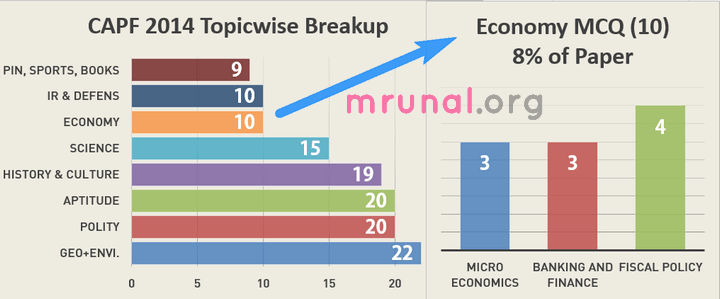
| Topic | MCQs in CAPF-2013 | Weightage |
|---|---|---|
| Geography & Environment | 22 | 18% |
| Polity | 20 | 16% |
| Aptitude | 20 | 16% |
| History & Culture | 19 | 15% |
| Science | 15 | 12% |
| Economy | 10 | 8% |
| IR & defense related | 10 | 8% |
| PIN, Sports, Books | 9 | 7% |
| Total | 125 | 100% |
Economy in all recent exams of UPSC
| Economy | CAPF-2014 | CAPF-2013 | CSAT-2013 | CDS1-2014 |
|---|---|---|---|---|
| Economy | 10 | 21 | 18 | 9 |
| total MCQs | 125 | 125 | 100 | 120 |
| % | 8% | 17% | 18% | 8% |
Economy: Internal breakup in CAPF
| Internal breakup | MCQ | weightage |
|---|---|---|
| Micro economics | 3 | 30% |
| Fiscal Policy (budget, taxation, subsidies) | 4 | 40% |
| Banking and finance | 3 | 30% |
| total | 10 | 100% |
Compared to last year, Number of questions decreased and difficulty level increased. But still, there is continuity in the trend of MCQs- for example
| topic | CAPF-2013 | CAPF-2014 |
|---|---|---|
| Question that requires you to do “data interpretation of Annual financial statement” | ascending descending of taxes | which deficit increased between BE-2013 and RE-2013 |
| WTO related | latest nation to join | food subsidies in Bali summit |
Economy: Span of current affairs
| date | topic asked in CAPF-2013 |
|---|---|
| 11-Nov-13 | PSU bank ownership |
| 24-Nov-13 | SBI POS terminal |
| 6-Dec-13 | Bali summit WTO |
| 17-Feb-14 | Interim budget |
| 17-Apr-14 | SEBI norms |
| 13-Jul-14 | Exam conducted |
Moral of the story:
- at least last 6-8 months’ current should be prepared before CAPF exam
- overall 5 current + 2 contemporary (GAAR, Wheat) + 3 static micro = 10 MCQ
Economy Difficulty level of MCQs in CAPF-2014?
Debatable, depends on preparation level of a person. But in my opinion all questions were difficult, due to following reasons:
- Three MCQs on micro-economics because most candidates ignore it for CAPF.
- Bali conference food subsidies, old topic from last year. Many would have downplayed given that exam taken >6 months after it.
- Government stakes in bank ownership- again old topic from last year. Many would have forgotten that number 58 to 51. (because who has time for such trivial data memorization)
- GAAR: as such easy but due to term “Overseas investors” some candidates may become 50:50. Because IT commissioner can send notices even to Indians and NRIs under GAAR.
- Interim budget= who studies annual financial statement in such minute detail to see that ERD increased from 1.8% to 2%!
- Banking PoS terminal=> such banking GK not seen in earlier UPSC exams so candidates would have ignored while preparing.
- SEBI norms. Most candidates downplay the capital market / corporate sector part.
- MSP: it was easy to tell that second statement is wrong but still you were required to mug up an exact data that wheat MSP=1700, only then final answer could be ticked.
Lessons for CSAT-2014
- questions look tough yes, but they’re not “falling” from sky. The correct / incorrect statements are lifted verbatim from Hindu, Indian express etc. It again highlights the importance of making notes.
- Economic Survey is useful (observe MSP question).
- Microeconomics should be revised (only if you’ve read it already. Otherwise there is no time to start afresh, at this junction.)
- Never tick MCQ unless you’re absolutely sure. for example that interim budget question, many would have ticked fiscal deficit etc. by “gut feeling”.
- It is upto UPSC to replicate this model from CAPF to CSAT (i.e. economy section with less question and more difficulty) but nonetheless one should keepup the momentum because economy important for GS2 and GS3.
Conspiracy theory: TR Jain:
It seems all the micro economics questions were framed by T R Jain (or his fan) because all statements verbatim lifted from various books authored by T R Jain.
Anyways, without further ado, let’s begin solving.
Micro economics
total three questions
#1: Elasticity of Demand
37. When a fall in price of a commodity reduces total expenditure and a rise—in price-increases it, price, elasticity of demand will be :
- 1
- <1
- >1
- Infinity
Answer B <1.
Introductory Microeconomics and Macroeconomics By TR Jain, VK Ohri. Page 92
Less than unitary elastic demand (Ed<1), when:
- Total Expenditure increases when price increases
- Total Expenditure decreases when price falls
NCERT class12 microeconomics page32 tells same story but via a complicated mathematical equation.
#2: Commodity Demand
85.Which of the following factors affects individual’s demand for a commodity?
- Price of the commodity
- Income of the consumer
- Prices of related goods
Select the answer using the code given below:
- 1 and 2 only
- 2 and 3 only
- 1, 2 and 3
- 1 only
Business Economics by TR Jain, OP Khanna, Page 42
Determinants of individual demand for a commodity (DX)
- Price of the commodity
- Prices of other related goods
- consumers income
- tastes and preferences
- expectations
Therefore answer is C all 1,2 and 3 correct.
#3: Substitution rate
111.The rate at which the consumer is willing to substitute one good for another without changing the level of satisfaction is known as:
- Marginal rate of substitution
- Marginal rate of technical substitution
- Diminishing marginal utility
- Equi-marginal utility
Marginal rate of substitution (MRS) is the rate at which which the consumer is willing to substitute one good for another without changing the level of satisfaction therefore answer (A)
NCERT Class12 microeconomics chapter 2, page 14 also mentions this topic but without giving the verbatim definition.
Budget, Taxation, Subsidies
four questions from this segment
#1: MSP
104.Which of the statements given below is/are correct?
- For the marketing year 2014-2015, the minimum support price (MSP) for wheat in India has been fixed at Rs. 1,400/quintal. (right)
- MSP is the rate at which the government sells the grains through the fair price shops (wrong)
Select the correct answer using the code given below:
- 1 only
- 2 only
- Both 1 and 2
- Neither 1 nor 2
Statement 1 is right as per table 8.8 on Economic Survey 2013, Page 148.
1450: was “proposed” by Agri ministry (October 2013). But I’m unable to locate source where it says government accepted / announced 1450.
July, 2014 Financial express says
” government had announced a Rs 50 hike in the minimum support price (MSP) to Rs 1,400 per quintal for wheat procurement for 2014-15 marketing season.”
Statement 2 is wrong by common knowledge. But still if you want reference: Ramesh Singh Page 8.12 (6th edition), MSP is the Is the minimum price at which the government will purchase farmers crops – irrespective of whatever may be the market price for that crop.
Therefore, answer A only 1 correct.
#2: WTO Bali conference
119.As per the latest trade agreement in Bali Ministerial Conference of WTO, India and other developing and under developed countries can launch food security programs:
- Forever without any penalty under WTO rules
- Till an alternative mechanism is developed
- For four calendar years
- Only if subsidy component under such programmes is less than 10 per cent
Ref: TheGuardian, December 6, 2013
The negotiators in Bali finally came to a provisional agreement, where Countries agreed to a four-year peace clause, meaning that they won’t challenge India’s food security measures before December 2017.
Therefore, answer (C) For four calendar years.
Ref: Hindu’s businessline, Dec18, 2013
Sharma had said in his statement that the Bali outcome provided for an interim mechanism to be put in place and to negotiate for an agreement for a permanent solution for adoption by the 11th Ministerial Conference of the WTO, which will be held in 2017. (until then) members will be protected against challenge in the WTO.
Therefore answer (C) four calendar years.
#3: GAAR
110.Which of the statements given below is/are correct?
- In India, the provisions of General Anti-Avoidance (GAAR) will be implemented with the effect from 1 April 2015
- The provisions of GAAR were aimed at checking tax avoidance by overseas investors
Select the correct answer using the code given below:
- 1 only
- 2 only
- Both 1 and 2
- Neither 1 nor 2
1 is right. “As per the existing proposal, GAAR is scheduled to roll out from April 1, 2015, for the assessment year 2016-17.” Ref: Indianexpress
Statement #2 is right Ref: Businessline. (some people may debate over the word “overseas” because IT commissioner is empowered to send notices even to Indians and NRIs. but since statement is verbatim is given in businessline hence correct.
Answer (C) Both 1 and 2 correct.
#4: Interim budget
125.Data presented in Interim Budget for 2014-2015 reveal that for the financial year 2013-2014, the revised estimates do not show a decline in :
- Revenue deficit
- Effective revenue deficit
- Fiscal deficit
- Primary deficit
I’ve discussed this question in my recent lecture on Economic survey: L1/P3 at 30:37 minutes
Answer is B Effective revenue deficit.
For “official” reference, you’ve to collect data from Annual financial statement from interim budget 2014
| DeficitBE-2013RE-2013BE-2014 | ||||
| Fiscal Deficit | 542499 | 524539 | 531177 | |
| GDP% | 4.8 | 4.6 | 4.1 | |
| Primary Deficit | 171814 | 144473 | 104166 | |
| GDP% | 1.5 | 1.3 | 0.8 | |
| Revenue Deficit | 379838 | 370288 | 378348 | |
| GDP% | 3.3 | 3.3 | 2.9 | |
| Eff. Revenue Deficit | 205205 | 232060 | 210244 | |
|---|---|---|---|---|
| GDP% | 1.8 | 2 | 1.6 | |
लेकिन यार इतना डिटेल में कोन प्रिपेर करता है? (who prepares in this much detail!?)
Banking and finance related
Three questions here too.
B1: PSU Bank ownership
107.The Economic Advisory Council to the Prime Minister (PMEAC) in India has recommended phased dilution of Government stake in Public Sector Banks from:
- 74% to 56%
- 58% to 51%
- 58% to 49%
- 51% to 49%
Rediff Date 11th November 2013
Prime Minister’s Economic Advisory Council has recommended phased dilution of government stake in public-sector banks, from 58 per cent to 51 per cent, and introduction of on-tap licensing of new banks.
Therefore answer (B)
B2: Banking POS
113.Recently a leading public sector bank of India allowed withdrawal of upto Rs.1000 from any shop/trader with a point-of-sale (PoS) terminal. Identify the bank from below:
- Bank of Maharashtra
- Punjab National Bank
- State Bank of India
- Bank of Baroda
Answer is State bank of India. Ref Hindu Businessline dated 24th November 2013.
B3: SEBI norms corporate governance
5. Which of the following statements about the detailed corporate governance norms for listed companies issued in April 2014 by SEBI is/are correct ?
- It provides for stricter disclosures and protection of investor rights, including equitable treatment for minority and foreign shareholders
- Under the new norms listed companies are required to provide the option of facility of e-voting to shareholders on all resolutions proposed to be passed at general meetings.
Select the correct answer using the code given below:
- 1 only
- 2 only
- Both 1 and 2
- Neither 1 nor 2
Answer C Both 1 and 2 Correct
Both statements lifted from Indianexpress 17th April 2014
Remaining parts coming soon. Corrections post in comments with reference.
Visit Mrunal.org/answerkeys for more answer keys with explanations.

![[Errors/discrepancy] 16 MCQs where UPSC Official Prelims-2020 Answerkey & Coaching classes differ, while 2 MCQs cancelled](https://mrunal.org/wp-content/uploads/2021/11/csp2020-akey-differ-table-500x383.png)
I think GAAR is from 2016
http://www.outlookindia.com/news/article/Implementation-of-GAAR-Rules-From-April-2016-Govt/811630
Implentation of GAAR had been deferred by ex-FM to 1 April 2016. Read the Businessline article you’ve posted as a reference for overseas investors; It says the same. Apart from it http://articles.economictimes.indiatimes.com/2013-01-14/news/36331701_1_gaar-provisions-shome-panel-shome-committee
As per the existing proposal, GAAR is scheduled to roll out from April 1, 2015, for the assessment year 2016-17.
http://indianexpress.com/article/business/business-others/govt-yet-to-take-call-on-gaar-implementation/
govt take back that decision to implement that…….no new date has been given……..2016 is still official
according to minister of state of finance Nirmala Sitharaman , GAAR will be applicable from 1st of April,2015
2016 is according to Shome’s recommendations.. according to govt it is 2015
I am regretting for not attending physicals of CAPF 2013. Seeing this answer key…It seems i am not clearing CAPF 2014…..
same here..did’t go for physical though it was in delhi itself..still regretting for capf2013 because atleast that would have been a UPSC interview experience even if we defer the joining after being selected..:-(
thnx bro…out of 10 economy questions, i have 6 correct and 4 incorrect…:-( ….eagerly waiting for other parts of answer keys…
What the hell man. I got only 5 correct. agar iss mein ye haal hai tou csat mein kya hoga.
Double dip depression hoga economy dekh k
yes jade lucy, I’m feeling the same. Mrunal bhai has aptly prophesied CSAT-2014 to be the “Qatl ki Subah”.
Perhaps this is DP Agrwal’s reply to those demanding removal of aptitude paper…If you want me to remove aptitude, then I’ll toughen GS paper beyond your imagination!
only 1 wrong
Prepare for the worse, hope for the best.
“D.P” naam sun te hi hasi aa jati hai
So many questions from env and geo…let’s hope they are a little better.
Need some insigts on Species they could ask this year
how to find the entire answerkey??
My score is 5 right..5 wrong….
thank you sir….
Thank you…
sir, regarding the question for MSP of wheat, u hv given the right info. it is 1400 rs/qntl for year 2013-14. they have asked for year 2014-15 and that is 1450 rs/qunt..so both statements are wrong…right answer option D
2 right , 4 wrong,, got confused with answers in exam, lack of revision..
Sir what is expected cut off??
Economic section my score 6 out of 9..my paper 2 was horrible..I hav written only 96 marks paper..
Dear Bhavesh, this year paper was much easy than last year.. since last year cutoff was 107. so this year it must be higher than tha.somewhere around 115-125. some are even sayinf 130+ since vacancies are less this time.
In 2nd paper those who attempt 180-200 managed to get 60-80. (see toppers interviews 2012 and 2013). u have a low chance of clearing cutoff of paper 2 .
so cruel…btw if it was tougher
bhaai sabki lagi hai tension na le…..haven’t came across any guy who is scoring 100+…..kisi k aa rahe hai kya 100+, comment kar do yaar
Rahul, no it was easy compared to last year so cutoff is bound to increase
It won’t
Ok.if you dont mind then please check last year economy questions and compare.These year’s were difficult as also mentioned by Mrunal sir
dude it doesnot matter whether paper was easy aur tough …cutt off will definetly rise because seats are less this only 138 …last year it was 450 +…
@mrunal your answer to WTO question is wrong. the correct answer would be B.
from your source of businessline:
“In the interim, until a permanent solution is found, members will be protected against challenge in the WTO under the Agreement on Agriculture (AoA) in respect of public stockholding programmes for food security purposes.
“It unambiguously stated that the interim solution shall continue until a permanent solution is found,” he had said.
Also I’m not sure about the price elasticity question, I think the correct answer will C, please explain it with regards to the following link: http://en.wikipedia.org/wiki/Price_elasticity_of_demand#Interpreting_values_of_price_elasticity_coefficients
Economics : 7/9 correct
expecting 120~125 Paper I
and Paper II ~120 , would i be through ?
The MSP of wheat for year 2014-15 is 1450.
1400 was msp for the year 2013-14.
hence , option D is right.
I think as per d news GAAR will roll out from april 2016 as per the shome committee recommendation… pls check the answer…
Mrunal I am just copy pasting Anand sharma`s statement published in PIb
We were able to build a broader coalition of support forcing US and EU to cede ground. India declined a country specific carve out and insisted that protection must be available to all developing countries. After intense negotiations over 3 days, a few hours before the Conference was scheduled to end, a revised draft text was placed before the membership, which addressed our core concerns. It provides for an interim mechanism to be put in place and to negotiate for an agreement for a permanent solution for adoption by the 11th Ministerial Conference of the WTO. In the interim, until a permanent solution is found, Members will be protected against challenge in the WTO under the Agreement on Agriculture in respect of public stockholding programmes for food security purposes. It unambiguously stated that the interim solution shall continue until a permanent solution is found. By implication, India will have the flexibility of providing support to its farmers without the apprehension of breaching its WTO entitlements. It has also effectively led to a commitment from Members of the WTO to work on a permanent solution as part of a post-Bali work programme. Now we will be preparing for negotiations for arriving at a permanent solution. Countries which donot run such public stockholding programs also retain the flexibility to introduce them if they so wish to.
I states that they would try and negotiate a final solution by 11 th ministerial meet but if the negotiations do not yield a permanent solution the interim arrangement would continue.Hence the 4 calendar years is what they are trying to strive for but in a real sense the solution is permanent till an alternate mechanism is chalked out.
http://pib.nic.in/newsite/PrintRelease.aspx?relid=101827
Please enlighten if I am wrong.
Q. 119: The answer is debatable. Answer may be either 2 or 3. Following links may explain apart from what Mrunal has given.
http://www.thehindu.com/news/national/indias-stand-prevails-in-bali/article5430252.ece
“The draft proposes an interim mechanism to safeguard minimum support prices to farmers against WTO caps till a permanent solution is adopted.”
“Food Security Law may push India’s minimum support prices above WTO limits, but interim mechanism provides safeguards till WTO rules are corrected.”
http://businesstoday.intoday.in/story/yashwant-sinha-on-wto-bali-deal-impact-upa-on-food-bill/1/201301.html
“As far as food subsidies are concerned, they had a ‘peace clause’ which was supposed to last four years as an interim arrangement. Now, we are claiming that we have not accepted the fouryear limit and therefore we can breach the 10 per cent subsidy limit as and when necessary. The point is that the next ministerial is due after four years. All the arrangements which we have entered into in the Bali ministerial will automatically come up for review in the next meet. So, it is four years whether we like it or not. It is not indefinite.
Invader, any prediction for reserved candidates cut off this year?
@Mrunal There was a quid pro quo at Bali in which developing countries agreed on trade facilitation agreement in lieu of a permanent solution. Yes I accept that this interim provision is for 4 years but there is scope of ambiguity on these two points.
Agree. “Question talks about India and other developing nations” — Does the 4 year relaxation for India talks about the Trade policy Review which happens once in 4 years where India is bound to answer. In the WTO resolution report, I remember that I somewhere read that it is relaxed till a further solution is made.
Had confusion in exam too and gone for ” Till an alternative mechanism is developed”.
There’s a question on globalisation too.
Which of the following is not a characteristic of Globalisation?
Que.no 48(SET-A).
India has rejected the peace clause of treaty which state that india wud be protected for 4 years i think answer four years is not there,as this clause has been rejected by india.it is till alternate mechanism
For GAAR it is 2016
Mrunal Isn’t it that Garr will be implemented from 1st april 2015 but will be effective from assessment year 2016-17?Please look into it.
Sir verry nice sir give to advantage for mpsc and upsc student
Mrunal Sir,
Please post a complete answer key for the CAPF 2014 question paper. Then you can take your time to post the explanations as well. But please first post the answer key of CAPF 2014.
5 correct 3 wrong 2 unattempted
Dear Mrunal Sir, I have attempted total of 60 questions in Paper 1 out of which 9 are wrong. means i am getting a score of 99 marks on an average. Paper 2 was great. I attempted all the questions sticking to the word limit and keypoints.. what are the chances for me to clear it. Should i start preparing for PET?
First of all, you calculated wrong. If 51 questions are correct then 51 X 2=102. OK. BUT in negative you have to deduct 2/3 i.e. 0.66 marks. So 9 X (2/3)= 6 MARKS IN NEGATIVE. score becomes 102-6= 96 marks.
I think you should wait. Paper 2 gets evaluated only if you clear paper 1. Lat year’s cutoff was over 100. & always keep scope for +/- 10 marks when evaluating yourself. Wait for Mrunal’s full key. You may be getting more or less marks. Hope for the best.
Penalty is 1/3=0.33.
It is 2/3=0.67 as marks per question is 2