
- Prologue
- [Act 1] WHO calculates WPI, CPI, IIP?
- [Act 2] WHEN they publish WPI, CPI, IIP?
- [Act 3] WHERE do they get data for WPI, CPI, IIP?
- [Act 4] WHAT are the components of WPI, CPI, IIP?
- [Act 4] WHY REVISE WPI, CPI, IIP series?
- [Act 5] WHY WPI, CPI, IIP important?
- [Act 6] Other indexes
- [Act 7] Laspeyre’s formula
Prologue
Chapter 4: Prices and Monetary Management. Three subparts
- Monetary management, measures of money supply, Urjit Patel
- Indexes’ Theory: WPI, CPI, IIP, Services index and others
- Indexes’ Current: Survey observations on WPI, CPI & IIP, How to combat inflation.
Wait…what happened to remaining chapters?
- Ch. 8 to 13 published as articles.
- Chapter 1 to 3; 5 to 7 available as powerpoint and videos. (Will release them as articles after prelims and its “unofficial” answerkey.)
[Act 1] WHO calculates WPI, CPI, IIP?

| WPI |
|
| CPI |
|
| IIP | Same as CPI |
[Act 2] WHEN they publish WPI, CPI, IIP?
WPI data publication
| Weekly |
|
| Monthly |
|
| Final |
|
If holiday, then WPI data released next working day.
| CPI |
|
|---|---|
| IIP |
|
[Act 3] WHERE do they get data for WPI, CPI, IIP?
So far we know, who makes the index, and when they release it. But WHERE do they get the statistical inputs?
WPI Data Collection
| Primary articles | Respective ministries, dept, PSU, State Governments |
| Fuel and power | Same as above |
| Manufactured products | Leading manufacturing units |
| total | 676 items |
Problems in Data collection
- Since the collection of prices is on voluntary basis, the flow of price data, especially from manufacturing units, becomes irregular leading to problems in compilation of Wholesale price index.
- Economic Adviser has created a webportal, so factory owners can directly supply data. But momentum not picked up yet. Seems they’re too busy changing profile pics on facebook.
- Therefore, Economic Advisors has made arrangement with NSSO to collect price data from the manufacturing units, until webportal becomes popular.
CPI Data collection
| Urban areas | NSSO officials survey. Data entered into NIC web portal. |
| Rural areas | NSSO officials + Postal Officials (if NSSO can’t reach). Not all villages surveyed, only ~1200 villages. |
IIP Data Collection
| IIP information Supplier | Items |
| DIPP: Dept of Industrial Policy & Promotion | 430 |
| Indian Bureau of Mines | 61 |
| Iron & Steel Joint Committee | 47 |
| Chem. & Petrochemicals Dept. | 47 |
| Textile Commissioner | 44 |
| Vanaspati Directorate | 11 |
| Jute Commissioner | 11 |
| Petroleum ministry | 11 |
| Railway Board | 6 |
| Fertilizer Department | 6 |
| Coal Controller | 3 |
| Directorate of Sugar | 1 |
| Salt Commissioner | 1 |
| Tea Board | 1 |
| Coffee Board | 1 |
| Central Electricity Authority (power Min.) | 1 |
| Total items | 682 |
[Act 4] WHAT are the components of WPI, CPI, IIP?
#1: WPI components of Wholesale price index

- Economic Advisor, Lespeyer’s formula, Base year 2004.
| WPI components | weight |
|---|---|
| Manufactured ProductsInternal weight: Chemical >metal > food | 64.97 |
| Primary Articlesinternal weight:Food > Nonfood > Mineral | 20.12 |
| Fuel & Powerinternal weight: Mineral oil > Electricity >Coal | 14.91 |
| total weight | 100 |
These three categories are further subdivided into picture worth 1000 words.
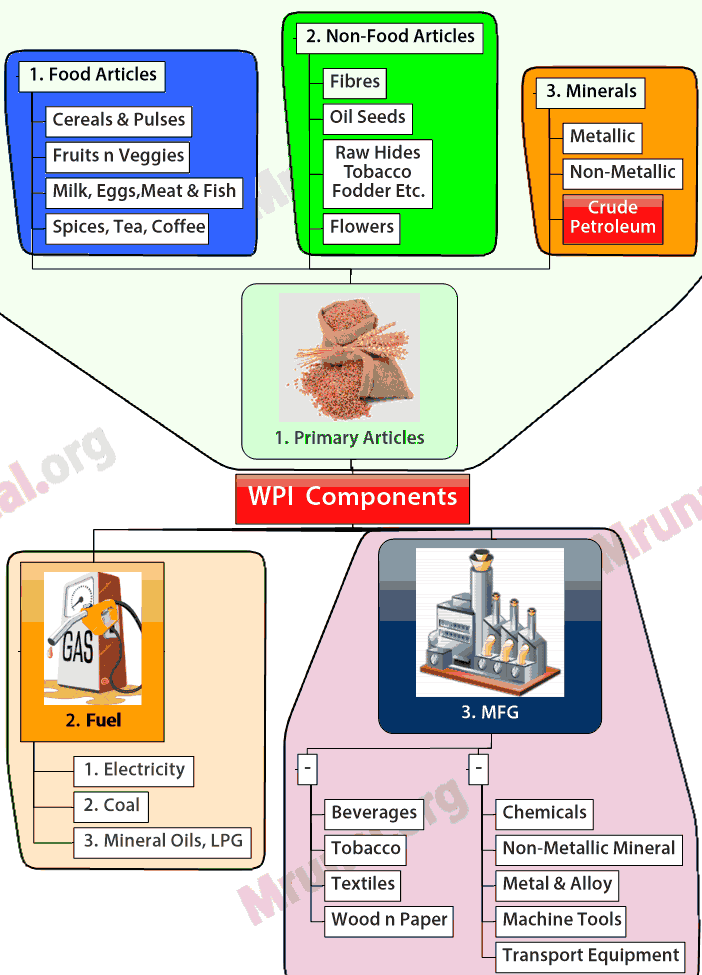
What is Headline inflation WPI?
- Number we get from all components viz. primary, fuel and mfg.
What is Core inflation WPI?
- core means, we should ignore food and fuel part.
- So, core inflation = Only WPI of Non-food manufacturing industries.
- Headline WPI – (primary + fuel + food mfg. industries)
#2: CPI components of Consumer Price Index

- CSO calculates using Lespeyer’s formula, Base year 2010
- Five category of items. I’ve arranged them in descending order of WEIGHT (Combined All India)
| CPI components | Rural | Urban | Combined |
|---|---|---|---|
| Food, beverages, tobacco | 59.31 | 37.15 | 49.71 |
| Misc.Health edu etc. | 24.91 | 28 | 26.31 |
| Housing | NA | 22.53 | 9.77 |
| Fuel, light | 10.42 | 8.4 | 9.49 |
| Clothing,bedding,footwear | 5.36 | 3.91 | 4.73 |
| Total | 100 | 100 | 100 |
Mind it: Rural CPI doesn’t consider Housing inflation.

| Ranking | within that highest weightage given to |
| food, bev., tobacco | Cereal > Milk >Veggies > …..Sugar (lowest) |
| Fuel and light | no subgroup |
| clothing, bedding, footware | (Clothing-bedding) > Footware |
| Housing | No subgroup. |
| Misc. | Transport > Medcare > Household requisites>…>Recreation (lowest) |
What is Headline CPI inflation?
The number you get from combined data of above categories.
What is Core CPI inflation?
Core CPI =Headline CPI MINUS (food and fuel components.)
Consumer Food Price Index (CFPI)
- By the same good folks who calculate CPI (=CSO-walla)
- Using same Laspeyre formula
- Using same base year: 2010
- If total weight of CPI = 100, then Food price index = ~52% of its weight
| Components | Rural | Urban | Combined |
|---|---|---|---|
| Cereals and products | 36.71 | 28.51 | 34.16 |
| Milk and products | 16.53 | 21.59 | 18.1 |
| Vegetables | 12.64 | 12.93 | 12.74 |
| Oils and fats | 8.98 | 9.44 | 9.13 |
| Egg, fish and meat | 6.5 | 7.38 | 6.77 |
| Pulses and products | 6.25 | 6.11 | 6.2 |
| Sugar etc. | 4.64 | 4.11 | 4.47 |
| Fruits | 3.65 | 6.14 | 4.43 |
| Condiments and spices | 4.1 | 3.79 | 4 |
| Total | 100 | 100 | 100 |
So far we are done with components of WPI, CPI and food inflation. Moving on
#3: IIP: Sectorwise Components?

| sector | weight | items | itemgroups |
|---|---|---|---|
| Manufacturing | 755.27 | 620 | 397 |
| Mining | 141.57 | 61 | 1 |
| Electricity | 103.16 | 1 | 1 |
| total | 1000 | 682 | 399 |
- Mind it: Total weight is 1000. So, if you want percentage weight, then shift decimal one point to left.
- For example: manufacturing weight = 75.5%
IIP : Goods-wise Components?
IIP data released in two formats
- Sector wise: Mining, mfg, electricity (that we just saw above.)
- Goods category wise using the same components as above, but data presented for goods category wise….as shown below.
| Basic Goods | Any bulk raw material/product used in manufacture. High Speed Diesel, Aviation Fuel, Kerosene, Urea, Cement all kinds, Granites, iron, copper and Electricity |
| Capital Goods | Plants, machinery and goods used for further investments. Boilers, compressors, engines, Transformers, Commercial Vehicles and all machineries like Textile Machinery, Printing Machinery etc. |
| Intermediate Goods | used for manufacturing of another product. Cotton yarn, Plywood, Adhesives, Aluminum and steel pipes etc. |
| Consumer durable | can be used for more than 2/3 years). Pressure Cooker, AC, tyre, Tv, mobile, automobile, Gems and Jewelry etc. |
| Consumer non-durable | can’t be used for long periods. Fruit Pulp, edible oil, milk powder, tea, Cigarettes, Apparels, Newspapers, Antibiotics etc. |
| IIP | Weight |
|---|---|
| Basic Goods | 456.82 |
| Consumer non-durable | 213.47 |
| Intermediate Goods | 156.86 |
| Capital Goods | 88.25 |
| Consumer durable | 84.6 |
| total weight | 1000 |
IIP-8 core industries
- Within IIP, following 8 are core industries because they’ve impact on almost all other economic activities:
- Coal, fertilizer, electricity, crude oil, natural gas, refinery products, steel, and cement.
IIP- Deflation
- IIP is a quantitative index, the productions of items are being expressed in physical terms.
- But for some items, the information is received in “Value” term rather than quantity or volume.
- So, CSO uses WPI as a deflator to convert that “price” into “volume”.
[Act 4] WHY REVISE WPI, CPI, IIP series?
Now time for a “FLASHBACK” in this movie
| index | new series effective from |
|---|---|
| CPI | 2011, January |
| WPI | 2010, September |
| IIP | 2011, June |
So if these are the new series we talked about then what was the system before that?
Revision of Wholesale Price Index (WPI)
The WPI series has to be revised often, because of two reasons:
#1: base year
- Inflation is a “relative” concept. When we say there is inflation – it means things used to be cheaper at some previous year.
- So, to calculate WPI, we need a base year. Base year should be revised once in a while.
#2: product mix
- WPI calculates inflation using Laspeyres formula for weighted arithmetic mean.
- But this formula fails to capture the dynamic changes in product mix and structure of the economy over time.
- For example, 15 years ago, price of VCR and magnetic tape cassettes would have mattered. But no one uses them anymore.
- Same way, 15 years ago, people did not buy that much moisturizer creams and perfumes.
- Hence we’ve to keep changing the components.
| BEFORE | AFTER Sen Committee, WPI reform |
|---|---|
| — | New system Started from 2010, Sep |
| Base year 1993 | 2004 |
| 435 items | 676 |
| — | Increased no. of price quotations |
| — |
|
| — | Added new items. |
WPI: New items added:
List not exhaustive
Primary articles
- Lemon, Gaur Seed, Rose, Jasmine, Marigold
- Crude petroleum, Copper Ore, Zinc Concentrate
Manufactured items
- Computer Stationery, UPS, SMPS, VCD player
- Dish Antenna, Fibre Optic Cable
- Perfume, Scent Cream, Moisturizer, Body Powder
- Leather Gloves, jackets, garments, bags
- Football, Toothbrush
Saumitra Chaudhuri Committee on WPI
| Current WPI | Saumitra recommends |
|---|---|
| 676 items | ~1200 items. |
| 11 vegetables | 17 |
| — | Expected to be operational from next year |
| — | Collect prices from more centres, to get better estimate. |
| — | Reduce weight of primary food items. Increase weight of mfg. items |
| Base year 2004 | 2009, And then to 2011 |
Enough of WPI, moving on
Revision of Consumer price index series (CPI)
| PROLEM Before | SOLUTION After |
|---|---|
| — | Started from 2011, January |
| — | base year 2010 |
Specific groups only.(Baseyear in bracket)
Problem= doesn’t give “whole” picture |
|
| Item list designed based on NSSO’s 2004 survey. In future, CPI will be revised using NSSO’s 2011 survey. |
Mind it: this doesn’t mean they no longer calculate CPI for industrial workers; Agro & rural laborers. They still do it.
Revision of Industrial Index production (IIP)
- Each IIP item should have certain minimum contribution to national production.
- For example VCR industry’s contribution in Today’s economy = 0%
- Therefore, need to update list with based on technological changes, economic reforms and consumption patterns of the people.
| IIP Before | IIP After |
|---|---|
| — | C.P. Chandrasekhar Committee |
| Base year: 1993 | 2004 |
| Added new items: Apparels, Gems and Jewellery, Newspapers, pasteurised Milk, Writing & Printing Paper, Ayurvedic Medicaments, Woollen Carpets, Wood Furniture, Terry Towel, Coir Mats & Mattings, Polythene Bags, Instant Food Mixes, Fruit Pulp etc. | |
| Information source agencies: 15 | 16.
|
| NIC-1987 | Items used from National Industrial Classification (NIC)-2004 |
| — |
|
Comparison: WPI, CPI, IIP
| QUESTION | WPI | CPI | IIP |
|---|---|---|---|
| HOW? | Lespeyre’s formula | same | same |
| WHO? | Economic advisor | CSO | CSO |
| WHEN? | weekly & monthly | monthly | monthly |
| WHERE they get data? | ministries, dept., industries | NSSO and Postal workers | ministries, dept, bodies |
| Components | 3: MFG > Primary > Fuel | 5 categories | 3: MFG > Mining >electricity |
| types | only one WPI | Rural, urban, combined | Sector wise and goods Usage wise. |
| items | 676 | 682 | |
| base year | 2004 | 2010 | 2004 |
| CORE | non-food manufacturing | headline – (food+fuel) | 8 industries |
[Act 5] WHY WPI, CPI, IIP important?
Yes, why bother calculating WPI, CPI and IIP in the first place!?
Why is WPI important?
Monitors the dynamic movement of prices.
| Who | Why they use WPI? |
| Government | To design trade, fiscal and other economic policies |
| RBI | To design monetary policy, under Multiple indicator method: RBI used WPI. (But Rajan started using CPI for this purpose, since April 2014, on Urjit patel recommendation. |
| Businessmen | In the business contract- to calculate price escalation clauses in the supply of raw materials, machinery and construction work. |
Why CPI important?
Measures the price of goods that households consume.
| Government |
|
| RBI |
|
| Businessmen | Calculating Dearness Allowance |
Why IIP important?
- The IIP measures volume changes in the production of an economy
- Provides a measurement that is free of influences of price changes
- Data used in Government policy planning purposes, Industrial Associations, Research Institutes and Academicians.
[Act 6] Other indexes
Service performance indices (SPI)
| Index | Does it cover service sector inflation? |
| WPI | Nope |
| CPI | Partially e.g. education, healthcare |
| IIP |
|
- Anyways, Economic Advisor started services price indices (SPI). (recall he also does the WPI).
- On experimental basis.
- To capture inflation in following service sectors:
| Railways SPIs | freight and passenger services |
| Banking SPIs |
|
| Postal SPIs |
|
| Telecom SPIs | only for cellular services on the basis TRAI report. Quarterly basis. |
All of them use same Laspeyre’s formula.
Baltic Dry index
- London based Baltic Exchange, releases this index number on daily basis.
- Measures cost to transport raw materials by sea.
| If Baltic number | meaning |
|---|---|
| Increases |
|
| Decreases |
|
Producer Price Index (PPI)
- measures price change from the perspective of the seller.
- i.e. average change in selling prices received by domestic producers for their output.
- Covers both goods + services. (WPI only covers goods)
- Sellers’ and purchasers’ prices differ due to government subsidies, taxes and distribution costs. Therefore, better to use PPI. Bcoz CPI doesn’t cover this.
- Majority of the OECD countries measure inflation based on Producer Price Index (PPI)
- WPI has been replaced in most countries by Producer Price Index (PPI) due to the broader coverage provided by the PPI in terms of products and industries
- PPI has more concordance with system the national account. (compared to WPI)
- Therefore, Office of the Economic Adviser (OEA) has taken up the initiative for constructing a Producer Price Index (PPI) for India.
Some notable countries
- Ireland uses BOTH WPI and PPI
| Only WPI | Only PPI |
|---|---|
| Japan, Australia, Greece, Norway and Turkey | Canada, USA , Aussies, S.Korea, UK, Spain, Italy |
Some more indexes
| RBI |
|
| OBICUS |
|
| ASI |
|
| HSBC |
|
| NEER|REER |
|
[Act 7] Laspeyre’s formula
Not for prelims. But when they want to begin “STRESS” interview particularly during bank/MBA.
- Laspeyre was a German economist .
- His formula used in calculation of WPI, CPI, IIP, service price indices.
- It is a Weighted arithmetic mean.
Let’s understand with a crude example.
- Suppose a local thug’s “INFLATION” index uses following format, with 2004 as base year.
- He can only decide the base year and weights assigned to each components on his own. Condition: he should distribute the weight in such manner that total weight is 10, 100, 1000- that way % calculation is easier.
- After that, monetary policies, fiscal policies and market forces will determine the prices in base year and current year. He just has to apply formula.
So, excel data looks like this:
| Components | weight | 2004 prices | 2014 prices |
|---|---|---|---|
| Desi liquor | 10 | Rs. 10 | Rs. 15 |
| Gutkha | 20 | Rs. 2 | Rs. 5 |
| Cinema | 70 | Rs. 50 | Rs. 75 |
| Weight | 100 |
First, I’ll find relative price (Current prices divided by BASE year’s prices)
| Components | weight | 2004 prices | 2014 prices | R |
|---|---|---|---|---|
| Desi liquor | 10 | Rs. 10 | Rs. 15 | 1.5 |
| Gutkha | 20 | Rs. 2 | Rs. 5 | 2.5 |
| Cinema | 70 | Rs. 50 | Rs. 75 | 1.5 |
Now I’ll multiply Relative price with weight assigned to each components
| Components | weight | 2004 prices | 2014 prices | R | RxW |
|---|---|---|---|---|---|
| Desi liquor | 10 | Rs. 10 | Rs. 15 | 1.5 | 15 |
| Gutkha | 20 | Rs. 2 | Rs. 5 | 2.5 | 50 |
| Cinema | 70 | Rs. 50 | Rs. 75 | 1.5 | 105 |
| Total | 100 | 170 |
- Finally, the addition of RXW will me index number for current year. 15+50+105=170.
- That means Current inflation in 2014, is 70%, compared to the prices in base year 2004.
- In 2015, If I get the number 180=80% inflation than base year (2004)
- But compared to 2014, the 2015’s year on inflation would be (180-170)/170=~6%.
Statistically we can express with this formula:

Note: some books use P0/Q0, it’s basically the same. Because they take “weight” as = (p x q).
| Paasche index | Tells us what today’s “Basket” of commodities, would have cost @yesterday’s price. |
| Fisher index | Geometric mean of (Laspeyrese and Passche). This solve the problem of “substitution bias” in consumer Expenditure. |
![[Win23] Economy Pill4ABC: Sectors: Agri, Mfg, Services, EoD, IPR related annual current updates for UPSC by Mrunal Patel](https://mrunal.org/wp-content/uploads/2023/04/win234b-500x383.jpeg)
@sakshi
final interpretor of constitution of India is Supreme court
our constitution is rigid when it comes to provisions which require passing with special majority and with assent of not less than half of the states and is not rigid for provisions which require simple majority
any govt which looses he confidence of house has to resign , any govt while forming has to have the majoriity of house , no concept of minority govt as such….and that particularly means that while passing the bills like money bill or confidence or no confidence motion you have to have the support of majority else you need to resign
AGAR PRELIMS NAI NIKALA 24 ko jo hai………toh Gharwaale ghar se bahar nikaal denge………
i am nt trying to sound like “dukhi aatma” ………but kya karu saala
all the best to u
u r IN with 15+marks above cut off
Thank you for compiling all the relevant indexes under a single head. Great revision material.
But in case of hung parliament also the governor has to choose CM as per punchi commission recommendation
Amendability of any constitution,while an important marker of the type of the constitution(rigid/flexible)is at the same time a relative concept.There are no clear or rigid definitions and it is more of a spectrum.
The level of flexibility is essentially determined by the type of majority needed to ratify any amendment.For example,in the Indian constitution,we broadly have three types of majorities: Simple,Special and Special Majority with ratification of states.The Indian constitution is rigid when it comes to amending the areas which shall affect the state.For example,if the seventh schedule is to be amended(it contains the union,state and concurrent lists),then along with a special majority,ratification by half of the states is needed.If i were to give an example consider the recent NJAC bill.It deals with the appointments of higher judiciary(implying SC as well as HC judges,hence affecting the states as well).The act has been passes by the Lok Sabha and the Rajya Sabha,it will now go for ratification from the states and if half of the states ratify,it shall go for President’s assent and finally become an Act.
When we consider the US constitution(where all amendments require ratification by three-fourth of the states),we can appreciate what is meant when we say flexibility.It is a result of this provision that till date the US constitution has been amended only 33 times,while Indian constitution,comparatively much younger,has already been amended 99 times. On the other end of the spectrum is UK,where a unique history of constitutional development has led to amendments by simple majority only.
PS:please correct me if any argument(s) is flawed.
But compared to 2014, the 2015′s year on inflation would be (180-170)/170=~6%………………pls can anybody can explain this that how to calculate one year inflation?????? ye 6% kaise aaya??????
Hi Mrunal Sir Ji,
Please Help us to undrstand the Indian insurance sector,please provide a separate article for it.
Thanks
Ok, random question if Mrunal ever happens to read this – since there is so much talk about taxing cigarettes more, what is the point of including tobacco in the group with the highest weightage in CPI? Why can’t it be removed or at least given less weightage in the calculations? It doesn’t make sense to have policy on one hand to make cigarettes more expensive and on the other to target cutting down inflation in which cigarette prices play a significant role, no?
Ok because cpi follow the retail inflation…snd presently there are over 200 million people consuming smokeless tobacco and over 100 million people are smoking it in some form…thus a large chunk if population do include it in their spending pattern….so it id there…the dame way when they remove those thing which are no more utilised on large scale like transistors etc.
Sir, under ACT 2[WHEN] part, weekly WIP has been discontinued. Am I missing something ?
Also, i had a question? In the relation between inflation and exchange rate, which one is the cause and which one is the consequence ?Thanks.
NOW THE Q IS WHICH INDEX TO USE ? ? ?
1. WPI is useful in certain context
– The cost of setting up of factory over the several years, & further to calculate cost of production & returns over several years, the basket under CPI does not include machinery, chemicals and so on
– Secondly the price of electricity in CPI is consumer tariff not industrial tariff
– data on WPI is available every week while the data on CPI is available monthly, so there is time lag in data availability for CPI compared with WPI data availability which makes the impact on RBI as well as govt decision making
-There are so many CPI – CPI for Industrial worker[CPI-IW], Agricultural laborer[CPI-AL], Rural laborer [CPI-RL], unnecessary confusion. even doesn’t make sense for the decision making of RBI & GOVT.
i like ur explanations which are cut by you. like they are busy in uploading profile pic…etc… though your reasons and explanations are wonderful.. we like it…keep posted and educating
Hi
I read ur article. It was very nice. I would like to ask if you could help me understand whether the measures used in india e CPI and WPI are correct ?
For example the price of onion last year was 15 and now upto 25, but inflation says only 6 to 7% increase–if u can justufy this i would really appreciate . Looking forward for ur reply asap
Sir,
Please put your lecture(economy) in english bcoz we are southern states not aware of hindi.
Mrunal Sir …Please answer
What is correct about headline inflation in India
1. It is measures at wholesale as well as consumer prices
2. We see enough diversities among the Indian consumers ,that is why we have 4 varient of the inflation index at the consumer price.
3.The concept was 1st introduce by C Rangarajan in the late 80’s
Your Options
a) only 1
b) 1 and 2
c) only 3
d) none
Please explain also
It is 1 and 2 onlt
THANKYOU , IT IS VERY EASY TO UNDERSTAND
If Question comes Inflation is calculated in India by CPI or WPI? Answer should be CPI(April 2014)
stuff is good especially for last min prep but wd appreciate if the author showed a wee bit more class and and addressed officials with proper salutations, I mean Rajan! come on a Mr or Dr or Governor wd be much better.
mrunal sir pls tell me if i can’t read THE HINDU then which current affairs book i need to purchase for UPSC level?????
Mrunal Bhai can i fully depend on your all 69 videos and PPTs of Economics .??
Thank You Sir…
For all the efforts you put into to make some stranger’s dream come true… Every single day you do selfless work for we people.
Thank you sir from the bottom of my heart!!! May you always be happy Sir :)
Mrunal Sir, The new CPI is calculated using geometric mean, acc to http://pib.nic.in/newsite/PrintRelease.aspx?relid=115396 (Appendix A, point (e) in the end) , So it means, the Fischer index is being used now?
thank you very much sir
thank u sir
Sir..what about prelims 2016
where is mrunal’s acedmy
Thanks
This is so helpful
Hello, the CPI base year has been changed to 2012. What about the other, like WPI?
2005
Thanks a lot sir… :)
very much helpful…..thank u
Little update
Cpi base year 2012
Wpi base year 2011-12
iip base year 2004_05
Sir WPI base year is currently 2004-05. Feb 2017 WPI Is 6.55%.