
- Introduction
- #1: Getting the conceptual clarity
- Breakup: SSC-CGL Tier I (2010, 2011, 2012)
- Breakup: SSC-CGL Tier II (2010, 2011, 2012)
- #2: Practice
- Choice of Quantitative Aptitude Book?
- Books for Maths/Quantitative Aptitude
- Download: NCERT Maths Textbooks
- Download: Blank answersheet
introduction
Competitive exams are meant for real-men and women. This is no country for crybabies, kids, college teens and no0bs. So first of all, you must get rid of the following “loser” mindsets:
- Yaar this maths is so hard, I can’t do it.
- I’m not from science/engineering background hence this is not my cup of tea.
- I’m poor in maths and I cannot improve.
- Thik hai, dekh lenge. (alright, I’ll see).
- Maths is not difficult. All it requires is concept clarity + lot of practice. In SSC-CGL exam, you’ve to face Mathematics at two stages
| Stage | Maths-Questions | Penalty |
| Tier-I (Prelims) | 50 Qs | Negative 0.25 |
| Tier-II (Mains) Paper I: Arithmetical Ability | 100 Qs worth 200 marks | Negative 0.50 |
- The Approach for Maths, stands on two pillars.
Pillars |
How? |
|
|
|
|
#1: Getting the conceptual clarity
- We’ll divide Maths or Quantitative Aptitude, into topics and further into subtopics.
- Your task is to cover one topic at a time, first get conceptual-clarity and then solve maximum questions at home.
- Whenever you learn any shortcut technique, you note it down in your diary.
- Similarly, whenever you make any mistake while solving sums, you also note that down in your diary. Night before the exam, you review that diary of mistakes. (why do this? Because it is the “Art of Aptitude” (Click ME)
| Topic | Subtopics | How to approach |
Number theory |
|
|
Basic Maths |
|
|
|
|
|
|
|
|
Algebra |
|
|
|
|
|
Avg and Ratios |
|
Can be solved without formula. Go through https://mrunal.org/2012/03/aptitude-alligationsmixturesalloys.html |
|
Lolz | |
|
For ratio-proportion NCERT Class 8 Chap 13. | |
|
https://mrunal.org/2012/05/aptitude-partnership-and-profit-sharing.html | |
STD |
|
All of them can be solved with just one Universal STD formula. Explained in www.Mrunal.org/aptitude |
Geometry |
|
|
|
|
|
|
Understand basics from NCERT Class 10 Chap 8 and 9. Then exam-oriented concepts from your Quantitative Aptitude book. | |
% |
|
Also do NCERT Class 8 Chap 8. |
|
Mere extention of % concept. Just practice. For long division, use this approximation method: https://mrunal.org/2012/11/aptitude-long-division-two-digit-division-calculation-without-tears-and-without-boring-vedic-speed-maths.html |
|
| Profit, loss, discount, marked price. | https://mrunal.org/2012/11/aptitude-concepts-of-marked-price-and-successive-discounts-profit-loss-without-stupid-formulas.html | |
| Simple and compound interest rate | https://mrunal.org/2012/04/aptitude-compound-interest-rate.html | |
PCP |
|
|
Misc. |
|
|
|
|
|
|
Not asked. |
Breakup: SSC-CGL Tier I (2010, 2011, 2012)
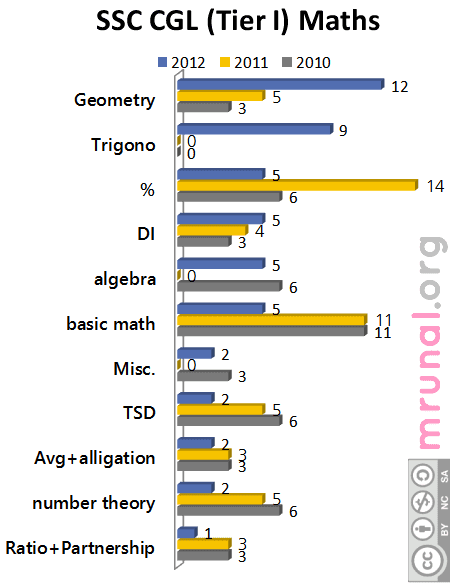
| Topic | 2010 | 2011 | 2012 |
|---|---|---|---|
| Ratio+Partnership | 3 | 3 | 1 |
| number theory | 6 | 5 | 2 |
| Avg+alligation | 3 | 3 | 2 |
| TSD | 6 | 5 | 2 |
| Misc. | 3 | 0 | 2 |
| basic math | 11 | 11 | 5 |
| algebra | 6 | 0 | 5 |
| DI | 3 | 4 | 5 |
| % | 6 | 14 | 5 |
| Trigonometry | 0 | 0 | 9 |
| Geometry | 3 | 5 | 12 |
| Total | 50 | 50 | 50 |
The 2012’s Tier-I paper, is “trend-breaker”. Because
- The conventional questions from ratio-proportion, basic maths, time-speed-work are asked for namesake only.
- Otherwise, Out of 50 Maths questions in tier-I, almost 30 questions are from just Geometry+Trig+Percentage application.
- Earlier, they used to ask mostly area-volume-perimeter type questions from Geometry segment. You just had to plug-in values into the formulas and get the answer.
- But This 2012’s paper has mostly theory based geometry (angle, bisector, tangent, inequality of triangles etc.)
- Similarly the difficulty level of algebra, number theory based questions is bit raised.
Or perhaps SSC too decided to employ the BackbreakingTM move of UPSC! Anyways, jokes apart, the lesson here is, “adapt.”
Breakup: SSC-CGL Tier II (2010, 2011, 2012)
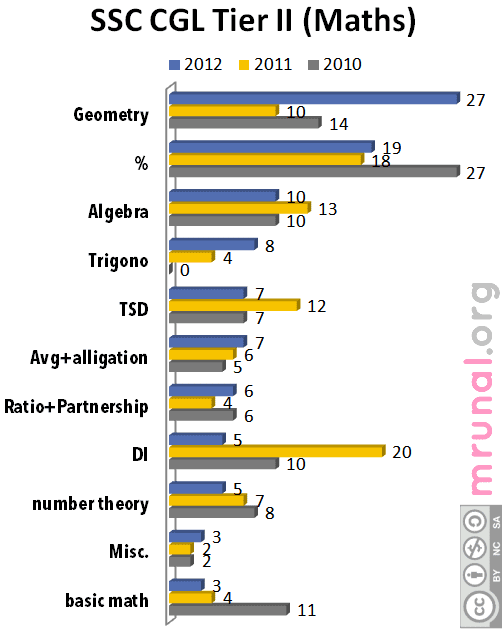
| Type | 2010 | 2011 | 2012 |
|---|---|---|---|
| basic math | 11 | 4 | 3 |
| Misc. | 2 | 2 | 3 |
| number theory | 8 | 7 | 5 |
| DI | 10 | 20 | 5 |
| Ratio+Partnership | 6 | 4 | 6 |
| Avg+alligation | 5 | 6 | 7 |
| TSD | 7 | 12 | 7 |
| Trigonometry | 0 | 4 | 8 |
| Algebra | 10 | 13 | 10 |
| % | 27 | 18 | 19 |
| Geometry | 14 | 10 | 27 |
| Total | 100 | 100 | 100 |
- Here too, Geometry+Trigonometry have been given emphasis like never before.
- Almost 65% of the paper is made up of Geometry, Trig, Percentage and Algebra (and in that too, mostly Quadratic equations.)
#2: Practice
- Merely knowing the concepts or formulas won’t help. Because unless you practice different variety of questions, you won’t become proficient in applying those concepts flawlessly in the actual-exam.
- Second, despite knowing concept and formulas, people make silly mistakes either in calculation or in pluging the values.
- Third reason- Tier I has 200 questions in 120 limits. =not even 2 minutes per question. Plus, questions reasoning and comprehension might take more than 5 minutes! Therefore speed is essential. Since there is negative marking system, accuracy also matters.
- So it is beyond doubt that you have to practice excimer number of questions at home.
- The question is where to get the practice? Which book should be used for SSC exam?
Choice of Quantitative Aptitude Book?
- In all competitive exams, “uncertainity factor” is involved. Despite your best preparation, you might lose the success-train by 2-3 marks.
- Therefore you must never put all eggs in one basket.
- While you are preparing for SSC, you should also keep open mind and apply for other competitive exams, such as IBPS, ACIO, ONGC, Railways, LIC, CDS, Coast Guard etc. (Depending on your career-taste).
- Publication houses will come up with new books for each and every of ^these exams, but we have neither the time nor the money to buy a new book for every new exam.
- Such readymade books are only skimmed down version of original topicbooks. For example, if there is SSC-FCI exam, or ACIO exam, these people will combine a few topics of GK, maths, reasoning and english. And present you a book.
- Problem= you don’t get comprehensive understanding or coverage. Besides, given the population of India, competition level is always high, irrespective of exam. So half-hearted preparations with readymade “condensed” books don’t help much.
Almost all of these exams follow same structure:
- General awareness
- Maths
- Reasoning (Verbal, Non-Verbal)
- English vocabularly, grammar and comprehension.
- How do they differ from each other?= number of questions, difficulty level and inclusion / exclusion of particular subtopics.
- So when you’re picking up books for the first time, you should choose the books, that have universal usefulness for similar exams. That way your time, effort and money will be saved.
Books for Maths/Quantitative Aptitude
DONOT use Quantitative Aptitude by R.S.Agarwal for SSC-CGL.
Problems with RS Agarwal’s Math book:
- The way SSC-CGL question pattern is transforming, R.S.Agarwal’s book on Quantitative aptitude, is just not ‘upto the mark’ to match this changing environment.
- Its chapter on Trigonometry (Height and Distance) is simply insufficient to handle SSC-CGL level bombarding.
- Similarly coverage of algebra, quadratic equations and number theory is either absent or just for namesake.
- Geometry coverage is mostly confined to area-volume-perimeter (=mensuration). But SSC-CGL is moving towards Non-mensuration geometry (angle, bisectors, midpoint, circles, triangles etc.)
- The printing and presentation is very “ cluttered”. He has written the book assuming that you were already good at maths from school level.
- If you’re already good at basic concepts, use this book for practicing and improving your speed, else don’t bother, there are better books in market.
Pricing factor
 |
Author |
Quantitative Aptitude For Competitive Examinations (S.Chand) |
R.S.Agarwal |
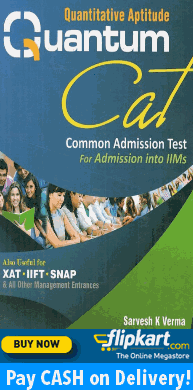
Quantum CAT (Arihant) |
Sarvesh Kumar |
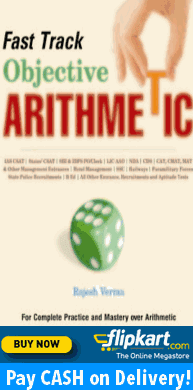
| Fast Track Objective Arithmetic (Arihant) | Rajesh Verma |
- The point is, both books of Arihant Publication (Sarvesh or Rajesh) are way better than R.S.Agarwal, in terms of content, presentation, language and coverage, without being too expensive than R.S.Agarwal’s book.
- And both of them have universal application for almost all of the competitive exams in India (for maths segment).
- My advice, go with either Rajesh Verma or Sarvesh Kumar. Then the question, which one to pick up?
Fast Track Objective Arithmetic by Rajesh Verma.
|
Quantam CAT by Sarvesh Kumar
|
|
|
|
|
^But merely getting either of these books, is not going to make you a topper.
If you want to become truly “invincible” for the maths portion of any competitive exam, then you must practice maximum numbers of questions at home and maintain a “diary of mistakes”.
This concludes how to approach Mathematics/Quantiative Aptitude for SSC-CGL exam.
Now only two topics remain (will be discussed later, in separate articles):
- How to approach Logical Reasoning
- How to approach English vocabulary, grammar and comprehension
Download: NCERT Maths Textbooks
Mrunal.org/download
Download: Blank answersheet
https://docs.google.com/open?id=0B9AJvFSzIyiwVGZBbHMtUWEwV2M
Studyplans for other topics of SSC-CGL
Click on following articles to know strategy, booklist for General Awareness, Reasoning and English.
| General Awareness for Tier I | Click me |
| Reasoning / General Intelligence for Tier I | Click me |
| English Grammar, Vocabulary, Comprehension for Tier I and II | Click me |
![[SSC] CGL 2014 Tier-2 Result, Cutoff, Answerkeys out, Interviews to begin in June, Tips for Typing Test](https://mrunal.org/wp-content/uploads/2015/05/c-t2-result-500x383.jpg)

![[Download] SSC Question Papers 2014 Tier 1: Both 19th & 26th October with Official ANSWERKEYS & UP-RO, CPO, T2-Stats](https://mrunal.org/wp-content/uploads/2014/10/Cover-SSC-2014-T1-Papers-500x383.jpg)
hi sir. in ssc cgl tier1 what is the procedure for cutoff, will the each section has cutoff marks like bank exams or over all paper has cuttoff marks, y because im poor in english vocabulary, if i get much less in english n if i get good score in other sections. will i get qualifed or not??? plz give reply sir.
Need help in evaluating the books
I see Arihant boook is good but there are so many mistakes reg the printing and formulae.
what’s your opinion on AAhijit Guha Aptitude book ?
PLEASE SUGGESTION FOR SSC TIER 2 MATHES
Best books for advanced maths for ssc tier I and tier II.
math very simple sulotion
how i prepared g.k???
do not go deeply only lucent is enough its my personal experience
give suggestion for nic ao scale1 prepration
Hello sir, pl suggest for gk lucent is enough or any other book have to refer Alsop suggest for current affairs which materials through I have go
How to prepare for ssc cgl to crack with best marks
Sir for math tier 2 suggest sarvesh kumar or rajesh verma …..plz just best among these…
Regards
sir plz give the detail analysis of gs portions of all 12 sets of ssc-cgl 2014.
Hi Mrunal sir,
Please can you lay some light on the post of statistical investigator including studyplan, role and strategies. Please help !!!
Bhai bekaar job hai.. Hectic. field Job.. that’s why cut off is always low comparable to others..
WHEN IS THE TIER2 EXAM OF SSC
AND WHEN WILL THE RESULT COME OF TIER1
I am preparing for cgl tier 2 exam what are the books can prepare for ? can u help me?
sir can i buy sscportal.in study kit which is 3500 rs is it worth sir and they are giving add that 148 questions are asked from their bokk in 2013……..please reply me
Dear Sir ,
How can I collect freedom foghter’s Slogan or Quotes which said by any economist, and leaders for constitution, parliamentry and other Please provide me as soon as Possible I am preparing for CGL 2015 only following your site always After that I will prepare for Civil Service so My First & last option in CGL will be CSS . So please suggest me about it…. and Sir I am regular follower of yours….
I have cleared SSC CGL Tier I – 2014. Now I am going to appear for TIER II in the end of next month (April). I would like to concentrate more on Qapp. Should I give preference for Geo+Percentage+Algebra(Quad)+Trig. For current affairs, should I go through from Jan 2014. And for Eng.. comprehension and reasoning….???? Luckily, I have passed Tier I. I don’t know what to do now. Plz….. help me…..
Hi please tell me which book is better from rajesh n sarvesh k verma for specially trigo, algebra and mensuration as i week in these chapters so pls suggest me the best one out of two
Sir please update the question analyse for 2013 tire 1& 2) and 2014 (tire 1).
good website for all competitive exams
Sir I am a hindi medium student and preparing for ssc -cgl 2015.sir plz suggest me which book should I bought for maths section.
does anybody know when will ssc-cgl notification will come ? they said on 14 march but it is not out till now…notification mein he itte dheele h paper aur result mein toh jaane kya he hoga..!!
ssc got mad…its annual exam calender is fake dont trust on it…
Refering Quantom Cat… . Good Book for those who are beginners and also for them who already good in maths. More examples more practice.. If you have good book other than Quantom cat , please let me know.
Is ssc cgl 2015 notification out?
Hey I am qualified for paper3 of tier2 but I dont want to give this paper as I have not prepared for it. Can I skip it without getting disqualified for other 2 paper ? Or if I give & dont pass paper 3 then would it affect my clearing exam based on just 2 paper?
plss sister gimme some tipss plzz plzz… unable to deal with alzebra n trigonometry …
yes must be becose after exam query your study
sir, i worked as a clerk in bank of baroda;i resigned my job due to personal problems; the mananagement has not accepted my resignation due to a charge sheet imposed against me which is pertained to my unauthorised absence. i am appearing for SSC-CGL 2015????WHETHER I INFORM MY PAST WORK EXPERIENCE IN APPLICATION FORM????? kindly reply???? hav my num vardhan.040@gmail.com,07842432862
10 Years ago, the average age of a family of 4 members was 24 years. Two children with age difference of 2 yr have been born in the family but average age of the family is same. The present age of the youngest child is.
10 Years before the average age the family with 4 members being 24 Years
10 Years before the total age of the family with 4 members being (24 x 4) 96 Years
10 years after the average age of the family with 6 member 24 Years
10 Years after the total age of the family with 6 members being (24 x 6) 144 Years
The difference of age being the age of the two new child that is (144-96) 48 Years
As the two child born with the age difference of 2 Years
so, we take the elder child with 2x and the younger child with x
and their sum being the total age that is 2x+x=48 Years
Now, 3x=48 Years
and ultimately x=48/3 that is 16 Years
So, the younger child being (x) that is 16 Years and the elder child being (2x)that is (16 x 2) 32 Years and the total being (16+32) 48 Years.
age difference of two years indicates that the ages are X and X+2… (X and 2X doesnt agree with the given condition of age difference of two years)
so, X+X+2=48
2X=46
X=23 (age of the younger one)
23 and 25 being the ages.. sum of ages is 48
Vey nice
Thank you very much .
for Math Discussion.
Plz send me more question & Short cut Method of Math.
this answer is wrong…. the correct answer will be – age of the youngest child is 3 years…
For ssc cgl plz tl me 1 book, m average in maths.
Quantum CAT (Arihant) Sarvesh Kumar
Fast Track Objective Arithmetic (Arihant) Rajesh Verma…
which one