
- China: Opium Wars, Boxer rebellion, Imperialism
- Japan: an imperialist Power
- Asia: South and South East
- Asia: Central and Western
- Mock Question
ok so far, We were looking @Class 10 (Old NCERT), “Story of civilization volume II”, Chapter 9, “Imperialism and Colonialism.”That chapter revolves around subtopics:
|
Already covered under previous article. click me |
|
|
|
Asia being covered in the present article. |
|
We’ll see them later in a separate articles. |
|
China: Opium Wars, Boxer rebellion, Imperialism
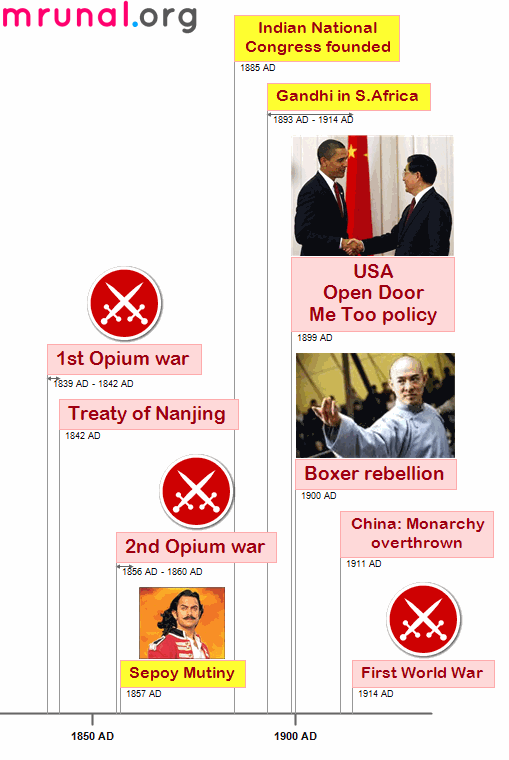
Semi-colonization of China
The opium Wars
- The imperialist domination of China begin with the opium Wars
- Before these opium Wars, only two Chinese ports were open to foreign traders.
- China was already a prosperous civilization that had invented paper, printing and gunpowder. There was no demand for British goods in China.
- So the British had to pay back in gold and silver for importing Chinese tea, silk, jade and porcelain.
- This Led to trade deficit for Britain (And recall the mercantilism policy– Europeans preferred export over imports. Wealth of a country was measured in gold and silver.)
- So, British merchant started smuggling opium from India into China on a large scale, to cover up for their cost of importing Chinese goods.
East India Company’s role opium trade
- In India, the British East India Company had established a monopoly on opium cultivation.
- But due to Chinese ban on opium, the East India Company did not carry the opium itself.
- Instead, they used “country traders”—i.e., private traders licensed by the company to take goods from India to China.
- The country traders sold the opium to smugglers along the Chinese coast for gold and silver.
- In China the East India company used the same gold and silver (from illegal opium trade) to purchase Chinese tea, silk and other goods, sold them in England @higher price=truckload of profit.
Thus, the illegal opium trade was profitable to British but it did immense physical and moral damage to the Chinese.
1st Opium war
Finally Chinese government officials seized an opium cargo and destroyed it. Britain declared war (first Opium war) and easily defeated the Chinese. Result?=>
The Treaty of Nanjing (Nanking)
According to this treaty of Nanjing
- China was forced to pay fines to British for war damages.
- Hong Kong was given to Britain
- China had to open five port cities to the British traders.
- Chinese government was no longer free to impose tariffs on the foreign goods
Extraterritorial rights clause
The British subjects in China were answerable only to British law, even in disputes with Chinese! (Recall similar issue in India- the Ilbert Bill.)
MFN (Most Favored nation clause)
Whenever any nation extracted a new privilege from China, that privilege was extended automatically to Britain!
2nd Opium War
Soon, England and France fought another war with China, on the pretext that a French missionary had been murdered. (2nd Opium war, aka Arrow war). Result?=>
Treaties of Tianjin
- Freedom of movement for Christian missionaries.
- residence in Beijing for foreign envoys
- the opening of several new ports to Western trade and residence
- right of foreign travel in the interior of China
- China was defeated again and was forced to grant even more privileges to the winners. By the end of 1860s, China had to open 14 ports to Foreigners.
1st Sino Japan War
- For centuries Korea was a tributary state of China.
- but Japan was trying increase her influence over Korea. Why?
- Korea is strategically located opposite the Japanese islands
- Korea’s natural resources of coal and iron
- This ultimately leads to War between Japan and China.
- Experts had believed that China would win, given its bigger military. But Japan won thanks to its adopted western military technology.
Result?=>
- China had to recognize Korea as an independent state.
- China had to give away Formosa, Taiwan and part of Southern Manchuria to Japan.
- China was forced to pay about $150 million to Japan for war damages.
Sphere of Influence
- Now, China had to pay war damages to Japan, but she did not have enough ca$h.
- So, France, Russia, Britain and Germany agreed to give loans to China.
- but in return, these Western countries divided China into “sphere of influence”
- Sphere of influence = each Western country had certain regions of China reserved exclusively for its purpose only. (Exclusive rights to build railway, mines etc. in that region).
- for example, Britain had exclusive rights over Yangtze valley, and only Russia had the right to build railoads in Manchuria.
- This division of China into spheres of influence has been often described as the “cutting of the Chinese melon”
United States: Me too Policy
- After the economic depression of the 1890s, USA needed foreign trade to boost its economy.
- In China, the American textile manufacturers had found markets for cheap cotton goods.
- But United States feared that China would be completely parceled out to France, Russia, Germany and Britain, because of those ‘spheres of influences’.
- Therefore United States suggested the policy known as “Open door policy” (also known as “me too policy.”)
According to this policy, all countries would have equal right to make trade anywhere in China.
- Britain supported United States in this policy, thinking that it would discourage the annexation of China by Japan or Russia. Because Japan and Russia could easily send their armies to Chinese mainland.
Boxer Rebellion
Chinese people was unhappy because of following:
- Economic Exploitation by Western powers.
- The extraterritorial right granted to foreigners
- China’s humiliating defeats in Opium wars and against Japan.
- Corruption, inefficiency of their own royal government.
- they resented the work of Christian missionaries, blaming them for harming traditional Chinese ceremonies and family relations; + missionaries pressured local officials to side with Christian converts in local lawsuits and property disputes.
This led to formation of a secret organization known as “Yihetuan” (Society of Righteousness and Harmony). The foreigners called them “Boxers”.
- Boxers blamed foreigners for all the ills in China. They started seizing /destroying properties of foreigners, Christian missionaries and Chinese converts.
- The movement took form of a violent rebellion.
- Although the Boxers were officially denounced, they were secretly supported by many of the royal court.
- British, French, Japanese, Russian, German, and Americans sent their troops to curb this rebellion. Ultimately the military might of western powers crushed the Chinese rebellion.
Result?=> Western powers got following:
- Fines from China for a period of 40 years
- More trade concessions
- Right to station their troops in Beijing.
Epilogue China
- After the failure of boxer rebellion, Imperialism continued with the cooperation from Chinese warlords.
- Foreign powers bought these military commanders by giving ‘loans’ and in exchange the warlords granted even more privileges to the foreign powers.
- Thus in a period of few decades, China had been reduced to a status of an international colony
- Although China was not conquered or occupied by any imperialist country, but the effect of these developments in China were same as any other areas which were formally colonized.
- although there are some fine differences:
India |
China |
| Colonization was Direct and absolute. | indirect control over the politics,economy and society without taking on the onus for ruling the country= semi-colonization. |
| Britain gained the monopoly of control over India. | no single imperial power had a monopoly of control. China was simultaneously exploited by many powers |
Japan: an imperialist Power
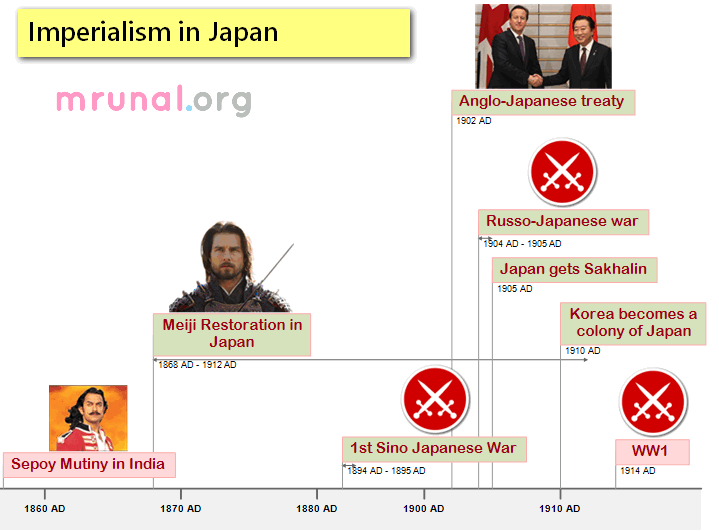
- In 1850s, United States sent warships under Commodore Perry, and forced the Japanese to open their country for the American shipping and trade. (this is known as “Gun-boat diplomacy”)
- later, Japan made similar agreements with Britain, Holland, France and Russia.
- But Japan itself became an Imperialist country after the Meiji Restoration.
Meiji Restoration
It was a political revolution under which the erstwhile Tokugawa shogunate (feudal-military government) was replaced with a new imperial government under the Emperor Meiji.
Japan adopted the slogan “wealthy country and strong arms” and sought to create a nation-state capable of standing equal among Western powers.
Following reforms were undertaken by Meiji government:
- Government shifted from Edo to Tokyo
- A national constitution, bicameral parliament (diet).
- Dismanted of the old feudal regime and introduced prefecture system of administration.
- Administration was centralized
- Modern civil service bureaucracy was setup.
- Modern banking and fiscal system.
- Modern industrial enterprises; railroad, telegraphs.
- Universal primary education
- Modern army and navy and adopted western military technology.
Thus, within a few decades, Japan became one of the most industrialized countries in the world.
But Japan has few raw materials to support her industries. So she also wants new lands for raw material and market for her finished goods. Result?=>
- Japan also started her imperialist expansion.
- China provided ample opportunities for Japan’s imperialist designs. We already saw how Japan defeated China in the first Sino-Japanese war.
Anglo-Japanese Alliance
- between Britain and Japan
- to assist one another in safeguarding their respective interests in China and Korea
- It was a cornerstone of British and Japanese policy in Asia until after World War I.
- How did Japan benefit from it?
- This alliance recognized Japan as a power of equal standing with great European powers.
- In the Russo-Japanese War, France (ally of Russia) did not intervene, fearing that Britain would intervene from Japan’s side. This helped Japan win the war.
Russo-Japanese War
- Recall under sphere of influence (in China), Russia was building railroads in Manchuria.
- But after first Sino-Japan war, China was defeated and it handed over certain parts of Southern Manchuria to Japan.
- Both Russia and Japan wanted to dominate Korea and Manchuria.=> ultimately, Russo-Japanese war. Russia is defeated. Result?=>
- President Theodore Roosevelt of the United States served as mediator between Russia and Japan and a peace treaty was signed.
- Russia handed over Port Arthur and the South Manchurian railroad (which led to Port Arthur) to Japan.
- Russia gave half of Sakhalin Island to Japan.
- Russia agreed to evacuate southern Manchuria
- Russia recognized Japan’s control of Korea (ultimately in 1910, Korea became a colony of Japan)
Japan: Epilogue
- Japan’s rise as an imperialist power shows that imperialism was not limited to any one region, religion or people.
- Imperialism was rather the result of greed for economic and political power which could distort the policy of any country regardless of its race, culture or religion.
- When first world war started, Japan could look back with some pride that she too had become a great power and could expand further at the cost of China if the Western powers would only allow her.
Now let’s briefly look over the colonization of other parts of…
Asia: South and South East
Asia: Central and Western
Both England and Russia wanted to control Central Asia, Iran, Afghanistan and Tibet.
2nd half of 19th Century: Russian annexed almost all of Central Asia.
Anglo Russian agreement (1907)
- between Russia and Britain
- on how to divide control of Iran, Afghanistan, and Tibet between them.
| Part | Under Anglo-Russian agreement |
| Iran |
|
| Afghanistan |
|
| Tibet | both retain and Russia agreed not to interfere in the affairs of Tibet |
let’s check individual countries
Afghanistan
- The British had a minor economic interest in Afghanistan, they were mainly worried about defending their crown jewel (India) against Russian expansion.
- Governor General Lord Auckland waged 1st Afghan war, to install a puppet regime in Afghanistan.
- With three Anglo-afghan wars, British learned that it is easy to overrun Afghanistan but very difficult of hold and occupy it permanently, because of tribal-rebellions.
- 1893: Durand Line
- between Afghanistan and British India,
- marking their respective spheres of influence;
- in modern times it has marked the border between Afghanistan and Pakistan.
- 1907: Anglo-Russian Agreement
- Russia agreed to recognize Afghanistan is being outside her influence.
- Britain agreed not to annex Afghanistan as long as Afghani ruler remained loyal to her.
Tibet
- 1907: both retain and Russia agreed not to interfere in the affairs of Tibet
- 1911: Chinese monarchy was overthrown and Tibet increasingly passed under British influence.
Iran/Persia
- for both Britain and Russia, independent Iran was a convenient buffer area between the their empires.
- Initially, both Russia and England setup banks in Iran to obtain economic control.
- 1907: England and Russia reached the “Anglo-Russian agreement” for controlling Iran via “sphere of influence”:
- North Iran= Russia; Southern Iran= Britain; central Iran was neutral and open to both.
- Thus, a joint Anglo – Russian supremacy was established over Iran.
- 1917: Russian Revolution established a new Soviet government.
- The new Soviet government denounced the old Anglo Russian agreements and gave up her rights in Iran.
- After the discovery of oil, the British and American oil interests became more powerful in Iran.
- While Iran remained nominally independent, but under the domination of foreign oil companies from United States and England.
Western Asia
- During these years, Germany was extending her influence over Turkey.
- A German company got concession to build a railway from Constantinople to Baghdad and the Persian Gulf.
- Through this railway, Germany wanted to promote her economic interests in the region onto Iran and India.
- France England and Russia opposed this, but an agreement was reached to divide the region among Germany, France and England.
- But First World War changed the situation.
- Germany and Turkey were defeated. The winners took away Germany’s colonial possessions. thus Germany as an imperialist nation was completely eliminated from race in Asia and other parts of the world.
|
They were under Turkish empire, but England and France took them away after winning first world war. |
- After discovery of Oil, the main objective of Imperialist countries = obtain oil and concessions to control oil resources in Western Asia. (Main players: America, Britain and France)
This concludes the colonial domination of Asia. Click on the following timeline to see how individual pieces fit together.
click to enlarge
Mock Question
- Briefly explain the cause and consequences of the following events (5 marks each)
- The Opium wars
- The Treaty of Nanjing
- The First Sino Japan War
- Boxer Rebellion
- The First Russo-Japanese war
- Write a note on following (5 marks each)
- Sphere of influence
- Open Door policy
- Gun-boat diplomacy
- Meiji restoration
- Anglo-Japanese Alliance
- Anglo-Russian agreement
- Analyse the factors responsible for the Boxer rebellion. 12m
- Write a note on the “cutting of the Chinese melon” by Western powers. Explain how Sino Japanese war helped them? 12m
- Rise of Japan as an imperialist country. 12m
- Describe the power-struggle between Russia and British in Iran and Afghanistan. 12m
- “Although China was not conquered or occupied by any imperialist country, but the effect of these developments in China were same as any other areas which were formally colonized.” Elaborate. 15m
- Whereas China with its incomparably greater human and material resources spent itself vainly in trying to expel ‘foreign devils,’ Japan, by embracing the West, not only retained its independence but became a world power in its own right. Comment 15m
- “Imperialism was the result of greed for economic and political power which could distort the policy of any country regardless of its race, culture or religion”. Comment. 15m
![[Art Culture] Ancient-Texts: Purana, Mahapuranas, Upapuranas, Characteristics](https://mrunal.org/wp-content/uploads/2022/12/CleanShot-2022-12-29-at-09.47.10-500x383.jpg)
![[Model Answer] GSM1-2017/Q4: World History- Decolonization problems in Malay Peninsula](https://mrunal.org/wp-content/uploads/2017/07/c-aoaw-danny-gama-maatin-500x383.jpg)
![[Answerkey] Prelim-2017: History, Culture, Indus Valley Horse, & Science-Technology with explanation for all four sets (A,B,C,D)](https://mrunal.org/wp-content/uploads/2017/06/c-ana-CSAT17-diwaane-500x383.jpg)
Simple and crystal clear ….
sir,
please write an article about the recent PRISM controversy and India’s CMS on cyber security.
Commendable job….
sir hindi medium walo k liye bhi kuch kijiye plz
sir to read world history from IGNOU its very vast..pls can u give the selective topics to read…and not only for world history,for the subjects you suggested to study from IGNOU,ps give the selective topics.
no coaching . .no money to purchase texts no senior guide nothing but have a small match box [mobil ]wit big aim always heart saying you will definitely Get what you want. . bcoz THE “GREAT MRUNAL BHAI” is always there made everything at the figure tip . . .Sir I’m a big fan of you . .copying notes and always following you . . .till the destiny . . THANK YOU SIR .
no coaching . .no money to purchase
texts no senior guide nothing but have
a small match box [mobil ]wit big aim
always heart saying you will definitely
Get what you want. . bcoz “THE GREAT
MRUNAL BHAI” is always there. . made
everything at the finger tip . . .Sir I’m a
big fan of you . .copying notes and
always following you . . .till the
destiny . . THANK YOU SIR .
.
Sir plz provide general studies study plan. At least give us update that when you will provide this information.
ye sab mene school mein padha tha. mrunal sir, i guess, aapki website se hi history ka kaam chal jayega. 200 words to har topic ke ban hi jayenge aapke articles se. fir ignou ka kya karna hai. thanks :)
Hi sir now m doing BBA n want to take sinskrit lit as my optional dor which graduation in the same sub is compulsory.If I complete my PG in sunskrit, can I take it as an optionals? Thank u. Plz reply.
I am new here.today’s first day I am reading your blog.the information was truly useful and my optional for mains is history. and i hope that ur guidance will be of tremendous help to the students like me… thanks sir…
any idea abt wen will the csat result be out?
I wonder ke aapko kya aisi cheez h jiski knowledge na ho…. true altruism sir. Million thanks for your nobel work.
thank you so much sir
Hats off mrunal sirji
Excellent sir,
Hi Sir,
Kindly provide the link to download old ncerts for history and geography..
Thanks alot sir,
Monica
Sir plz give some guidance on mppsc mains exam scheduled to be held in oct 13.we r waiting for ur updates as it is practically impossible to cover the whole syllabus in less than three months with my job
Economics of animal rearing kahaan se padhna hai
m really tensed abt prlm result….i know this is not the right place to discuss abt. cut offs …but still can anybody say somthing abt. this-my score is 225-230 (general).so is there any chance???or i am out of race??plz reply..so that i can start my mains prepn….this is my 2nd attempt…
desperatley waiting 4 new article
waiting 4 new article
sir plz give strategy of new syllabus we are eagerly waitng
just called as excellency
Sir
Please throw us some light whether one should study Statistics and data interpretation because its not clear whether UPSC will not ask the question from it or not.If one see closely the syllabus they have mentioned “Aptitude” in the new syllabus. The word “aptitude” has wider connotation,it means they may ask Statistics and data interpretation along with many other aptitude topics.Even though you have mentioned that they have removed the Statistics and data interpretation part.But i am still very confused whether to leave it or not.
Please guide me on this issue.
Thanks
Is Mrunal dead? He is not posting anything since many days.
kk mind your comments …… respect the person who is publishing such nice articles for us
Plzz do Respect Mrunal’s work…… Persistent Patience, a pathway conquer Civil Services…. Hope u have that :-)
hey you stupid foolish idiot….you nincompoop mind your comments……..
Where to find des topics in detail. R dey in des old ncerts? Cnt find
Dear All,
It is regarding the prelims paper. In OMR answer sheet, I have blackened the wrong circle for the roll number. Although I have corrected it through whitener. But there was still mark white color ink left on the OMR sheet.
What should I expect, whether my answer sheet would be rejected or accepted ?
Immediately call Imran Faird sir in UPSC and ask him what to do. Please dont delay it any further as results are due to come in July 3rd week. So in all probability they will prepare the results soon and then start their checking, verification etc.
They may ask you to send a letter with your details or they may tell it is not an issue. If you are in delhi, visit UPSC and get this resolved.
Can you please tell what is the number to call?for contacting Imran Fardi sir
011 23387410. Its there in telephone directory in UPSC site
I called them they said ab kuch nahee ho sakta.they have already sent the answer sheet for evaluation
Mrunal sir
could you please explain the technology missions topic from paper -IV of civils mains
Thanks Vignesh.
I have talked to Faird sir. He said that there is no need to worry as in cases if any conflict comes in computer scanning of roll no. in OMR sheet and actual roll no. as per serial number of OMR sheet then manual checking is being done of the roll no.