
- IBPS Data Interpretation & Maths: Internal breakup
- Ignore following topics
- Speed Maths
- Booklist for IBPS Data Interpretation & Quantitative Aptitude
- #1: Data Interpretation (DI)
- #2: BODMAS/Simplification
- #3: Number sequence-series
- #4: Linear Equations
- #5: Permutation-Combination-Probability
- #6: Average
- #7: Ratio-Proportion-variations
- #8: Percentages, profit-loss, SI-CI
- #9: Number theory and Remainders
- #10: Geometry (Area-Volume-Perimeter)
- #11: Time-Speed-Work-Distance
IBPS Data Interpretation & Maths: Internal breakup
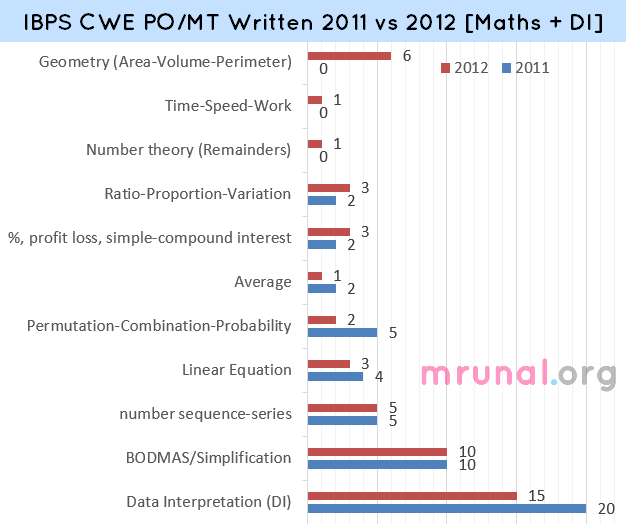
| Topicwise Breakup IBPS CWE PO/MT | 2011 | 2012 |
| Data Interpretation (DI) | 20 | 15 |
| BODMAS/Simplification | 10 | 10 |
| number sequence-series(although reasoning topic but asked here) | 5 | 5 |
| Linear Equation | 4 | 3 |
| Permutation-Combination-Probability | 5 | 2 |
| Average | 2 | 1 |
| %, profit loss, simple-compound interest | 2 | 3 |
| Ratio-Proportion-Variation | 2 | 3 |
| Number theory (Remainders) | 0 | 1 |
| Time-Speed-Work | 0 | 1 |
| Geometry (Area-Volume-Perimeter) | 0 | 6 |
| total | 50 | 50 |
Obviously high priority = DI + BODMAS + Sequence-series.
And, Although not many questions are coming from the individual topics of percentages, profit loss, simple-compound interest, Time-speed-word, ratio, averages etc. but collectively, these topics help you raise your score by atleast 10 marks. Hence their Cost:Benefit is quite good. (compared to the amount of data you’ve to memorize to get 10 marks out of Misc.GK/Sports/Persons in News type MCQs.) Therefore, donot run away from Maths, prepare it diligently.
Ignore following topics
- Quadratic equations (ax2+bx+c=0)
- Geometry theory (except area-volume-perimeter)
- Trigonometry
- Coordinate Geometry
- logarithm
Speed Maths
In Both previous years, at least 25 out of 30 questions came from Data interpretation+ BODMAS only
for both ^these topics, speed Maths=essential. Although internet is full of techniques of Speed Maths, Vedic Maths, but you must atleast master following techniques:
- Trachtenberg’s Techniques for:
- Multiplication by 5. It also indirectly helps you find out half (50%)of the given number as well. Because “m”x5= 10m/2. This helps you eliminate wrong answers quickly whenever you’ve find percentages.
- Multiplication by 9. It indirectly helps you guestimate the division by 11 as well. Because m/11=~0.9m
- Quick multiplication by 11. It indirectly helps you guestimate the number division by 9 as well. Because m/9=~0.11m
here is the wiki link: http://en.wikipedia.org/wiki/Trachtenberg_system
- Two digit division / long division / percentages approximation explained on
- Divisibility rules for various numbers (Given in NCERT, Quantitative aptitude books)
- Multiplication tables of 2 to 9, 12 to 25 must be learned by heart. Especially the tables of 13, 17, 19 and 23.
- Squares upto 29 and cubes upto 12 (required for the sequence-series questions and BODMAS)
- After that, as per your time and mood, learn the Vedic math techniques for finding cube-roots, square-roots of large numbers; three-digit multiplication etc.etc.etc.
Booklist for IBPS Data Interpretation & Maths
NCERT Maths
for clearing the basic concepts: all of them available at Mrunal.org/download
Mrunal.org/aptitude
for simplified techniques on %, Compound interest, permutation-combination-probability etc.
| Any one BankPO paperset | Require mainly for the Data interpretation practice.
|
| Any one book on Maths/Quantitative Aptitude |
|
#1: Data Interpretation (DI)
Can be of two types
| DI | with photo (Chart) | without photo |
|---|---|---|
| Example |
|
|
| Essential Skill |
|
Addition-subtraction. (although sometimes will require %, ratio, division as well.) |
How is Bank DI different from other exams?
- In SSC CGL, LIC, State PCS exams, usually chart- based simple case. Doesn’t involve lengthy calculations.
- In IBPS/Bank PO, even if chart-based DI is asked, often you’ll be given an additional table showing ratio/sales etc. So you’ve to utilize the information from both chart + table to derive the answers.
How to approach?
Data interpretation doesn’t have much theory, except in pie-chart case (about conversion between % and circle degrees + when and where will the answer = “data-insufficient’)
- First master the minimum speed math techniques given above.
- Understand the Ratio related concepts.
- Understand the basic concepts of bar graph, pie-charts etc. from Class 11 NCERT Statistics.
- Then start solving DI questions given the paperset book (Arihant / Kiran )
#2: BODMAS/Simplification
Bank exams (PO and Clerk) have an unwritten rule: first 10-12 questions must be from BODMAS.
Here are two sample questions
- [Square root (6354)] x 34.993=?
- 39.89% of 4331 divided by 58.779% of 5003=?
#1: first clear you basic concepts about following
| Simplification (BODMAS) | NCERT Class 8 Chap 1 |
|---|---|
| Surds, indices |
|
| Roots, squares, Cubes | Basics from NCERT Class 8 Chap 6 and 7. |
#2: then master the speed math techniques I listed earlier.
#3: Have a target of solving atleast 10 questions from your paperset every night, before going to sleep.
#3: Number sequence-series
Although it is a reasoning topic, but they’ve asked it in Maths section. Consider following examples from previous IBPS papers
Q. In the following number series, only one number is wrong. Find out the wrong number
8424, 4212, 2106, 1051, 526.5, 263.25, 131.625
Answer-choices
- 131.625
- 1051
- 4212
- 8424
- 263.25
Preparation source
- for the warm up exercise, go through chapter 3 (Classification) of RS Aggarwal’s Reasoning book
- Then maximum practice, go through your paperset book.
Bad thing about such questions: Sometimes you’ll be able to decipher the pattern within a minute, and sometimes, even after doing trial-error for more than 15 minutes, you might not see the pattern. Therefore, my suggestion is: during the exam, you put the entire set of sequence-series questions on “mark and review”. (And when you’re done with other sections, come back and solve these questions at the end of exam.) Don’t waste initial momentum here.
#4: Linear Equations
Another ‘reliable’ area in IBPS. Sometimes, you’ll need to apply concepts of linear equations, to tackle questions from Time-speed-distance, ratio-proportion-variation, averages etc as well.
Here are some samples questions from previous exams:
- Rubina could get equal number of Rs. 55, Rs. 85 and Rs. 105 tickets for a movie. She spends Rs. 2940 for all the tickets. How many of each did she buy?
- The ratio of the present age of Manisha and Deepali is 5 : X. Manisha is 9 years younger than Parineeta. Parineeta’s age after 9 years will be 33 years. The difference between Deepali’s and Manisha’s age is the same as the present age of Parineeta. What should come in place of X?
- Akash scored 73 marks in subject A. He scored 56% marks in subject B and X marks in subject C. Maximum marks in each subject were 150.The overall percentage marks obtained by Akash in all the three subjects together were 54%. How many marks did he score in subject C ?
Two things to be kept in mind, while solving questions on linear equation:
#1: keep minimum variables
Suppose the question runs like this “The sum of present ages of father and son is 56, and 5 years ago Son’s age was……….blah blah blah….find the present age of Father. ”
| avoid this | do this |
|---|---|
|
|
|
|
#2: Cannot be determined
Suppose you end up with two equations like this:
- x+y=5
- y+z=6
Here you’ve two equations but three variables (x, y and z). You can never find out the unique value of x, y, z in such situation. Hence answer = “Cannot be determined”.
But sometimes, even two variable-two equation set can be impossible to solve. For example
| No solution | infinite solution |
|---|---|
|
2x+ 3y=94x+ 6y=18 |
To learn more about ^this, refer to NCERT Maths Class 10, Chapter3, table given on the page #9.
Preparation source for Linear Equations
- Understand basic concepts from
- NCERT Class 8 Chap 2 and 9.
- Then NCERT Class 9 Chap 4
- Lastly NCERT Class 10 Chap 3.
- Then maximum practice from your Quantitative Aptitude book and OR paper set book.
#5: Permutation-Combination-Probability
Most of that can be solved without memorizing any formulas. In my opinion, this is the easiest of all math problems. Go through following articles
Permutation-Combination
- [Aptitude] Permutation Combination made easy without Formulas
- [Aptitude] Combination: Coins possible Sums (without formula)
- [Aptitude] PnC: arrange such that two people Always sitting together?
- [Aptitude] PnC: How many Ways to arrange letters of word “RECUPERATE” (Permutation without Formulas)
- [Aptitude] PnC Arrange digits in ascending order to form numbers (asked in UPSC 2009)
- [Aptitude] PnC: Conditional Selection in Committee
- [Aptitude] PnC: Binomial Expansion. How many ways to select one or more out of given Items?
Probability
- [Aptitude] Probability Made Easy (Extension of Permutation Combination Concept!)
- [Aptitude] Probability : Two Dice problems Sums and multiples
Then solve maximum questions from your Paperset book.
Sample Questions from previous exams
- (IBPS 2011) An urn contains 4 green, 5 blue, 2 red and 3 yellow marbles. Answer following questions
- If two marbles are drawn at random, what is the probability that both are red or at least one is red?
- If three marbles are drawn at random, what is the probability that at least one is yellow?
- If eight marbles are drawn at random, what is the probability that there are equal numbers of marbles of each colour?
- If three marbles are drawn at random, what is the probability that none is green?
- If four marbles are drawn at random, what is the probability that two are blue and two are red?
- (IBPS 2012) A bag contains 13 white and 7 black balls. Two balls drawn at random, what is the probability that both are of same color?
- (IBPS 2012) In How many different ways can the letters of the word “THERAPY” can be arranged so that the vowels never come together?
#6: Average
Go through following articles, then maximum practice from your paper set book.
- [Aptitude] Averages: Entry / Removal of 1 element => Increase / Decrease in Average Shortcut method explained
- [Aptitude] Averages: More than two elements added / removed : shortcut technique explained
Sample questions
- The average marks in English of a class of 24 students is 56. If the marks of three students were misread as 44, 45 and 61 in lieu of the actual marks 48, 59 and 67 respectively, then what would be the correct average?
- The sum of the ages of 4 members of a family 5 years ago was 94 years. Today, when the daughter has been married off and replaced by a daughter-in-law, the sum of their ages is 92. Assuming that there has been no other change in the family structure and all the people are alive, what is the difference in the age of the daughter and the daughter-in-law?
- In an entrance examination, Ritu scored 56 percent marks, Smita scored 92 percent marks and Rina scored 634 marks. The maximum marks of the examination is 875. What is the average marks scored by all the three girls together?
Alligations (Wine-Water Mixture)
Although not asked in previous exams but since it is an allied topic of “averages, so just to be safe, go through following articles
- [Aptitude] Alligations,Mixtures,Alloys: Water,Milk,Wine mixing: Weighted Average Made Easy for CSAT,CAT,CMAT,IBPS Aptitude
- [Aptitude] Alligation: Advanced applications in Interest rates, Profit-loss, Average Wages (Wine-Water Concept)
#7: Ratio-Proportion-variations
- NCERT Class 8 Chap 13.
- then max practice from your Quantitative Aptitude book and or papersets
- Also prepare the allied topic: “Partnership”, using this article https://mrunal.org/2012/05/aptitude-partnership-and-profit-sharing.html
Sample Questions from previous papers
- A certain amount was to be distributed among A, B and C in the ratio 2 : 3 : 4 respectively, but was erroneously distributed in the ratio 7 : 2 : 5 respectively. As a result of this, B got? 40 less. What is the amount?
- Rs.73,689 are divided between A and B in the ratio 4 : 7. What is the difference between thrice the share of A and twice the share of B?
- The fare of a bus is X for the first five kilometers and 13/- per kilometer thereafter. If a passenger pays Rs. 2402/- for a journey of 187 kilometers, what is the value of X?
#8: Percentages, profit-loss, SI-CI
No need to mugup any formulas. Can be solved effortlessly, just go through following articles
- [Aptitude] Concepts of Marked Price and Successive Discounts (Profit-Loss) without (stupid) formulas
- [Aptitude] Compound Interest Rate, Population Growth without Formulas
- [Aptitude] Product Consistency: If Sugar price increases then consumption should be Decreased by What %, Time-Speed-Distance problems,
Then solve maximum sums at home.
Sample Questions from previous IBPS PO Exams:
- An article was purchased for Rs.78.350/. Its price was marked up by 30%. It was sold at a discount of 20% on the marked up price. What was the profit percent on the cost price?
- What is the difference between the simple and compound interest on Rs. 7,300/- at the rate of 6% per annum in 2 years?
- The simple interest accrued on an amount of Rs. 22,500 at the end of four years is Rs. 10,800. What would be the compound interest accrued on the same amount at the same rate of interest at the end of two years?
- Ramola’s monthly income is three times Ravina’s monthly income, Ravina’s monthly income is fifteen percent more that Ruchika’s monthly income. Ruchika’s monthly income is Rs. 32,000. What is Ramola’s annual income?
#9: Number theory and Remainders
| topic | approach |
|---|---|
|
|
Sample Questions from previous papers
- When X is subtracted from the numbers 9, 15 and 27, the remainders are in continued proportion. What is the value of X?
- The product of three consecutive even numbers is 4032. The product of the first and the third number is 252. What is five times the second number?
- Sum of three consecutive numbers is 2262. What is 41% of the highest number?
#10: Geometry (Area-Volume-Perimeter)
- Basics from
- NCERT Class 8 Chap 3, 11.
- NCERT Class 9 Chap 9, 12, 13.
- NCERT Class 10 Chap 13
- Then maximum practice @home.
Sample Questions from IBPS-2012
- The area of a square is 1444 square meters. The breadth of a rectangle is 1/4th the side of the square and the length of the rectangle is thrice the breadth. What is the difference between the area of the square and the area of the rectangle?
- The premises of a bank are to be renovated. The renovation is in terms of flooring. Certain areas are to be floored either with marble or wood. All rooms/halls and pantry are rectangular. The area to be renovated comprises of a hall for customer transaction measuring 23 m by 29 m, branch manager’s room measuring 13 m by 17 m, a pantry measuring 14 m by 13 m, a record keeping cum server room measuring 21rn by 13 m and locker area measuring 29 m by 21 m. The total area of the bank is 2000 square meters. The cost of wooden flooring is t 170/- per square meter and the cost of marble flooring is Rs.190/- per square meter. The locker area, record keeping cum server room and pantry are to be floored with marble. The branch manager’s room and the hall for customer transaction are to be floored with wood. No other area is to be renovated in terms of flooring.
- What is the respective ratio of the total cost of wooden flooring to the total cost of marble flooring?
- If the four walls and ceiling of the branch managers room (The height of the room is 12 meters) are to be painted at the cost of 1901- per square meter, how much will be the total cost of renovation of the branch manager’s room including the cost of flooring?
- If the remaining area of the bank is to be carpeted at the rate of Rs. 110/- per square meter, how much will be the increment in the total cost of renovation of bank premises?
- What is the percentage area of the bank that is not to be renovated?
- What is the total cost of renovation of the hall for customer transaction and the locker area?
#11: Time-Speed-Work-Distance
All of them can be solved with our universal STD formula. See following articles to learn the concept
Sample Questions from previous IBPS exams
- A and B together can complete a task in 20 days. B and C together can complete the same task in 30 days. A and C together can complete the same task in 40 days. What is the respective ratio of the number of days taken by A when completing the same task alone to the number of days taken by C when completing the same task alone?
AP-GP
Although these questions were not seen in recent exams but if you’ve time and mood left, prepare the basics from NCERT and practice a few MCQs. You might get lucky for question or two!
| Arithmetic Progression | NCERT Class 10 Chap 5. |
|---|---|
| Geometric Progression | NCERT class 11 chapter 9. |
For more on IBPS PO/CWE related articles and study plans, visit Mrunal.org/IBPS
![[United India AO] Share your Mains exam experience for benefit of future aspirants](https://mrunal.org/wp-content/uploads/2014/12/Cover-United-AO-500x383.jpg)
![[Result] IBPS PO 2014 result out for written exam + call letters for clerks, Marksheets for RRB](https://mrunal.org/wp-content/uploads/2014/11/Cover-result-ibps-po-2014-500x383.gif)
thank you sir. . .
thank u…!
Thanxx a Tonn Admin..
thanks sir
thank u sir
nyc site
But how to prepare qa by arun sharma z best in da business.I seriously recommend dis to every aspirant!!!!dis book will definitely not disappoint u!
Thank u very much sir i m waiting for this a long time ago…
Sir,
Please upload [Studyplan] IBPS CWE clerk.
Hi,
Ignore following topics ,means excluding these topics?
Not to study?
Or have to study?
thanks a lotttt sir.it is very useful for us.
thanks to clear so many doubts regarding ibps po.
thanks a tonn…
Thank you Sir…very helpful
Thnku so much Sir…Dis will help me out in my exam:)
Thank You Sir And other Kindly provide Study material (If possible) for Dy. So. Officer Gujarat High Court as soon as possible .
Thamk u sir..plz provide some solved eg. of BODMAS..i dont know how to approach such eg.s
Sir actually i need some help of you in regard IBPS PO,which will be held in month of october.i am aspirant of CAT and i also filled the form PO.i am OBC student and i aslo want to crack IBPS PO,so sir please give me your valuable words so that i would able to crack down PO exam.i seek your help in all section specially in G.K section.
Thank you
Your fan
Atul
sir,
please suggest any book for number sequence-series(although reasoning topic but asked here)
thanks to clear so many doubts regarding ibps po.
thanks sir
Sir Give me Speed Method to Solve Math
And English
Send Me Mail
sir
fast track objective arithmetic by rajesh verma is sufficient for IBPS po?
I bought mk pandey book(reasoning) as per suggestion of mrunal.he was right it has good concept building on topics like input output,assumption/reference,data sufficiency,Linear arrangement. but alas on the most important topic circular arrangement the book gives just one question (utter nonsense) as 7-8 questions on circular arrangement is a sure for ibps po(rs agarwal book covers the circular arrangement topic but the type of circular arrangement questions(arrangement with blood relationship,country,occupation etc) asked in previous ibps question is not there).so if anyone want to buy that book for circular arrangement.it would be a big mistake.for rest of the topics this book is good(concept building-mk pandey,practice-rs agarwal)…
for circular arrangements.. refer to the book of puzzels “bsc publication”.
thanks mrunal sir
Thank you very much.
PLZ SOLV MY PROBLEM
sir,please help me out in finding online practise papers for IBPS Po’s….
sir, i have covered almost all the topics in reasoning… banking awareness, , in quantitative aptitude, i am practicing di series simplification ..because i find them interseting . (left individual topics jst learned their formulae), my problem is speed.. as only less than a month is left for ibpo 3 xam …so m in tension how to increase speed.?. i know how to find squre, cubes.. learned tables upto 24 , cubes upto 15 squares upto 30 … long division trick… no prob in maths at all but when it comes to english n reasoning , my tym of solving their question get streched…n find myself unable to complt papr in tym… kindly suggest me some tip… what should i do to increse speed… ?? i alot tym like for maths…. 40 minutes , reasoning 30 minutes , english 25 minutes , general awareness 15 mint , computer 10 mints , when i strt solving model paper maths resoning n english takes more than i aloted .. .. n my stategy gets ruined . plz help me sir for this… .as less than months is left for final xam
jst solve more n more practice sets… speed will increase.. for sure
good material mrunal
sir ,no shorcut methods or tricks for BODMAS OR DI????/
1+1+1+1+1+1+1+1+1+1-1+1+1+1+1+1+1×0 = ?
14
well done Brendon!
As always fabulous work sir…very informative..been following your blog on ssc cgl, ibps, upsc, ib acio etc and it has paid rich dividends in the exams till date and i am sure it will continue to do so in the future as well…on an unrelated issue…your answer is 14 @ ankita
okk ..m little confuse in the procedure .whether 9+5=14 is the rit procedure or 10+5-1=14 ???