
Table of Contents
Mains-PYQ-GSM1–2026-Demographic-Transition
- Critically examine the challenges of demographic transition in contemporary India. (15m, 250words, CSM’26)
- समकालीन भारत में जनसांख्यिकीय संक्रमण की चुनौतियों की समालोचनात्मक परीक्षा कीजिए। (15m, 250words, CSM’26)
✍️ Intro
- (Definition) Demographic transition refers to the shift in a population’s birth rate, death rate, and age structure as a country develops.
- (Data) India’s Total Fertility Rate has already fallen below the replacement level of 2.1, as per NFHS-5 (2019–21).
- India’s demographic dividend is expected to peak around 2041, when the working-age population (20–59 years) will form 59% of the total. After that, it will start declining.
⚠️ Body1: Challenges of demographic transition

- Ageing population: rising need for old-age homes, geriatric care, and specialist doctors
- Regional labour shortage: Southern states are ageing faster than the North, leading to migration of workers from North to South — which has already caused friction over language and access to rental housing, slums & traffic congestion etc..
- Pension sustainability: with more elderly and fewer working-age taxpayers, we’ll have raise the retirement age- just like China, Japan and France.
- School closures: states like Himachal Pradesh, Uttarakhand, Andhra Pradesh, and Madhya Pradesh already have over 40% of elementary schools with fewer than 50 students enrolled. Merging such schools within a 1–3 km radius may be efficient, but it also means job losses for teachers and longer, harder commutes for young children.
🌱 Body2: How to address these challenges
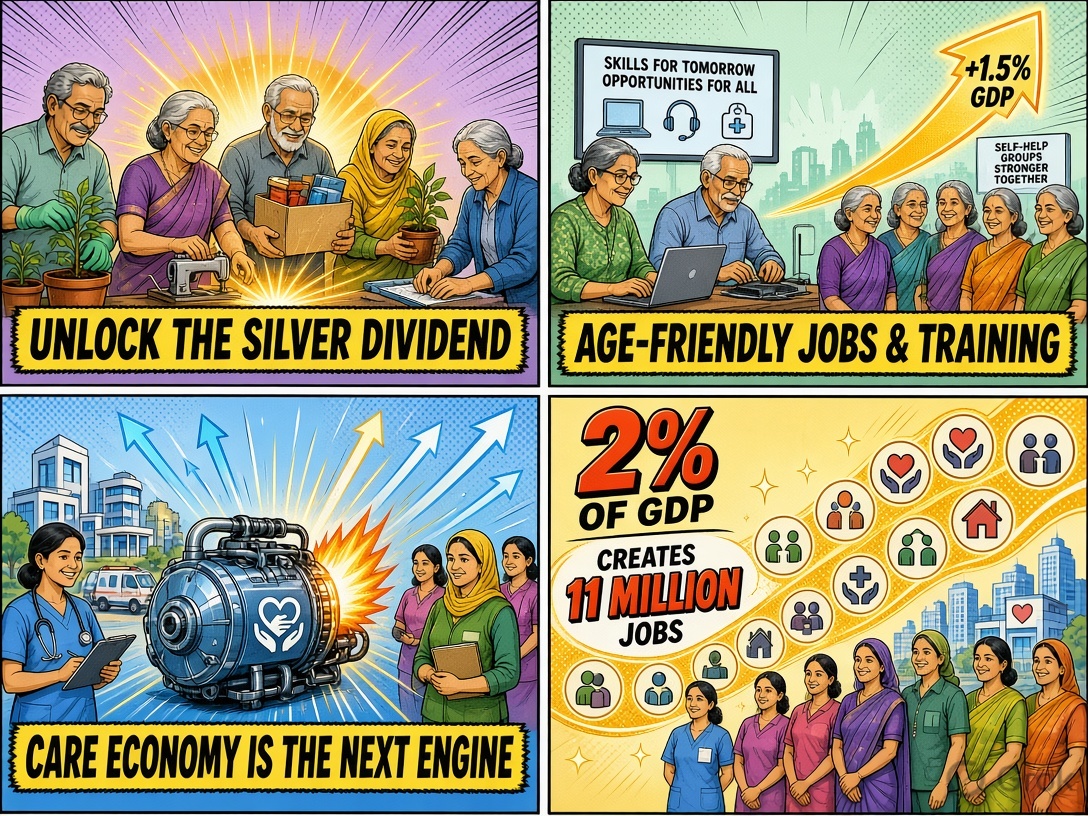
- “Silver dividend”: enabling older citizens to remain economically productive through work, entrepreneurship, volunteering, or caregiving.
- The Asian Development Bank estimates that greater workforce participation of the 60–69 age group could boost GDP by 1.5% across Asian economies. However, this requires age-friendly jobs, skill-training programs, and encouraging elderly self-help groups.
- The care economy is a major opportunity: the ILO calls it one of the fastest-growing sectors globally.
- If India invests 2% of GDP in care work, it could create around 11 million new jobs, nearly 70% of which would likely go to women.
✍️ Conclusion
India must act now to keep its population pyramid manageable and productive, so that today’s demographic dividend does not turn into tomorrow’s demographic winter.
Yes Covered in Mrunal’s Economy Lectures

Screenshot
Click me to Join Mrunal’s courses at Unacademy
📝 हिंदी अनुवाद (Hindi Translation)
✍️ परिचय
- (परिभाषा) जनसांख्यिकीय संक्रमण का अर्थ है देश के विकास के साथ-साथ जनसंख्या की जन्म दर, मृत्यु दर और आयु संरचना में आने वाला परिवर्तन।
- (डेटा) भारत की कुल प्रजनन दर (TFR) पहले ही 2.1 के प्रतिस्थापन स्तर से नीचे आ गई है, जैसा कि NFHS-5 (2019–21) में दर्ज है।
- भारत के जनांकिकीय लाभांश के 2041 के आसपास अपने शिखर पर पहुंचने की अपेक्षा है, जब कार्यशील आयु वर्ग (20–59 वर्ष) कुल जनसंख्या का 59% होगा। इसके बाद इसमें गिरावट आने लगेगी।
⚠️ मुख्य भाग 1: जनसांख्यिकीय संक्रमण की चुनौतियाँ
- बुजुर्ग जनसंख्या में वृद्धि: वृद्धाश्रमों, बुजुर्ग चिकित्सा सेवाओं और विशेषज्ञ डॉक्टरों की बढ़ती मांग
- क्षेत्रीय स्तर पर मजदूरों की कमी: दक्षिणी राज्य उत्तरी राज्यों की तुलना में अधिक तेजी से बूढ़े हो रहे हैं, जिससे श्रमिकों का उत्तर से दक्षिण की ओर पलायन हो रहा है – इससे भाषा विवाद, आवास की समस्या, झुग्गी-बस्तियों और यातायात की भीड़ जैसी समस्याएं पहले से ही पैदा हुई हैं।
- पेंशन व्यवस्था की स्थिरता: बुजुर्गों की संख्या बढ़ने और काम करने वाली जनसंख्या घटने से, हमें चीन, जापान और फ्रांस की तरह सेवानिवृत्ति की आयु बढ़ानी होगी।
- स्कूलों का बंद होना: हिमाचल प्रदेश, उत्तराखंड, आंध्र प्रदेश और मध्य प्रदेश जैसे राज्यों में पहले से ही 40% से अधिक प्राथमिक स्कूलों में 50 से कम छात्र हैं। ऐसे स्कूलों को 1–3 किमी की दूरी के भीतर मिलाना प्रशासनिक रूप से कुशल हो सकता है, लेकिन इससे शिक्षकों की नौकरी जाएगी और छोटे बच्चों को लंबी यात्रा करनी पड़ेगी।
🌱 मुख्य भाग 2: इन चुनौतियों का समाधान
- “रजत का लाभांश” (सिल्वर डिविडेंड): यानी की बुजुर्ग नागरिकों को काम, उद्यमिता, स्वेच्छासेवा या देखभाल के कार्य के माध्यम से आर्थिक रूप से सक्रिय रखना।
- एशियाई विकास बैंक के अनुसार, 60–69 वर्ष की आयु के लोगों की कार्यबल में भागीदारी बढ़ाने से एशियाई देशों की GDP में 1.5% की वृद्धि हो सकती है। लेकिन इसके लिए आयु-उपयुक्त नौकरियों, कौशल प्रशिक्षण और बुजुर्गों के स्वयं सहायता समूहों को बढ़ावा देने की जरूरत है।
- देखभाल अर्थव्यवस्था एक बड़ी संभावना है: अंतर्राष्ट्रीय श्रम संगठन (ILO) इसे दुनिया में सबसे तेजी से बढ़ने वाले क्षेत्रों में से एक मानता है।
- यदि भारत देखभाल कार्य में GDP का 2% निवेश करे, तो लगभग 11 मिलियन नई नौकरियां बन सकती हैं, जिनमें से करीब 70% महिलाओं को मिल सकती हैं।
✍️ निष्कर्ष
भारत को अपनी जनसंख्या संरचना को संतुलित और उत्पादक रखने के लिए आज ही कदम उठाने चाहिए, ताकि आज का जनांकिकीय लाभांश कल के जनांकिकीय संकट में न बदल जाए।
![[Mains Model Ans] What do you mean by Digital Rupee? In this context, explain the working and progress of India’s Central Bank Digital Currency (CBDC). (10m, 150words, CSM’26)](https://mrunal.org/wp-content/uploads/2026/08/PROOF_1A1_GSM3-Eco-Digital-Rupee-CBDC-500x383.jpg)
![[Mains Model Ans] Examine the view that financial inclusion is an integral part of social and economic inclusion in a country like India. Also throw light on the usefulness of the R.B.I.’s Financial Inclusion Index. (10m, 150words, CSM’26)](https://mrunal.org/wp-content/uploads/2026/08/PROOF_1D_GSM3_Eco-Financial-Inclusion-Index-500x383.jpg)
![[Mains Model Ans] Examine whether the constitutional mandate of rights-based welfare can be effectively realised amid non-integrated governance and minimal public investment. (15m, 250words, CSM’26)](https://mrunal.org/wp-content/uploads/2026/08/PROOF_2C_GSM2-Rights-Based-Welfare-500x383.jpg)
![[Mains Model Ans] “The centre of global trade is gradually shifting from the Atlantic region to the Indo-Pacific region.” Examine this statement. (15m, 250words, CSM’26)](https://mrunal.org/wp-content/uploads/2026/08/PROOF_3A_GSM1-Indo-Pacific-Trade-Shift-500x383.jpg)