
- Prologue
- Scope-Significance of Dairy Sector
- Location: Dairy cooperatives
- Milk Supply Chain: Upstream Issues
- Milk Supply Chain: Processing Issues
- Milk Supply Chain: Downstream Issues
- NDDB
- Operation Flood
- Government Schemes
- National Dairy Plan (NDP)
- Mock Questions on Milk Supply Chain Management
Prologue
First, regarding “Write Articles, Win Books” competition: so far 34 entries received. And last date to submit is 25th Sept 2013. Click me for more details.
For UPSC General Studies Mains Paper III, we were looking at the Food processing and related industries in India. So far we saw following topics
- Food processing industry: Awesomeness and Obstacles
- Food processing industry: Truckload of Government Schemes and bodies
- Marketing of agricultural produce: issues and constrains, Nuisance of APMC Acts and Commission Agents
- Agro/Food Processing: Export, Dumping, FDI, Finance, Taxation, Budget Provisions, CODEX, NWR, BRGF, RKVY
- Supply Chain Management, Upstream Downstream requirements for Fruit & Vegetables, Confectionery industries
Then I got bored with food processing, hence made three compilations on Hindu Sci-tech (and some posts about results, answer keys etc.) Anyways, back to where we had left in [Food processing]: fruits veggies SCM-updream downstream. Now time for Dairy & Milk Supply Chain Management SCM-upstream downstream issues.
| UPSC syllabus | topic in this article |
|---|---|
| prelims Paper I |
|
| (GS1) location of primary, secondary, and tertiary sector industries in various parts of the world (including India) | Dairy industry in India. |
| (GS2) Effect of policies and politics of developed and developing countries on India’s interests, | How the Fonterra crisis will help Indian dairy biz. |
| (GS3) economics of animal-rearing | Lot fodder material. |
| (GS3) Food processing and related industries in India-scope and significance, location, upstream and downstream requirements, supply chain management. | for Milk/Dairy business. |
Next time we’ll see [Food processing] meat, poultry and fisheries.
Scope-Significance of Dairy Sector
| HIGHEST
PRODUCTION |
Top five Milk producers (World)
|
| LARGEST
POPULATION |
|
| CONTRIBUTION TO GDP | Livestock sector (milk, meat, eggs) contributes 3.6% of GDP. (2010’s data) |
| Availability |
|
| EMPOWERMENT |
|
India has proximity to milk deficit countries e.g.
|
|
Hence Indian dairy production could be utilized to earn good foreign exchange by targeting those markets. More under “Downstream=>Export”.
SOME STUPID NUMBERS FROM ECONOMIC SURVEY:
| Year | Milk (Million Tonnes) | Eggs(Million Nos.) | Fish(Million Tonnes) |
| 2011-12 | >120 | >60,000 | >8500 |
Location: Dairy cooperatives
| STATE | Brand Name | official name |
|---|---|---|
| GUJARAT | Amul | Gujarat Cooperative Milk Marketing Federation (GCMMF) |
| ANDHRA | Vijaya | Andhra Pradesh Dairy Development Cooperative Federation (APDDCF) |
| KARNATAKA | Nandini | Karnataka Cooperative Milk Producers’ Federation (KMF) |
| MAHARASHTRA | Mahanand, Gokul, Dhawal, Dudh Pandri | Maharashtra Rajya Sahakari Maryadit Dugdh Mahasangh (Mahasangh) |
| PUNJAB | Verka | Punjab State Cooperative Milk Producers’ Federation (MILKFED) |
| TN | Aavain | Tamilnadu Cooperative Milk Producers’ Federation Ltd (TCMPF) |
Issue: there is a regional imbalance in production and processing capabilities. e.g. UP contributes over 17 percent of India’s total milk production. Ironically, only one percent is procured by co-operatives, remaining milk goes to private-dairy players, who exploit farmers, and do adulteration.
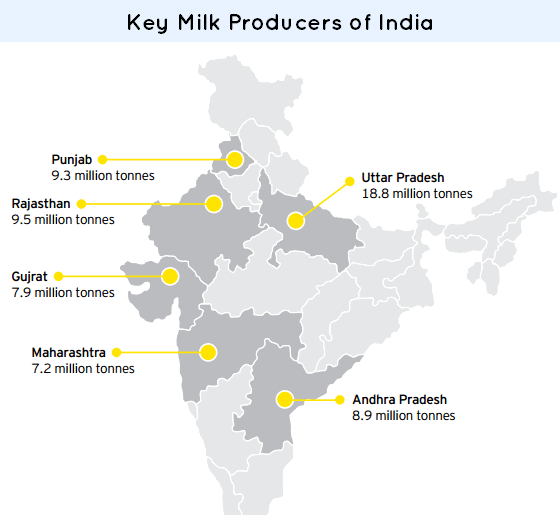
| NO. COWS N BUFFALOS | MILK PRODUCTION | PER CAPITA MILK AVAILABILITY |
|
|
|
Bottom in all of above: North Eastern States, Delhi, Goa and UT.
- Milk production =directly related to fodder availability.
- Fodder=need irrigation.
- Therefore, states with good irrigation facilities and / or rich farmers that can afford tubewells= milk production is high.
For these reasons, you can see how MP is in top-5, for number of cows and buffalos BUT still MP doesn’t figure in top-5 in milk production due to fodder shortage. (Rankings taken from NDDB website)
Milk Supply Chain: Upstream Issues
| Country | Avg. Cow Milk Kg Per Year |
| Australia | >4000 |
| EU | >5500 |
| USA | >8000 |
| World Average | 3100 |
| India | 800 |
India has world’s largest cow population, but the average productivity of Indian cows is among the lowest in the world. WHY?
- Veterinary service problems
- Breeding problems
- Fodder problems
Let’s see them one by one:
#1: Veterinary problems
|
|
|
|
- Inadequate availability of vaccines vs. High prevalence of FMD, theileriosis and brucellosis amongst cattle
- FMD alone causes economic loss of ~Rs.20,000 crore per year to India. let’s check more details about FMD for MCQs.
Foot and mouth Disease (FMD)
- FMD is a viral disease that spreads rapidly between animals.
- high prevalence in Africa, the Middle East and Asia
- FMD affects cloven-hoofed animals (those with divided hoofs), including cattle, buffalo, camels, sheep, goats, deer and pigs.
- It can even affect wild animals e.g. Deer, wild pigs and buffalos.
- Pigs are regarded as ‘amplifying hosts’ because they can excrete very large quantities of the virus in their exhaled breath.
- Cattle are very susceptible to FMD. They get infected by breathing even small quantities of the virus.
- FMD spreads rapidly from one animal to another, especially in cool, damp climates and/or when animals are housed closely together.
- Although FMD is not very lethal in adult animals, it can kill young animals and cause serious production losses.
- Animal suffering from FMD :
- Becomes lame and unable to walk to feed or water.
- Stops eating because its tongue and mouth gets blister- very painful to chew anything. =Adult animal can survive a few days of starvation but young animal will die.
- Its mammary glands are damaged=milk production loss.
- FMD has serious ramifications in international trade of milk and meat. Because countries that are free of the FMD disease= they ban or restricting imports from FMD affected countries.
- There is no cure for FMD. The Affected animals will recover with time. Although Vaccines can protect against the disease.
Department of Animal Husbandry, Dairying & Fisheries (DADF) has initiated National Programmes for prevention and control of FMD, with help of State government.
#2: Breeding issues
| CLIMATE |
|
| BREEDING RESEARCH |
|
| Notable breeds |
|
Solution?
| BREED | promote in ___ area |
| HOLSTEIN FRIESIAN | in feed-fodder rich states |
| JERSEY | in states poor in feed/fodder resources. |
- Government started ‘National Project for Cattle and Buffalo Breeding (NPCBB)’ is to promote genetic upgradation of Indian cattle livestock through Artificial Insemination.
- NGOs like BAIF and JK trust are operating about 6,000 mobile artificial insemination centres.
#3: Fodder problems
- Rich farmers=irrigation /tubewell =can grow fodder=>higher milk yields
- But majority are poor farmers= rely on common pastures =>underfed cattle= less milk yields.
- For the same reason: MP is in top 5 for cattle population but not in top 5 for milk production
- While the number of livestock is increasing, the grazing lands are diminishing, because
- Real-estate mafias and National Son-in-law encroaching on such land
- Farmers prefer growing food grains, oil seeds, and pulses hence fodder production generally gets lower priority.
- At present, fodder is being cultivated only on 4% of gross cropped area= insufficient to meet requirement.
- High quality fodder seeds =not available.
- Agriculture crop residues are sold to paper industry, packaging, etc. rather than using as animal feed.
- We dont have specific extension machinery with specialized manpower for popularization of good fodder varieties.
Solutions?
| FODDER BANKS |
|
| FOREST |
|
| AZOLLA PRODUCTION |
|
Azolla fern
- Azolla is a floating fern. It resembles algae, Multiplies very rapidly.
- widely distributed in tropical belt of India.
- Grows in paddy fields or shallow water bodies.
| FOR CROPPING |
|
| FOR LIVESTOCK FEED |
|
Milk Quality
From farm to dairy, there is significant deterioration in milk quality. Because of two reasons:
|
|
|
|
Result: following properties of milk get affected
| SENSORY PROPERTIES | color, taste, odour |
| COMPOSITION | fat, protein etc. |
| HYGIENE | bacteriological growth |
Solution?
- Currently, when farmer supplies milk @dairy cooperative society (DCS) of his village, they only test one thing: “fat content”. Therefore, farmer has no incentive to maintain any other qualities of milk.
- Setup quality testing facilities @collection center to test bacteria count, acidity, smell/taste, bacterial count, heavy metals, pesticides residue etc. and not just fat-content alone.
- Train farmers on hygiene habits for milk collection.
- Pay farmers more money if they supply quality milk
- Supply of Hygiene Kits+ Training to DCS staff. Impose penalty if they don’t comply with the standards.
- Less manual handling, use more machines: Bucket Milking machines, Feed racks, water bowls and partitions etc.
Milk Supply Chain: Processing Issues
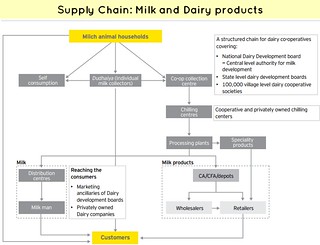
A typical supply chain of milk sector:
Regional imbalance
- Bulk of new capacity in the period in last decade, has been established in the Northern states, Maharashtra and Tamil Nadu. Remaining states are lagging in dairy growth.
- Capacity utilization of dairy plants is about 60% (assuming 300 working days in a year). Due to Lack of milk availability in the lean season.
- For e.g. Rajasthan has 8% share in milk production and 11% share in consumption of milk products, however the share in dairy processing capacity is 4%. Meaning much of the milk escapes from the ‘value-addition’ in dairy supply chain. A similar situation prevails in Bihar.
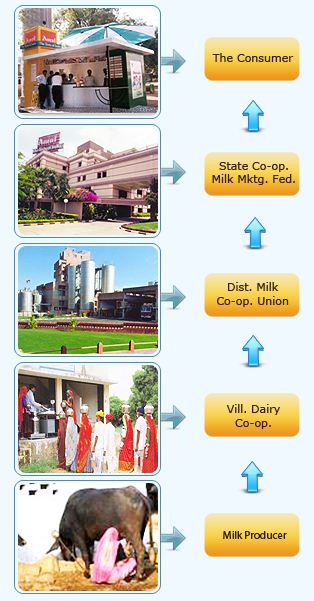
Anand/Amul Model/dairy cooperative model
| 1946 | Sardar Patel encourage the farmers of Anand region in Gujarat, to form their own milk cooperative, to protect themselves from exploitation from private milk traders |
| 1965 | National Dairy development board setup @Anand, to replicate the dairy cooperative model throughout country.
(PM Lal Bahadur Shashtri) |
| 1971 | Gujarat Cooperative Milk marketing federation setup (GCMMF) |
| 1974 | GCMMF starts maketing milk products under single brand name Amul (Anand Milk Union Limited) |
Amul Supply Chain
| VILLAGE |
|
| DISTRICT MARKETING COOP.UNION |
|
| STATE MILK COOP. FEDERATION |
|
| RETAIL |
|
- this “Amul Model” eliminates middlemen and directly engages farmer with the processor (dairy)
- These cooperatives form part of a national milk grid which links the milk producers throughout India with consumers in more than 700 towns and cities
here is one more supply chain diagram: click to enlarge
Cooperative sector limitations
| Reach |
|
| Competition |
|
| Management |
|
Milk Supply Chain: Downstream Issues
#1: MRP and adulteration
- WPI for Milk product= more than 190 (for 2012)
- Meaning there is 90% increase in the wholesale price of Milk, compared to base year 2004.
- This type of killer price rise=> has led to adulteration, fake milk from urea, Nakli-Maawaa etc. once in a while, you’ve seen reports about this, particularly in Delhi-UP region.
- Such fake milk products are extremely hazardous to health.
- In long term, they’ll destroy India’s name in foreign market, just like Chinese milk products lost business internationally, after news reports of Melamine adulteration in 2008.
Synthetic Milk
Synthetic milk is prepared by mixing urea, caustic soda, refined oil (cheap cooking oil) and common detergents.
| INGREDIENT | Why added in synthetic milk? |
| REFINED OIL | As a substitute for milk fat. |
| DETERGENT |
|
| CAUSTIC SODA | To neutralize the acidic PH of other ingredients and thus prevents fake-milk from turning sour during transport. |
| UREA |
|
| STARCH | Prevents curdling in fake-milk. |
Heath hazards of Synthetic milk: damages kidney, heart problems, cancer and even death
National Survey on Milk Adulteration 2011
- Was conducted by FSSAI. click me to learn more about FSSAI
- Bihar, Chhattisgarh, Odisha, West Bengal, Mizoram, Jharkhand and Daman & Diu= their milk failed in all tests.
- only Goa and Puducherry’s milk passed all the test.
- ~70% of Indian milk doesn’t meet the standards set by set by the Food Safety and Standards Authority of India (FSSAI)
Last year, Union government quoted ^this report, while filling affidavit in SC about milk adulteration. Union also said that it Is state government’s responsibility to act on milk adulteration problem. Later SC asked state governments to file affidavit about what action they’ve taken.
#2: Ethnic products: untapped potential
- Examples of ethnic milk products: Paneer, Rasogolla, Sandesh, Pantua, Rasomalai, Cham, Rajbhog, Kulfi, Rabri, Basundi, Burfi, peda, Gulabjamun, Kalakand, Dahi, Mishti Doi, Lassi, Chhach / Mattha, Srikhand etc.
- Scope: For ethnic milk products, profit level is ~12-38% of the input cost.
| PROBLEM | SOLUTION |
|---|---|
|
|
#3: Export issues
| export | import |
|---|---|
| >700 | >100 |
Earlier we saw India is located close to the milk deficit countries, but still India hasn’t capitalized on this location advantage due to the following reasons:
- Low quality and hygiene standards.
- Only ~35% of milk produced in India is processed. Rest is sold by local doodhwalla= not enough milk available for export.
- Domestic consumption of milk has increased => less surplus left for exports
- Lack of experience in marketing products in international markets, particularly for ethnic milk products.
- Low productivity and quality are the key reasons due to which processors in India, are not able to achieve the scale of operations of their counterparts in New Zealand or Australia.
Ban
| 2011 | Export of milk powders (Skimmed Milk Powders, Whole Milk Powders, Dairy Whitener, Infant Milk Foods etc.), Casein and Casein Derivative was prohibited |
| 2012 | ban lifted, these milk/casein products export given under Vishesh Krishi and Gram Udyog Yojana(VKGUY) |
Fonterra crisis
- New Zealand = one of the biggest dairy exporter of the world.
- Fonterra= New Zealand’s biggest dairy company
- 2013: News report came that Fonterra’s milk powder could have been contaminated with the Clostridium bacteria. It can cause fatal botulism.
- After this news report, China and Sri Lanka banned Fonterra’s products.
- Fonterra CEO says: it was a false alarm, the bacteria variety found in our milk powder is not capable of causing botulism, but nonetheless we have recalled all the batches exported. So don’t worry
Anyways, all this negative publicity and banning of New Zealand dairy products= gives opportunity for Amul to tap those export markets.
#4: Tax on inputs
- In earlier times, dairy industry had been subjected to octroi and sales tax etc. creating a non-level playing field with the unorganized sector.
- There had been high level of taxation on dairy equipment and machinery (excise, sales tax, octroi) Even the excise duty on polyethylene film, aseptic packaging machines, milk vending machines, pouch filling machines, used in packing and distribution.
- This has hampered the growth of dairy industry. Although nowadays, taxes on most of these items have been reduced / abolished.
- Necessary Reform: Speedy implementation of GST.
Enough of supply chain, let’s look at some allied topics: NDDB, Operation Flood, Government schemes related to dairy sector.
NDDB
- National Dairy Development Board
- Statutory body (1965)
- apex organization of dairy cooperatives in the country
- Chairman: Amrita Patel
- HQ: Anand, Gujarat
2013: NDDB been in news because
| AWARD |
|
| CHAIRMAN (PERSON IN NEWS) |
|
Operation Flood
| 1965 | NDDB setup. |
| 1970 | NDDB launches Operation flood. |
| 1996 | The End of Operation flood. |
Operation flood had three objectives:
- Increase milk production (“a flood of milk”)
- Increase farmers’ income.
- Reasonable milk prices for consumers
Op.Flood setup following hierarchy of dairy cooperatives
| LEVEL | Org. |
|---|---|
| VILLAGE | Primary Village Cooperative Society |
| DISTRICT | District Union |
| STATE | State Federations |
| NATIONAL | NDDB |
Operation flood worked in three phases from 1970 to 1996:
| PHASE-1 |
|
| PHASE-2 |
|
| PHASE-3 |
|
Result of Operation Flood
- Made India the largest Milk producer of the world.
- Imports of milk solids ended. Our milk requirements now met through desi-dairies. (Otherwise imagine, if we were still relying on “imported” milk, like imported crude oil – than what will be the current account deficit and rupee’s downfall!)
| CONSUMER EMPOWERMENT |
|
| ECONOMIC EMPOWERMENT |
|
| SOCIAL EMPOWERMENT |
|
| WOMEN EMPOWERMENT |
|
Government Schemes
(Although given in previous article, but copy pasting again for the sake of continuity during reading-revision)
Department of Animal Husbandry, Dairying & Fisheries
They run following schemes:
- install Bulk Milk Coolers at village level close to the area of milk production
- for installation of bulk milk cooler
| Intensive Dairy Development Scheme (IDDS) |
|
| Dairy Entrepreneurship Development Scheme (DEDS) |
|
| fodder |
|
| clean milk |
|
National Dairy Plan (NDP)
By National dairy development board (NDDB), with support from International Development Association (IDA)
- Phase-1 (2012-17) was launched at Anand, Gujarat.
- Scheme will run in 14 states – Uttar Pradesh, Punjab, Haryana, Gujarat, Rajasthan, Madhya Pradesh, Bihar, West Bengal, Maharashtra, Karnataka, Tamil Nadu, Andhra Pradesh, Orissa and Kerala.
- ^These states collectively account for over 90% of country’s milk production.
National Dairy plan will do following:
- Breed improvement + animal nutrition=> increase milk production, reduce methane emission.
- Strengthen of village based milk procurement system= Rural milk producers to get greater access to the organized dairy sector.
- Use of ICT technology: Internet Based Dairy Information System (i-DIS), Data warehousing System along with Business Intelligence tool etc.
- HRD, management, knowledge sharing, R&D and other fancy stuff
Funding pattern
| ca$h comes from |
|
| to | NDDB: National Dairy Development Board (a statutory body) |
| ultimately to | End Implementing Agencies (EIAs):
|
Mock Questions on Milk Supply Chain Management
MCQs
- Correct Statements about Foot and mouth disease(FMD)
- It is caused by brucellosis bacteria
- Wild animals are immune to FMD
- FMD is usually lethal to Adult buffalo
- None of above
- Incorrect Statement about Foot and Mouth disease (FMD)
- Pigs are considered amplifying hosts for FMD
- Pigs themselves are immune to FMD
- Both
- None
- Find odd term
- Sahiwal
- Murrah
- Gir
- Kankrej
- Correct statement about Azolla fern
- It is a weed that negatively affects paddy cultivation.
- If Azolla fern is mixed with fodder, it improves the health of cattle.
- both
- none
- Why is caustic soda used in manufacturing of synthetic milk?
- To act as an emulsifying agent and give frothy appearance to the liquid.
- To neutralize the acidity of other ingredients and stops milk from turning sour
- To increase the milk fat content
- None of above
- Correct statements about National Dairy plan
- It’ll be uniformly applied to all 28 states of India, in its first phase.
- International Development Association will finance part of this project.
- Both
- None
Descriptive
- 2m
- NDDB
- Intensive Dairy Development Scheme (IDDS)
- Dairy Entrepreneurship Development Scheme (DEDS)
- 12m
- Write a note on NDDB and its contribution in white revolution.
- National Dairy Plan (NDP) is a scientifically planned multi-state initiative to improve milch animal productivity. Comment
- Write a note on the functions of Department of Animal Husbandry, Dairying and Fisheries.
- 25m
- The destruction of India’s village system was the greatest of England’s blunders.
- Government initiatives to boost the milk productivity in India.
- Dairy cooperatives have played an important role in the women empowerment and social transformation of rural India. Comment
- Write a note on the upstream and Milk Supply Chain: Downstream Issues in the dairy sector of India.
- Essay (200m)
- Education remains the key to both economic and political empowerment.
- There is more potential for economic growth in rural India than at any time in decades.
- The Internet is becoming the town square for the global village of tomorrow.
- Emigration, forced or chosen, is the quintessential experience of our time.
- The notion of the world as a village is becoming a reality.
- A nation that continues year after year to spend more money on military defense than on programs of social uplift is approaching spiritual doom.
![[Win23] Economy Pill4ABC: Sectors: Agri, Mfg, Services, EoD, IPR related annual current updates for UPSC by Mrunal Patel](https://mrunal.org/wp-content/uploads/2023/04/win234b-500x383.jpeg)
awesome work
Mrunal bhai, we very much depend on your articles for mains preparation even. They are easy to understand,time saving,conceptual….so please increase your no. of articles,so that we can go confidently in mains 2013…
Being a bit finicky, the Map marking production of milk accounts for Punjab producing 9.4 MT while Andhra Pradesh tallies at 8.9 MT that is followed by the chart ranking the states according to their Milk production. Here Punjab is placed 4th below Andhra Pradesh…And on a side note while the government plays musical chairs with Mr Khemka he should file another case against our National Son in Law for stealing the graze of our Mango Man’s Buffaloes and Cow’s….But I guess our National Son in Law is entitled to milking the democratic system he is wedded too…
PS: Maybe the “Animal Protectionist” in the family is sore with them just because of the grazing thing??
MCQ answers (subject to correction)
1.d
2.b
3.b
4.b
5.b
6.b
so nice work sir
Grt job done sir, thnx
a lot of thanks for nice work
Thanks a ton Mrunal, Just waiting for this piece!!! Thanks for your old articles too!
excellent
hi sir will dis food processing topic will help in appsc i.e state pub service exam in science n techh paper..?
Nice one bro !!
hi all,
regarding the essay question “There is more potential for economic growth in rural India than at any time in decades.”
what points could be included in this? can we disagree with the title of such essay?
yes u can agree.
PURA model given by APJ Kalam
73-74 amendment
focus of World bank/UNO on grass root level empowerment
successful SHG/WSHG movements-> economic empowerment
self employment base schemes, MGNREGA etc
rising awareness – recently mining requests rejected by Gram Sabhas in Orissa, Jal Satyagrah in MP
rise of internet/mobile – accessibility of info everywhere
use of technology, better availability of tech today
Hurdles:
political unwillingness, gap between technology at labs and in field
poor implementation of rules and regulations
illiteracy, education which does not provide employment
lack of land reforms
Problem with Urban:
dev comes with its own problems- overcrowding cities, pressure on infrastructure, unbalanced social fabric, issues related with migration, urban slums
for economic dev in long term, v must go to manufacturing. Service industry can’t sustain momentum bcoz – skill oriented, high education, cant employ masses etc etc
untapped economic resources due to lack of banking services penetration but today it is much more feasible than earlier decades. Thanks to technology and govt focus.
try to find out some projects which private sector is executing in rural area.
yes u can disagree too, but then u must prove ur point with different examples. Simply saying NO and then taking abt rural potential wil not help.
National Son-in-law encroaching land.. very goog hahaha..
SIR CAN U EXPLAIN NUCLEAR LIABITY ACT AND ITS PRESENT SCENE.
Can anybody tell me how will be the CPT test for FCI gradeIII, the sort of questions?????????
Simply great
hello mrunal,
can anyone tell me what all comes in the investment model…
(GS 3)
Hi SAM,
Various angels of this acc. to me : Public investment/Private investment/ PPP/ public private people participation(PPPP)
Investment led growth model/ Demand led growth model/ Savings led growth model/
FDI/ FII are also involved here because they involve the basis for Joint ventures/Subsidiary company’s investment model etc.
(I don’t know what more can be covered under it )
i wonder where is “Manu Jha”?!
HIE MRUNAL
I JUST WANTED TO INQUIRE ABOUT NICL AO EXAM HELD ON 8TH SEP 2013:
1= WHAT ARE THE SALARIES AND PERKS OF THESE OFFICERS
2= WHAT IS THE LEVELS OF HIERARCHY IN THE ORGANISATION
3= IS THERE ANY FOREIGN EXPOSURE IN THE ORG.
4= CAN WE PREPARE FOR CIVIL SERVICE IF WE JOIN IT.
5= IS IT BETTER THAN SBI PO
6= PLEASE ELABORATE SOME PROS AND CONS OF JOINING THE ORG…
PLEASE ANSWER ALL THE QUESTIONS POINT WISE
THANK YOU
got my acknowledgement from upsc…
thank u very much.. we need articles about ethics paper..
sir please throw some light on STRATGIES FOR UPSC AC(CPF)
2013 PREPERATION
already thrown. click me for CAPF strategy
what is quantitative easing? in economics
This one is amazing, I’ll have to read it again to understand better.
Meanwhile I have a query, if you can, I will be grateful to you, —- I am using feedly for Hindu for last two months and particularly focus on two to three long articles in columns. I read the two liner current affair from Josh Jagran. Is it sufficient or should I subscribe for Hindu Newspaper ?
Thank you sir.
small clarification needed
the diagram with respect to milk production in states hives 3rd rank to punjab where as the table given below gives the same rank to andhra pradesh…..
kindly clarify…..
The per capita availability of the milk has reached a level of 290 grams per day by the year 2012, which is more than the world average of 284 grams per day.
Source PIB
thank you very much mrunal sir..
you are a big support for mains preparation
Thankyou sir for these awesome articles and study material…its really helpful:):)
@Mrunal : World average milk per capita is 284 , India has 290. We are ahead>( Source : PIB)http://pib.nic.in/newsite/efeatures.aspx