
- Prologue
- WTO: Structure and functions
- Tariff and Non-Tariff Barriers to Trade
- WTO agreements
- Agreement on Agriculture (AoA)
- What is Bali summit and Peace clause?
- What is Trade Facilitation Agreement?
- Why Modi opposed Trade Facilitation Agreement
Prologue
Consider this a “Fork” of the Economic Survey chapter 9 on Agriculture and food production.
WTO: Structure and functions
Q. Write a note on origin, structure and functions of WTO? 200 words
1944: Bretton Woods summit leads to birth of three institutions
| Institution | KEY IDEA |
|---|---|
| World bank | Cheap loans for development projects in third world |
| IMF | Balance of payment and Exchange rates |
| GATT |
|

| MinisterialConference |
|
|---|---|
| GeneralCouncil |
has two bodies, with separate chairmen
|
| DirectorGeneral |
|
WTO Functions
- Ensure the developing countries benefit from world trade, especially the least Developed countries.
- Reduce barriers to international trade – both tariff barriers and non-tariff barriers.
- Get the members Enter into multilateral trade agreements to achieve above objectives.
- Provide forum for negotiation and dispute settlement for the members, if the agreements are violated.
- Cooperate with UN, World and IMF for a global economic policy that improves livelihood, protects environment and promotes sustainable Development.
Tariff and Non-Tariff Barriers to Trade
All countries want to protect domestic industries and prevent entry of foreign players. So, they create two types of barriers to International trade:
| Tariff Barrier | If US President Obama imposes 56% custom duty on Indian Cars. |
|---|---|
| Non-Tariff Barrier | If Obama tries to restrict entry of Indian cars without imposing heavy taxes on Indian cars, for example
|
- World Trade organization (WTO) aims to reduce such tariff and non-tariff barriers to international trade.
- But what if China starts manufacturing cheap cars with poor breaks, bad steering and carcinogenic paint. Can Obama ban such dangerous foreign products? Does WTO permit that?
- Yes, WTO made two special agreements for “safety”:
| Non-food products | Technical Barriers to Trade Agreement (TBT) |
|---|---|
| Food Products |
|
WTO agreements

Gist of the whole controversy surrounding India, WTO and TFA
Q. Write a note on WTO agreements 200 words
Five categories of agreements (or 6, depending on which book you refer!)
T1: Goods
- General Agreement on Tariffs and Trade (GATT)
- Agreements on
- Agriculture
- Textile
- Antidumping
- Safety / quality checks related
- Sanitary and phytosanitary agreement (SPS)
- Technical barriers to trade (TBT)
- Trade related investment measures (TRIMS)
- Subsidies and countervailing measures (SCM)
T2: Services
- General Agreement on Trade in Services (GATS)
- To ensure that services’ import/export enjoys the same principles of free and fair trade, just like the trade in goods.
T3: IPR
- Trade related intellectual property rights (TRIPS)
- Protects seven categories of IPR viz.
|
|
T4: Dispute settlement
- to enforce the trade agreements and commitments made by individual member country
- once a complaint is filed, first, the parties are allowed to sort the issue through mutual consultation
- If that fails, formal adjudication by an expert panel.
| T5: Policy review | T6: plurilateral agreements |
| Periodically, WTO carries out audit/inspection/review of the trade policy of member states and gives them constructive feedback. | Not signed by all countries:
|
~204 words
WTO has many other agreements but hard to memorize and fit into a 200 word answer anyways.
For exams in 2014-17, the important agreement is AoA. (Because it’ll stay in news due to 10% food subsidy issue)
Agreement on Agriculture (AoA)

| Pillar | What they want from member states? |
|---|---|
| 1.Market access | reduce import duties |
| 2.export competition | reduce export subsidies |
| 3.domestic support | reduce Amber box subsides |
AoA classifies subsidies into two parts:
| DOMESTIC SUBSIDY | EXPORT SUBSIDIES |
| mostly by third world to keep help farmers and keep vote bank happy | mostly by first world, to keep their MNC-corporatized farmer lobby happy. |
| to increase food production, food security | to capture “Foreign market” by flooding their cheaper products |
| India doesn’t give much “export” subsidies to farmers- except a select horticulture and floriculture Items | |
AoA further classifies them into 3 parts
|
AoA wants members to reduce export subsides
|
Green blue and Amber subsidies
- Just like traffic signal has three colors: green (GO), orange (caution) and red (STOP).
- Similarly, WTO classifies DOMESTIC AGRICULTURE subsides into three categories: green (GO), blue and amber (reduce).
- There is no “RED” box meaning WTO doesn’t wish to completely STOP subsides, because it is impractical anyways!
| Box | subsidies |
|---|---|
| GREEN |
|
| BLUE |
|
| AMBER |
|
Amber box: De Minimus limits
Q. Explain De-Minimus limits in WTO’s agreement on agriculture. Why is India opposed to it? (200 words)
- Under WTO’s agreement on agriculture (AoA), domestic-subsidies are classified into three groups: Green, Blue and Amber.
- Amber box subsidies create trade distortion because they encourage excessive production e.g. fertilizers, seeds, electricity and irrigation subsidies.
- Therefore, WTO wants to limit the amber box subsidies.
- De Minimus is the Minimal amounts of Amber box subsides permitted by WTO, even though they distort trade.
- De minimus limits are calculated on the agriculture production of the given member state in 1986-88.
| Country | De-Minimus: Amber box subsides quota |
|---|---|
| Developed | 5% of agriculture production in 1986-88 |
| Developing | 10% |
| Least developed | Exempted.** |
** Besides if they’re L.D.C=> they’ve no “AUKAAT” to give truckload of subsidies anyways.
Why is India opposed?
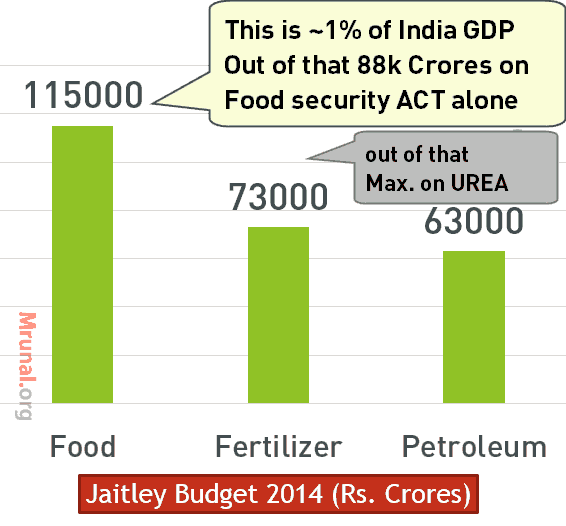
India fears it’ll have to cut down its food subsidy to comply with WTO’s De-minimus level
- In 1986: USA agriculture production was far ahead of India. So, their 5% De-minimus quota will be far bigger than our 10% quota (in absolute figures).
- Input costs have skyrocketed in these decades. But, De-minimus doesn’t consider inflation factor.
- So, if India has to limit its (Amber box) agro. subsides to a non-inflation adjusted 86’s production, we cannot continue the MSP to farmers or food security to poors.
- These subsidized foodgrains are meant for feeding the poors only, they do not distort international trade.
~190 words
| Subsidy component | RE-2013 | BE-2014 |
|---|---|---|
| Food | 92000 | 115000 |
| Petroleum | 85480 | 63427 |
| Fertilizer | 67971 | 72970 |
Ranking 2013: Food > Petroleum > Fertilizer
Ranking 2014: Food > Fertilizer > Petroleum
What is Bali summit and Peace clause?
Q. What is hell is “Bali Package” and “Peace clause”? (200 words)
- December 2013: 9th WTO ministerial conference held at Bali, Indonesia
- “Bali Package” is the collection of three prime outcomes of this summit.
| Trade facilitation agreement |
|
| LDC exports |
|
| food stockholding |
|
- as per the original Agreement on agriculture (AoA), the developed and developing countries have to keep their Amber box subsidies within De-minimus level i.e. 5% and 10% of their agriculture production in 1986-88 respectively.
- India opposed this base year and limits, because it’d make impossible to implement the food security programs for the poor and MSP for the farmers.
- Therefore, as a measure of temporary relief, Bali summit enacted a “peace clause” for the AoA
Salient features of Peace Clause
- No member, can drag any developing country to Dispute settlement mechanism of WTO.
- for violation of De-minimus limits in AoA
- Provided that the said developing country
- is paying subsidies for staple foodcrops
- for public stockholding program
- For food security purpose.
- is providing annual information of its food security Program to WTO.
- Permanent solution will be taken no later than 11th ministerial conference i.e. at December 2017.
~215 words.
What is Trade Facilitation Agreement?

Manniram is happy knowing that Modi has refused to sign TFA!
Q. Write a note on the salient features of Trade facilitation agreement (200 words)
| ORIGIN | 9th WTO ministerial conference held at Bali, Indonesia in 2013 |
| AIM | reduce red tapes and bureaucratic hassles in customs clearance |
Under TFA, Every member:
- Will have to publish a detailed list of procedure for import-export, fees, inspection rules, penalties etc.
- Minimize the proof documents and clearance required for customs clearance.
- Make all the information available on INTERNET to foreign traders, governments and interested parties
- Provide electronic payment of fees, duties, taxes.
- Setup a single window mechanism to help trader submits all documents at a single point- preferably online.
- Trader should be notified immediately, If goods are detained at customs.
- Provide faster customs clearance to perishable goods (Fruits, veggies, flowers).
- Member must not ask foreign traders to compulsorily route their applications/fees via local customs brokers/middlemen.
- Give Advance ruling, as and where applicable. (Recall advance ruling provision on taxes, under Budget-2014.)
Least developed countries
They’ll get financial and technical help to comply with above rules.
| LEVEL | body to implement Trade facilitation agreement |
|---|---|
| NATIONAL |
|
| INTERNATIONAL |
|
Benefits of TFA:
A simplified customs clearance mechanism will boost international trade, and thereby it will
| will increase in global GDP | $1 trillion (~Rs 60 lakh crore) |
| will create more jobs | 21 million |
| deadline to sign TFA | 2014, July, 31stBut India refused. |
| Agreement becomes effective from | 2015 |
~280 words. But in exam, all points can’t recalled so it’ll automatically “FIT” the 200 words limit!
Why Modi opposed Trade Facilitation Agreement
Q. Why has India refused to sign Trade Facilitation agreement? (200 words)
- WTO’s Trade Facilitation agreement (TFA) aims reduce the redtape and bureaucratic hassles in customs clearance and thereby facilitate international trade.
- But, TFA maintains that it doesn’t “diminish” the rights and obligations of members under other agreements of WTO.
- For example, under the Agreement on Agriculture (AoA) if a developing country is giving Amber box subsidies beyond 10% of its national agriculture production (base year 1986), THEN other members will be justified in putting trade sanction or WTO-complaint against the said country.
- 2013: In Bali Summit, the then UPA Government agreed to sign TFA, after WTO “Peace clause”, which gave temporary exemption to developing countries from 10% de-minimus provision until 2017.
- 2014: Change of regime,
Modi Government has refused to sign TFA before deadline (31st July 2014), because:
- Once India has signed TFA, the developed countries may stonewall her demands for a rational change in base year and ceiling limits on agro. Subsidies.
- Then India will have to cut down agro. Subsidies in MSP and food security programs, else they’ll put sanctions on us, soon as Peace-clause “temporary” deadline is over in 2017!
- And yet, we’ll have to keep giving them easy customs clearance because we signed the TFA!
Therefore, Government has decided to use TFA signature as a “Bargaining Chip” for a permanent solution of food subsidies issue.
~220 words
![[Win23] Economy Pill4ABC: Sectors: Agri, Mfg, Services, EoD, IPR related annual current updates for UPSC by Mrunal Patel](https://mrunal.org/wp-content/uploads/2023/04/win234b-500x383.jpeg)
ssc cgl 2013 re exam tier 2 will be on sep 20 and 21 according to ssc kkr website
sir thanks a lot for all the efforts…!
@mrunal sir cpf key upload kar do
thanks alot………………
Confusion regarding Contingency fund of India:
It is twice mentioned in laxmikant that money could be withdrawn from here subject to parliamentary approval.
(1) Money withdrawal from here comes under the definition of money bill
(2) While discussing about Contingency account Laxmi reiterate that money could be withdrawn subject to parliamentary authorization.
Another doubt that creep in is that what is the valid conclusion of “Either A Or B” Different books mention different things.
Mrunal if time permits please correct my doubts
@Vinay
Money taken out/fused in to the either consolidated/contigency fund of India fall under money bill.
Contigency Fund of India is placed at the disposal of the president and he can make advances out of it to meet unforseen expenditure but that unforseen situation must be authorised by the parliament. So this way this way the unforseen expenditure gets legal nod.
However in case of Consolidated fund of India………… to issue/drawn have to follow parliamentary law that already exist.
Correct me if I’m wrong.
Cheers!
Thank you sir!!!!!!
you are right, parliamentary sanction is needed for spending out of Contingency fund, however this sanction is sought only EX-POST-Facto, after the expenditure is done.
absolutely correct..!! In fact parliament enacted Contingency fund of India Act 1950 only for this purpose and any advances made are authorized ex-post-Facto and the Contingency Fund is refurbished with the amount withdrawn.
All matters in this regard fall under article 110- money bill
thanks ………
In Pitts India act:Please clarify someone about relation of BOD , BOC & council of GG .
Pitts India Act 1984:
1. Court of Directors – Composition remains same as regulating act 1773 ; And now they presided over only commercial matters
2. board of Control- a separate body constituted of 6 members and all were appointed by the crown meaning British government controlled them as Board of Control now were to look after political affairs of the company and supervise and direct all military and civil functions including revenues of British possessions in India.
3. Composition of Governor General’s council was reduced from 4( in 1773 act) to 3 including commander-in-chief.
Later on Pitts India act was amended in 1986 and governor general was given power to any time override the decisions made by his council and hence was made supreme being of the council
Court of Directors appointed governor general and his council in turn who commanded company’s affairs in India and Board of control was only constituted to overlook the governance of India with respect to political affairs so as to organize the governance in India.
Pitt’s Act started dyarchy. That is the political functions of the East india company in India came under Board of Control which had 6 members and Commercial functions under Court of Directors. GG was appointed by Court of Directors on approval of the crown.
SO it was like GG<CoD<British Parliament and Crown and GG<BoC< P and Crown.
thanks @maharaj&arjun..
one confusion..if COD was making decision related to company affair and BOC related to political revenue & military then what was work council of GG.
GG and his council was the supreme governing authority on behalf of Court of Directors and Board of Control and their governing related to commercial aspects were supervised by directors and their governing on military and civil matters were supervised by Board of control.
As you can see from introduction of Lord Cornwallis as he was made governor general as he was a close friend of Pitt ( the PM of Britain) and Dundas – the most influential member of Board of Control. So in a way GG and their council members were indirectly been appointed by Crown’s influence thus starting the end of company’s rule which ultimately occurred in 1858.
can anyone answer this with logic
el nino refers to
a> an atmospheric phenomenon
b> an environmental phenomenon
c> an oceanic phenomenon
d> a climatic phenomenon
bole to ek number mrunal bhai…………………
service allocation of cse 2013 done, out of 1122 only 981 have been alloted service
Thanks for this beautiful article Sir.
A depreciation of the rupee will raise net exports and therefore increase aggregate demand. Conversely, a currency appreciation would reduce net exports and, therefore, decrease aggregate demand.
Is this statement right or wrong? pls smbdy explain
@B+ve
Here in mrunal’s sir lectures on economic survey it was mentioned that
aggregate demand(effective demand) = final consumption + investments + (exports – imports)
1st case : Rupee depreciation ——>increased competitiveness of indian exports + high cost of imports—> more exports and less import —–> increase in aggregate demand ( caveat if everything else is kept constant as RBI manipulates its policy rate to counter depreciation that affects investment sentiments and consumption behavior)
2nd Case : Rupee appreciation ——>decreased competitiveness of indian exports + low cost of imports—> less exports and more import —–> decrease in aggregate demand ( caveat if everything else is kept constant as RBI manipulates its policy rate to counter depreciation that affects investment sentiments and consumption behavior)
P.S. Pure formula based statement
Note : On an average Indian economy’s effective demand is more biased towards Domestic rates as determined by RBI than exchange rate fluctuations like ( 56% , 44%)
Rupee depreciation cannot ensure increase in export. So the word “will” seems incorrect and word “would” be more suitable. In recent times INR depreciated, but not much effect on aggregate demand.
thanks for article sir
@mrunal sir:- plz answer
ques Consider the following statement about the joint
session of Parliament.
1. speaker of the lok sabha summons a joint
session of Parliament.
2. joint session is presided over by the speaker
of lok sabha.
3. a bill can be passed by special majority at
the joint sitting.
Which of the statements given above is/are
correct?
(a) Only 1 (b) Only 2
(c) Only 2 & 3 (d) None of the above
According to me ans should be (b) but it is given (d) and explanation for this is
There are two
types of joint session. one, at the time of
deadlock and second, for presidential
address. The latter is presided over by the
Plz Clarify sir, even in lakshmikant this provision is not mentioned
President.
question doesn’t reveal that joint session is called for presidential address or to end a deadlock b/w LS & RS so book is right. LEKIN SACH ME TUMHE ANDHKAR ME RAKH K TUMHARE SATH DHOKA KIYA GAYA HAI DOST!
@puku and B+ve
Please take note that the word “joint Session” ;
Whenever the two houses meet for deadlock scenario (article 118) it is mentioned in the constitution as “joint sitting” and not ” joint session”.
Hence strictly going by that convention as there is difference between “due process of law” and “procedure established by law” same is the difference between “joint session” and “joint sitting”.
Under article 86 and 87, president is conferred the right to address either houses or both the houses.
Under article 86 – can call anytime to address them
article 87 – It only refers to the Presidential address for thanks that generally takes place after a general election or before commencement of 1st session of parliament in a year.
Hence this reference under article 87 is sometimes termed as “Joint session” as it happened in 1969, 77 and 84.
To conclude for dead lock only joint sitting word is used under constitution.
And when joint sitting takes place ; as per law and rule established it is always and only presided by Speaker or in his absence deputy speaker or in his absence deputy chairman and so on as acc to rule made under clause 3 of article 118.
Hope i made it very clear. “Joint session” word does not exist in the constitution and UPSC will not ask any ambiguous question unless its answer has def surety.
very correct
yes, UPSC does not ask ambigous questions…but still u have clarified it beautifully thru the question he asked…
keep posting such “never thought of” questions!! :)
UPSC does ask ambiguous questions at times and last year’s question on endangered species is a testimony to this fact. IUCN said something else and UPSC used some other “sarkari” source to arrive at a different conclusion than IUCN. And as far as this question is concerned, I would like to make some points:
1. The article concerned is 108, not 118
2. President summons the joint session, not Speaker
3. It is presided by the Speaker.
Though technically it is “sitting” since a session may already be on, and that is the reason word “sitting” is used in constitution; but in common parlance “session” can be used. Thinking too much in such MCQs can be dangerous.
Roger that.
thaks for the article sir
thanks a ton sir..!!!!!!!!!
Please explain diff in 1.Savana & tropical grassland 2. Aw & BSh type climate in koppan classification
can anyone answer this with logic
el nino refers to
a> an atmospheric phenomenon
b> an environmental phenomenon
c> an oceanic phenomenon
d> a climatic phenomenon
savanna termed as tropical grassland which has according to koppan classification Aw type of climate has continental charactersticks acc which this climate experience seasonal cycle as monsoonal counterparts with annual range of temp upto 20 degree c and ppt 100 cms.
on other hand bsh is semi arid type of climate under the effect of temperate cyclonic circulations the ppt is throughout the year though higher concentration during winters(unlike monsoonal type) with annual range of ppt is 25 to 75. *ppt=precipitation.
tropical savannah like African savanna llanos campos(sa), Carpentaria and nullarbor (aus).
bsh like us prairies, pampas, aus downs and African veld
grasslands devoid of shrubberies and trees they have perennial cover of grasses but savannah are home to many tree varieties dominated by deciduous trees.
plzzz help me…if anybody has instructions along with admit card bcz i forgot to download instructions …plzzzz reply
Kirti, you can visit the upsc link (to download the admit card) again. It shows the instructions first before proceeding to the admit card, even if you have already downloaded the card.
Plz help!!!
Two trains for Mumbai leave Delhi at 6am and 6.45am and travel at 100kmph and 136kmph respectively.how many kilometers from Delhi will the two trains be together?
train 1 – 100 km/hr @ 6 AM
train 2 – 136 km/hr @6:45 AM
Relative speed = 136-100 = 36 km/hr
Train 1 at 6:45 AM would have already covered 75 km (100 * 45/60)
So this is the distance that train 2 has to cover with relative speed of 36 km/hr
So time taken by it in covering it = 75/36 = 2.0833hr = 125 minutes(multiply by 60 for minutes)
So to calculate the distance at which they meet = take any trains speed and multiply with 125 minutes
so lets take train 1: 100 km/hr for 125 minutes = 208.33
to this 208.33 km add 75 km as we took time after 6:45 AM(so we will have to add distance traveled by train 1 in those 45 minutes) = 208.3+75 = 283.33 km
or simply calculate distance traveled by train 2 in 125 minutes = 136*125/60 = 283.33 km
i think the simpler way wud be(no need to cal time and then dist)..
Let “X” be the dist wen they meet from Delhi..Train A travelled X+75(Dist traveled from 6 am to 6.45 am) and train B travelled X dist, so
X+75/100 = x/136
x=283.3 km
@Hriti
I was just explaining in very simple terms taking concept of relative speed.
As per ur concept of time equality
If they meet at X Km distance
equation would be: (X-75)/100 = X/136 = 283.3 (as we are equating the time since you have already taken X km as a variable)
yeah..i got ur intention of making it simple..
also..actually i solved it with equation X+75/136 = X/100 , but while putting up here..i made it incorrect..thanks for pointing out..
ur explainations are very good.
Thnxzz @maharaj n @hriti
@maharaj how u know everything abt everything ????……amazed by ur knowledge n ofcourse ur initiative to help everyone.
Mrunal sir, it is said that De Minimus is the Minimal amounts of Amber box subsides permitted by WTO. i.e., 10% is minimum. So, we can give more than 10% na?, then what’s the problem?. It should be maximum 10% allowed.
Hi Mallikarjuna,
I think you missed “within”.
Article says “as per the original Agreement on agriculture (AoA), the developed and developing countries have to keep their Amber box subsidies within De-minimus level i.e. 5% and 10% of their agriculture production in 1986-88 respectively”.
5% and 10% are the limits within which subsidies are permitted.
Read it again for better understanding.
Thanks
Thanks for ur reply. I understood the concept-it is within 5% & 10%, but under the subheading “Amber box: De Minimus limits” of the article it is given that De Minimus is the Minimal amounts of Amber box subsides permitted by WTO, which implies 10% is min limit (but actual is up to 10% or max 10%)
Hi .. pls explain the below question:
Q. Consider the following data table. Which statement best explains the climate variation between these two cities?
LOCATION MAX TEMP(F) MIN TEMP(F) MEAN ANNUAL PRECIPITATION(in) MEAN ANNUAL SNOWFALL(in)
CITY A 110 -36 23.8 31.9
CITY B 90 -19 38.2 92.9
a) City A and city B are located at the same longitude
b) City A is located at a high elevation,and city B is located at Sea level
c) City A is located far inland, city B is located near a large body of water
d) City A is located on the east coast, and city B is located on the west coast
Loking at the annual range of temp we can say the weather of A is of continental type with low pecipitation. for B the annual range is less and rainfall is high due to influnce of ocean or alrge water body .. So My answer would be C
Hehe Mrunal i must say that the pics of Gangajal are very pertinent in all the places u have used them…funny…i especially liked the life expectancy one…:D
hi mrunal
please explain the blue box subsidy and De-minimus quota ill effects for india.i could not understand both the concepts.
Q: In a test, a student attempted only six questions and having got full marks for each question, secured 40% marks in the test. how many questions did he not attempt?
3 , 6 , 9 , 12
how to solve this kind of qusn?
@ AMIT
for getting 40% u need 2 get 6 ques
for 100% =100*6/40=15
so total 15 q,u answered 6,remaining 9
@VINAY
just a query since ur here
is right to food a fundamental right or has it been converted to a “legal right” after food security act
as SC takes “right to food” as incorporated in “right to live” under article 21
Right to food is out of many, one of the liberal interpretation of Art. 21 by Supreme court after Maneka case(1978), but using this interpretation, no one can drag the govt. in court and that is why supreme court order(only) to the govt release the food grain which is rotting in go-down and govt places many reasons so then how a govt would be punished? This matter also falls welfare of people under Directive principle of state policy where govt is punished through election.
Now this right to food gets legal feather so supreme court able to drag govt/their functionaries into court room and ask you will be punished latter through election that’s sure but today I’m going to punish you and that is why often supreme court ask enact the law regarding night shelter to punish on deficiencies…
Hope it would work,
Cheers!
@B+ve
Yes i was kind of thinking this only.
These interpretations made by SC on Fundamental rights are in a right direction to make DPSP’s justiciable as our constituent assembly members wanted it.
Thanx a lot for confirming !!
Best of luck..!!!
thanks vinay..bdwy..got the ansr with the same strategy…thnks anyway…gud luck for prelims.
Dont we need one condition to conclude this answer that all the questions carry equal weightage of marks?
Guys just help how to calculate that when a calander will repeat. For example 1992