
- History Optional Paper 1: SECTION-A
- History Optional Paper 1: SECTION-B
- History Optional Paper 2: SECTION-A
- History Optional Paper 2: SECTION-B
- Original Scan for Hindi medium
History Optional Paper 1: SECTION-A
Q1. Identify the following places marked on the map supplied to you and writea short note of about 30 words on each of them in your Question-cum” Booklet. Locational hints for each of the places marked on the map are given below seriatim. 2.5 x 20 =50 marks
[columnize]
- An ancient capital
- A Palaeolithic site
- A cultural centre
- An Ancient capital.
- A Palaeolithic site
- A historical site
- A Harappan site
- An ancient capital
- A political and cultural centre
- Megalithic site
- A Mesolithic site
- A Chalcolithic site
- A prehistonc site
- A political and cultural centre
- An ancient capital
- A lost port
- Rock-cave art centre
- An ancient capital
- A political and cultural center
- An ancient town
[/columnize]
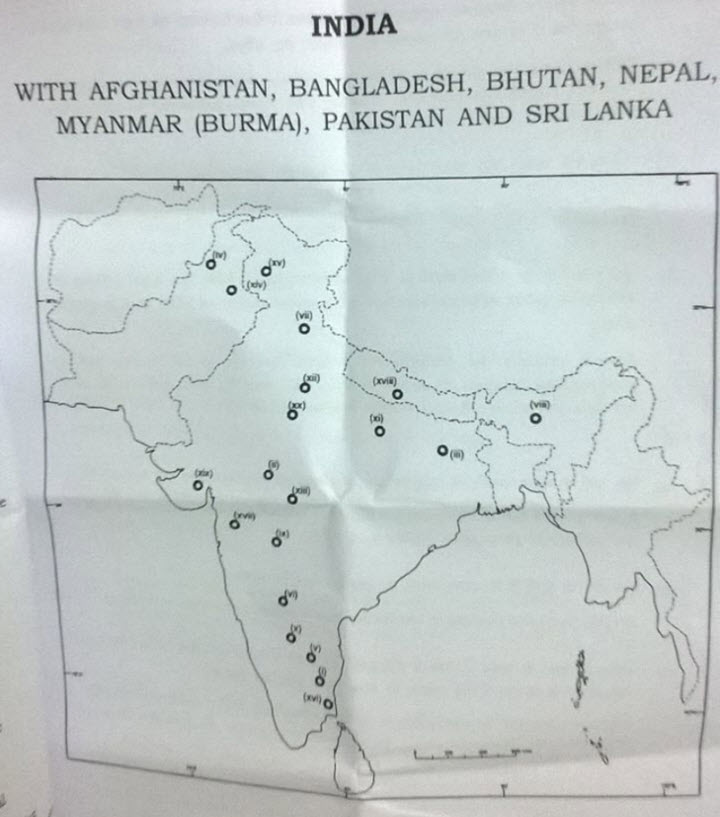
Q2.Answer the following: (15+15+20)
- “While using the accounts of foreign writers, historians must distinguish between statements based on hearsay and those grounded in perceptive observations.” Elaborate with examples.15 marks
- “The Upanishadic principles embody the epitome of the Vedic thought.” Discuss.15 marks
- Review critically the evolution of different schools of art in the Indian subcontinent between the second century BCE and the third century CE, and evaluate the socio-religious factors responsible for it. 20
Q3.Answer the following: (15+15+20)
- In what ways can the Megalithic culture be considered a foundational phase of the history of peninsular India?15 marks
- Do you think the Harappan civilization had a diversity of subsistence base?15 marks
- Discuss different interpretations of historians about the nature of Asoka’s ‘Dhamma’. Did his principle of `Dhamma-vijaya’ render the Mauryan Empire militaristically weak?20 marks
Q4.Answer the following: (15+15+20)
- Buddha’s teachings to a large extent could be helpful in understanding and resolving the problems of today’s society. Analyse critically.15 marks
- Discuss the provincial and district administrative units of the Gupta Empire with the designations and functions of the officers.15 marks
- What were the privileges granted to the donees in land-grant charters of early India? How far were these charters responsible for integration or disintegration socio-political milieu?20 marks
History Optional Paper 1: SECTION-B
Q5.Answer the following questions in about 150 words each:
- Critically analyse the agricultural economy from 750 to 1200 CE.
- Evaluate the contribution of Vaishnava saints to the growth of medieval Bhakti literature.
- Analyse the ordinances mentioned by Barani which Alauddin Khalji promulgated for market control.
- Give a brief account of resistance offered by Ahom State against the Mughal rule.
- How was cartaz system used by the Portuguese to maintain their control over the oceanic trade?
Q6.Answer the following: (15+15+20)
- Evaluating various theories regarding the Chola State, throw light on its village assemblies.15 marks
- Trace the technological and stylistic development in the architecture of the Sultanate period.15 marks
- Analyse the Mughal monetary system and examine their policy of minting of coins.20 marks
Q7.Answer the following: (15+20+15)
- Evaluate the ‘Kitab al-Hind’ of Alberuni as a source of history of India.15 marks
- Evaluating the theory of kingship of the Sultanate, discuss the deviations seen in the reigns of different Sultans.20 marks
- `The Battle of Plassey that decided the fate of Bengal was won by Clive through intrigues.” Explain.15 marks
Q8.Answer the following: (20+15+15)
- To what extent is ‘Segmentary State’ model relevant for defining the Vijayanagar State? Critically examine.20 marks
- How was lqta system of the Sultans different from the Jagir system under the Mughals?15 marks
- “India had been for hundreds of years the Lancashire of the Eastern world.” Critically examine this view.15 marks
History Optional Paper 2: SECTION-A
Q1.Critically examine the following statements in about 150 words each
- “Plassey did not complete the British conquest of India. Had the English been convincingly defeated in any subsequent battle in India, then (the battle of) Plassey would have remained as a minor episode in the history of India.”
- “Montague-Chelmsford reform proposals introduced `dyarchy’, but blurred the lines of responsibility.”
- “The military, feudal and traditional overtones of the Revolt of 1857 were overshadowed by its nationalist or proto-nationalist character.”
- “The ‘safety-valve thesis’ does not adequately explain the birth of the Indian National Congress in 1885.”10 marks
- “M.K Gandhi made a gross mistake in championing the Khilafat cause, an extra-territorial issue which cut at the very roots of Indian nationality.”
Q2.Answer the following: (20+20+10)
- “The Dual System of Government was a complete failure from the outset. In the first place, the abuse of the private trade reached a greater height than ever. In the second place, the demands of the Company for the increase led to gross oppression of the peasantry.” Examine.20 marks
- “… instead of rejecting the plan (Cabinet Mission Plan), they (the Congress Leadership) resorted to a half-baked legalistic stratagem to reserve their position on its long-term arrangements and accepted its short-term provisions.” Critically examine.20 marks
- “Dalit Movements for empowerment in independent India have essentially been for carving out political space through electoral politics.” Discuss.10 marks
Q3.Answer the following: (20+20+10)
- “Politics remained for the bulk of the Moderates very much a part-time affair. The Congress was not a political party, but an annual three-day show…” Elucidate.20 marks
- “The Anti-Partition Agitation (1909) had an economic character in Bengal unlike the Extremist Agitation in Maharashtra which had a religious character.” Examine.20 marks
- “Sardar Patel accomplished a silent revolution by ensuring the absorption and assimilation of a multitude principalities without shedding even a drop of blood.” Elucidate.10 marks marks
Q4.Answer the following: (20+20+10)
- “Though Sri Ramakrishna became the prophet of neo-Hinduism, he never claimed to have founded any new religion.” Elaborate.20 marks
- “Why did the British finally quit India on 15th August 1947 ? The Imperialist answer is that independence was simply the fulfilment of British self-appointed mission to assist the Indian people to self-government.” Examine.20 marks
- To what extent did the Freedom Movement in influence the Liberation Movement in Africa ?10 marks
History Optional Paper 2: SECTION-B
Q5. Critically examine the following statements in about 150 words each :
- “Reusseau strove to reconcile the liberty of the individual and the institution of Government through a new vision of the Contract-Theory of Government.”
- “The commercial and industrial interests created a veritable hothouse atmosphere in Europe for the establishment of colonies.”
- “Enlightened despots (Europe) were not necessarily politically liberal.”
- “… the passing of the ‘Reform Act’ marked the real beginning of modern party organisation in England … In a real sense, the present political system of England dates from 1832.”
- “The Russo-Japanese War helped in the rise of Japan as a great power.”
Q.6Answer the following: (20+20+10)
- “American Revolution seems to have come with remarkable suddenness. A roster of talented leaders emerged during 1763 to 1775 to make it happen.” Elucidate.20 marks
- If we, were to define our conception of the State, our answer would be that the State is the banker of the poor. The government would finance and supervise the purchase of productive equipments and the formation of workshops.” In light of the above statement of Louis Blanc, throw light on the Pre-Marxist Socialist Thought in Europe.20 marks
- To what extent did the expansion of European Powers in the late 19th century help in the modernization of Africa ?10 marks
Q7.Answer the following: (20+20+10)
- “The Declaration of Rights was the death-warrant of the system of privilege, and so of the ancient regime … Yet in the history of ideas it belonged rather to the past than to the future.” Examine.20 marks
- Critically examine the socio-cultural and economic impact of migration in Europe and Asia in the 18th and 19th centuries.20 marks
- Discuss the circumstances leading to the Suez Crisis of 1956 and examine its repercussions on global politics.10 marks
Q8.Answer the following: (20+20+10)
- “Europe was eclipsed through European folly due to the two world wars.” Elucidate.20 marks
- “The language of narrow nationalism held at Frankfurt destroyed the German Revolution; as the fatal idea of aggrandisement of the House of Savoy destroyed the Italian Revolution.” Discuss.20 marks
- Discuss the nature of American overseas expansion in Asia and explain the consequences.10 marks
Original Scan for Hindi medium
Click me to download originally scanned paper- containing both Hindi and English questions. Although PDF quality is not that great, so better wait for UPSC to upload papers in next 30-40 days.
Visit Mrunal.org/download for more questions papers of UPSC Civil services Mains examination.
“Montford Reforms proposals introduced dyarchy, but blurred the lines of responsibility”. Critically Examine. (150 Words)
Montford Reforms (MR), 1919 was a part of the carrot and stick policy of British government. It was essentially meant to appease the Home Rule League demands of Self-govt.
The objective of MR was to realize Responsible government. This could be done by:
a. Increasing the associations of Indians in every branch of administration.
b. Gradual Realization of Self governing institutions.
Montford Reforms:
1. Though Dyarchy was probably the best transition mechanism in a long time, it had a lot of drawbacks. The subjects, though divided essentially remained on the whims of Governor and his associates.
2. There was not even partial responsible government at the Center.
3. It did not even indicated the time frame for the realization of Responsible government.
4. It consolidated the Separate Electorate (SE) even though it knew that SE was a hindrance to self-governing principle.
5. The expected increased representation of Indians in the administration was not met with.
Albeit halting and extremely limited, MR was the 1st instance of transfer of British power.
Please somebody moderate my answer.
Nice answer… slick intro.. but i think you deviated from the demand on of the question after two points… The question specifically asks us to focus on the administrative aspects of 1919 reforms such as the the confusion of jurisdiction created by division of the subjects into reserved and transferred subjects,the confusion of accountability,the excess power enjoyed by governor and his interference in the governance and lastly why the act failed…. I suggest you refer to grover and grover… The book has awesome analysis of dyarchy…
Thank you for suggesting. I will try and rewrite the answer. Can you give me your email id so that we could share some more answers and practice answer writing.
as per question Dyarchy =what it is,what are the subject concern,division of subject need , impact ,responsibility on governor ,ministers is required ,you explained the only rule in general but not Dyarchy in particular .
you missed the most important part…. Shudding the responsibility of basic amenities by the bristish on Indian ministers. Health, education, sanitation etc made transferred subject.There was no proper budgetry allocations to these subjects and they proved to be a failure. The montford reforms was a reform in theory but not in practicality.
map question: 2nd site is Adamgarh , if I am not wrong. was also in news recently.
yar, m mark it as bhimbetka
What about 14. A political and cultural centre
It seems Taxila…I compared with the map given in Ancient History by Jha
I also marked it as Taxila. But now it seems it was Sialkot/Sagala. Taxila was important cultural centre but not political one. Sialkot was both….
Question 3 part2 of Paper I is directly from Upinder Singh………
Sir, Pol Science ke logo pe bhi apni kripa kijiye…..pls upload Pol Sc Papers too….Hardik Dhanyavaad.
sir , plz upload public administration paper….2014
Hi Mrunal sir .
I am preparing for 2015 exam , please refer the History optional book for mains .
Please share the information , who ever wrote the mains exam in 2014 History optional book for mains.
Thanks for your service.
Site 4 is Peshawar aka Purushpur ?
pushkalvati or Charsadda. both are same
when will ssc cgl tier1 result declared?
thanks sir
Hi Mrunal sir I am from science background (PCM).so my writing answer is not so perfect in case humanity subject . but I want to choose one of them from sociology or history for optional.but someone says to me that geography is the better sub. for science background student and scoring subject.sir kindly tell me which one will be better for IAS .
Thank you for suggesting.
Hi Sir/mam
Plz give some data about Envi. Science
I am not able to Download papers
Preparation for bank po
Really the paper are mundblowing
Pls give the answer of that question that you provide to me as possible. its my request to you sir/madam.
Good material for exams.
anyone here for reviewing history answers? …I can review yours
sir please give this papar & ncert books upload in hindi languate
sir
would u please suggest me the book list for history optional….
Thanks
I want to know how prapare this exam lower commission,?
sir kuch important tips btayen civil service exam ki study k bare m,,,
Sir,I am an aspirant of UPSC exam…I need proper guide to crack this exam in next attempt….
How can I get success ??
Sir main hindi medium ka student hu..mjhe syllabus main cnfusion hai..if main exam m history choose krta hu optional subject .to main exam m baki kon kon se subjects honge…plz help me..i am tottly cnfused…
What is your Message? Search before asking questions & confine discussions to exams related matter only.
I wants to join this site
Sir main hindi medium ka student hu..mjhe syllabus main cnfusion hai..if main history choose krta hu optional subject .to main baki kon kon se subjects honge…plz help me..i tottly cnfused…
I wnat to join this site
Sir main hindi medium ka student hu..mjhe syllabus main cnfusion hai..if main history choose krta hu optional subject .to main baki kon kon se subjects honge…plz help me..i tottly cnfused…
Sir main hindi medium ka student hu..mjhe syllabus main cnfusion hai..if main history choose krta hu optional subject .to main baki kon kon se subjects honge…plz help me..i tottly cnfused… cnfused