
- Prologue
- Iron-coal industry Location factors
- Iron Industry: three locations
- Factor: Empty Wagons
- Factor: Coking coal Shortage
- Factor: Technology
- Industrial Inertia
- Factor: strategic reasons
- Factor: Developmental policies
Iron-coal industry
- Iron ore + coke + limestone ==heat==> pig iron.
- pig iron=more processing=>cast-iron, wrought iron, steel and variety of alloys
Therefore, Essential inputs are:
- iron ore, coking coal and limestone
- water for cooling
- energy for heating
Steel industry also requires dolomite, manganese etc. but in small quantities=> their presence is not the main deciding factor for the location.
The three locations
- Near Forest
- Near Coalmines
- Near Coastal Areas
#1: Near Forest
- Until the end of medieval period, iron production was done on small scale.
- Energy was immobile (No wires to move electricity, No trains to move coal).
- To produce five tons of iron, you had to chop down one acre of forest to get sufficient charcoal.
- Therefore, wood supply=primary factor for deciding location. And smelters were usually setup near forest areas
- Even in Modern times, Visvesvaraya Iron and Steel Plant (Karnataka) was setup near jungle to get wood-charcoal. (Later switched to hydro-electricity from Sharawati river)
#2: Near coal fields
During the Industrial Revolution, iron and steel industry were setup near coalmines, due to following reasons:
- The coalfield region had a tradition of iron working based on charcoal as a result coalfield areas already had the labour and technology.
- In Britain, iron ore was found embedded with coal seams= same area provided both iron ore + coal
- During that era, to process 1 tons of iron ore, you needed 8-12 tons of coal. Railway engines were also inefficient. So, weight-wise, it was cheaper to transport iron ore to coalfields rather than transporting coal to iron ore site.
| Germany | Ruhr Valley, Saxony region |
| Britain | Lancashire, York shire, South Wales |
| United States | Appalachian-Pennsylvania-great Lakes |
| Australia | New South Wales region |
| China | Wuhan, Anshan, Chongqing |
by the way,
Why do we need “Coking coal”?
Because Iron ore=has iron oxide. But We’re only interested in iron. So, we’ve to get rid of the “oxide” part.
- Then how can we remove the “oxide” part? Ans. Make him marry with carbon and form “Carbon dioxide”.
- But where will you get the carbon? Ans. Coking coal. Because Coking coal has high concentration of carbon, compared to cheap varieties of coal like Lignite. Therefore you’ve to mix the coking coal with iron ore.
Iron Ore (Iron Oxide) + Coking Coal (source of Carbon) + Limestone (reducing agent)=heat*=> Iron + CO2 + slag.
*for heating you can use other variety of coal / even electricity.
#3: Near coastal areas
- By early 20th century the coal and iron ore mines in US-Europe started getting depleted. So, they started importing iron ore from other countries.
- As a result the iron space and steel industry started moving toward coastal sites to reduce cost of transporting ores from port to factory via railways.
| Japan | Iron steel industry is developed @coastal areas/port location because they rely on imported coal and iron-ore. E.g. steel industry in Osaka-Kobe |
| India | Steel plants @Vishakhapatnam, Ratnagiri, Mangalore |
| Malaysia | Has iron ore but not enough coalTherefore steel plants located near coastal area to get imported coal @minimum transport cost. |
| USA | In the coastal cities of Cleveland, Detroit, Chicago (using imported ores from Canada) |
Factor: Empty Wagons
- Ural=rich iron ore deposit
- Kuznetsk Basin in Western Siberia = rich coal deposits- sent to Ural region by Railways.
- The returning wagons after emptying coal, bring iron ore from Ural region.
- Result=> iron-steel industry developed @both places.
- Just like Ural-Kuznetsk, In India, Bokaro and Roukela steel plants:
- Trains bring iron ore from Rourkela => Bokaro
- and return with Coal from Bokaro =>Rourkela
- This optimizes the use of transportation (because wagons are never empty), and helped in growth of iron-steel industry @both places.
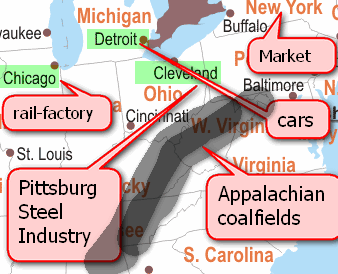
- Pittsburgh (Pennsylvania State) =steel industry was started using local iron ore and coal.
- But Local iron ore depleted so they started importing iron ore from Lake Superior region
- Problem: ships would bring iron ore but on their return journey, they’d be empty=> uneconomic use of transport.
- So, they started transporting Pittsburg coal to Lake Superior region in those returning ships=>steel industry developed in the lake region as well.
- But Since Pittsburgh itself is not a coastal city, so the coal/iron had to be transported to a port (Cleveland) first using railways.
- Thus, Cleveland (Ohio State) didn’t have iron ore or coal, yet got access to both => iron-steel industry developed in Cleveland. Same reason for Duluth in Minnesota.
Factor: Coking coal Shortage
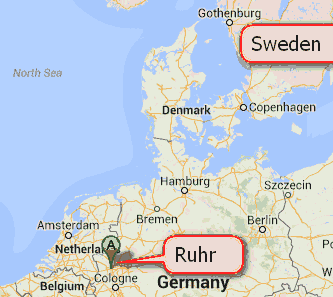
Sweden has high quality iron ore, yet it specializes in non-ferrous metallurgy and light engineering, (rather than iron-steel industry), why?
- Because Sweden lacks cocking coal.
- Sweden exports its own iron ore to Ruhr (Germany) and in return imports pig iron from Ruhr.
- Then Sweden converts imported German Pig iron into steel, using electrical furnaces. (Advantage: cheap hydroelectric power, because Sweden = hills + fast flowing rivers).
- but since imported pig iron=costlier (than if they had made it locally)=> the steel thus manufactured, is used for making high value items e.g. Volvo Cars, Bofors Guns etc.
Factor: Technology
New technologies for steel production reduced the “pull” factor of coalmines in deciding location. For example:
| Open hearth system | even scrap metal can be used to make steelreduced fuel consumptionEven natural gas can be used. |
| Oxygen converter process | Further reduced coal/energy requirement. |
Combined with the invention of electric smelters, technology helped in development of Mini-steel plants near industrial cities (And away from iron-coal reserves).
Industrial Inertia
- Today, coal is not the only source of energy. We’ve natural gas, hydel electricity even nuclear power.
- + Thanks to new technologies in steel production, you don’t need massive amt. of coking coal.
- But still traditional industrial areas are located in and around the coalfields- sometimes even after the coal mines have exhausted, these industries are not shifting to a different location. Example Lancashire in UK; Ruhr in Germany; Pittsburg in USA.
- When industries don’t move away from an area, despite the locational disadvantage= this phenomena is called industrial inertia.
Inertia due to Government Policy
- The industrialists in old area usually have deep pockets and political connections so they lobby to government for favorable protectionist policies +large labour population in old area=vote bank.
- For example, Pittsburg is not a coastal city and nearby coal-iron ore reserves are getting depleted=> it was becoming more expensive to produce steel using imported iron-ore.
- But then Pittsburg industrialists lobbied, and US government made steel-pricing policies like “Multiple Basing system”, “Pittsburg plus” etc. (in the early 1900s).
- The impact of such policies => even if you can make cheaper steel in some other place of US (e.g. Southern Coastal areas), you still need to sell it @prices equivalent of Pittsburg steel industry. This demotivates entrepreneurs from setting steel-factories elsewhere, because they can’t sell their product cheaper than Pittsburg, to attract more customers.
Industrial Inertial in India
In July 2013, POSCO (Korean steel giant), pulled out from the steel-mill project in Karnataka worth almost $6 billion FDI, due to bureaucratic red tapes in environmental clearances and land acquisition. We can only speculate the vested interests and powerplay going on behind the curtains involing bureaucrats, politicians and mining mafias.
Factor: strategic reasons
USA
After WW2 and from the lessons of Aerial bombings destruction in Britain, US government decided that it was not wise to let entire steel-industry concentrated in the East (Great Lakes-Pittsburg region). Therefore, some plants were setup in the west (California). They get coal from Utah and Iron Ore from Eagle Mountains.
USSR
- Before Second World War, Ukraine-Donbas region was famous for iron steel and heavy industry.
- But these region suffered great destruction during Second World War. (as the Enemy Germans came from the West.)
- Due to this bad experience, the Soviet government adopted a policy to disperse Soviet industries on the Eastern side, towards the Pacific coast.
Factor: Developmental policies
| India |
|
| China |
|
Although Mao’s “backyard” idea was an #Epicfail, we’ll see in the next article on steel industries!
thnks sir..
simply awesome mrunal bhai..
sir, in these geography articles you have mentioned GS paper1 specifically… Will you post articles for GS 3 geography part separately…. Thanks for post….
thanks a lot mrunal bhai.
thanks sir
I see no current affairs…especialy economy part…just doesn’t feel right
Nice compilation Mrunal…Thanks a ton.
very useful info. not only for upsc aspirants but also useful for workers so they can learn why their company was located in that place
food processing and related industries in india.sir please writedown this article.
No words to thank for the brevity with which the concepts have been explained and the invaluable help to the aspirants by you, Mrunalji.
Thanks a lot once again Mrunal Sir.. The way you are guiding us, we are truly indebted to you sir…
Could’t ask for anything else…Great work… :)
sir,
can you provide a link or source for preparing rajasthan related gk in english medium for RAS prelims 2013
Result is coming today !!
Keep ur finger crossed !!
the same question again….man how do you know this?
Pulkit.. The oracle.. ;)
coz they r d mischief mongers!!!! just to start rumours thatz it……………..otherwise these ppl know nthn about results or for that matter anythn!!!!
Dude, don’t spread panic.
There isn’t any declaration of result till now.
I called on the no. of additional secretary given on the upsc website’s directory and the person who attended the call said that the result can be expected to be announced this week. let us hope so!!!
1 hour left fr result….
@ frank , gajendra, pulkit
My intention is not to spread rumors okk…. I called dholpur house n dey told me abt this !!
whom do you called?
sir please update the study plan of ACIO exam 2013.
and also the expected essays for this year’s ACIO exam
Frustrating. It is bad to waste time on this kind of wait, but anxiety gets the better of us.
@ garnish
It does’t matter now coz its too late now n result wont be coming today !
Another hoax call !!
its not too late..people are still waiting at the upsc office?
its out check now
Hey CDS results are out…So no pre results today……….:P
Prelims result is out.. I cleared…
Prelims result out just now… cleared
what was ur expected marks??
248 to 252
around 240-245..gen.
cleared 240+vajiram and 250+cl
OBC But not in IFS.
congrats all :)
i also cleared,,,,,,,,,
https://www.dropbox.com/s/4gzg9slbbdgnqw3/result.pdf
https://docs.google.com/file/d/0BzYe-I2OdBjEQzd6djhoc25NREk/edit?usp=sharing
csp 2013 results
u cleared?
Thank you, Rahul. Just got to see results (thankfully, good news) because of your link. God bless! :)
i failed………………………. a years work and mains prep down the drain for the year
it is fake guys……….
cleared..yipeee..
watch me out 4 mains..whoever says fresher can’t be selected..ab aao..
roll no.: 258903
Plz any1 check my result & tell whether pass or fail?
My device dont support pdf file.
Thanks in advance.
roll no.: 258903
Plz any1 check my result(CSE only) & tell whether pass or fail?
My device dont support pdf file.
Thanks in advance.
sorry bro…try harder next time,i am sure u wl make it
sorry sandeeep… and thanks Rahul to share the document
sorry dude, u could not clear
No Sandeep..u dint make it this time. Sorry