
- Reserve bank of India 2011
- RBI Preliminary exam: structure
- Section #1: General Awareness (GA)
- Section #2: Quantitative Aptitude (QA)
- Section #3: English Grammar and Comprehension
- Section #4: Logical Reasoning
- To sum up
- Essential booklist/Preparation sources for RBI Grade “B” officer’s Exam
- Appendix:Topicwise Breakup of RBI 2011 Paper.
Reserve bank of India 2011
RBI Grade “B” officer’s exam, follows the same “structure” of UPSC Civil service exam.
This RBI exam has three phases
- Phase I (Objective Type Test)= Preliminary stage (Multi choice questions)
- Phase II Descriptive Exam (we already discussed this in old article, CLICK ME)
- Phase III Interview.
I’m extremely grateful to my trusted friend from pagalguy forum “csl80”, for providing me the paper of 2011’s exam and all other background information on this exam.
This whole strategy / studyplan is based on that.
RBI Grade B Officer Preliminary exam: structure
- No of questions= 200
- Sectional Passing marks = yes. (just like bank exam. It means Candidates have to secure minimum marks separately for each section.)
- Negative marking = yes (minus 1/4th of the marks allotted to a question)
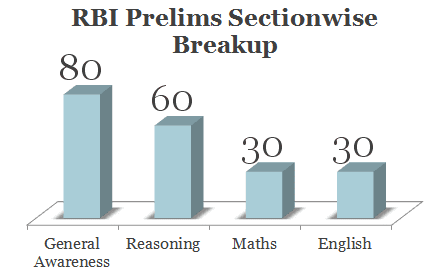
According to RBI’s pattern in 2011’s exam, here is the breakup
| Topic | No. of Qs | Marks | Time |
| General Awareness | 80 | 80 | 45mins |
| Math | 30 | 30 | 20mins |
| English | 30 | 30 | 20mins |
| Reasoning | 60 | 60 | 45mins |
| Total | 200 | 200 |
UPDATE (August-05-2013): As per the RBI Handout for 2013’s Prelim: there is sectional cutoff but no sectional timing. They’ll give 200 questions to you at once, and you can solve them in any order within 130 minutes
Section #1: General Awareness (GA)
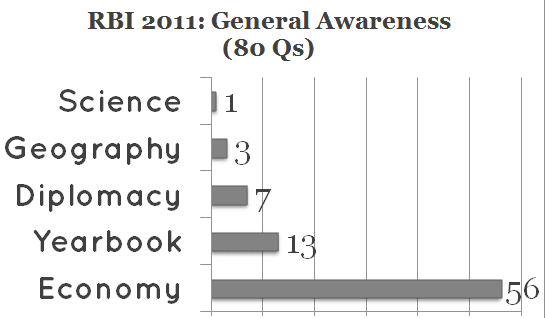
Let us look at the topic wise breakup of General Awareness, in 2011’s RBI preliminary exam.
| Topic | No. of Questions in 2011’s Exam |
| Economy | 56 |
| Yearbook | 13 |
| Diplomacy | 7 |
| Geography | 3 |
| Science | 1 |
| Total | 80 |
You can find the actual questions in the appendix below. Even 2010’s exam had more or less the same breakup: heavy emphasis on Economy and Yearbook type of questions. So now let us see how to approach each of above topics.
How to prepare Economy for RBI exam?
As you look in the last paper, you’ll see some questions are based on “static (theory) portion and rest are based on “dynamic (current affairs). I’ve given the reading list accordingly.
There are mainly 5 type of questions that can be asked in economy related MCQs.
- You’re given a term and four definitions. You’ve to find the correct definition. (or vice versa)
- You’re given a 4-5 organizations and their functions, and you’ve to “match the following”.
- Name of some person and which organization he’s related with. (or vice versa)
- Name of some Government policy/ Act is given, and some statements are given. You’ve to find the correct statements associated with that policy/act.
- Trivial: “Absolute dates and numbers”. For example How much money did Government allot in xyz fund sector? Or what was the repo rate in xyz month? or In which year NABARD was established?
Problem:
- Students devote all their energy in mastering 5th type of questions. But you’ve to bow down to the fact that there can be no end to trivial question. What if you prepared NABARD’s establishment year but they asked about LIC’s year? So the Cost:Benefit ratio is not good.
- Therefore Donot get obsessed with trival facts. Because no war is won without sacrificing a few soldiers. And Nobody expects you to score 100/100 marks – whether it is UPSC, RBI or CAT.
Now here is the reading list/ suggested books.
How to prepare Static Economy (theory)?
- NCERT economics: can be downloaded for free by clicking me
- NIOS (National Open School) study material for Economy (can be downloaded for free by clicking ME
- Indian Economy by Ramesh Singh (TMH Publication)
- For practice-Mock questions given at the end of General studies (GS) manual.
^this is more than sufficient.

- Don’t try to get in minute details (for example many topics in NCERT Class 12 Micro economic.)
- As I keep saying, no point in wasting time in Mishra Puri, Dutt Sundaram, Uma Kapila etc. books they’re written from academic point of view = not very helpful in competitive exam, time is luxery we don’t have.
Once this is done, use the General Studies manual, and solve all the mock questions given at the end of its Economy chapter.
- If you have one, then well and good.
- If you don’t have one, then borrow from some friend or visit Government library. There is absoutely no need to specially buy a GS manual for RBI exam.
How to prepare Dynamic Economy (Current Affairs)?
Prepare highlights of budget 2013 + Economic Survey (lot of content already covered in Mrunal.org/economy
Any one magazine
- I assume you’re in the ‘competition business’ since many months. So you’d have a good collection of current affairs magazines @home. Whether it is CST or Pratiyogita Darpan, Chronicle or Wizard doesn’t matter. Just go through its monthly Economy portion.
- Following are the Priority areas in a magazine in descending order of their importance.
- Economy
- International
- National
- Science tech
- Persons in News
- If you don’t have magazine, no worries, go to Government library of your city, all of these magazines will be available. You don’t have to read all of them, just pick any one and go through it.
- You can also visit Competitionmaster.com (he gives monthly current affairs)
- You can also read Pratiyogita Darpan online for free: http://pdeng.pdgroup.in/Index.aspx
- Question: which magazine to refer? If your sole aim is IAS exam then go for Civil Services Times.
- But if you’re simultaneously preparing for IAS+State PSC+Bank/RBI/SSC type of exams= go for Pratiyogita Darpan. Because he also provides papers for those exams.
Any one newspaper: The Hindu or Indian Express
How to read newspaper = already explained in following article
https://mrunal.org/2012/06/current-affairs-ias.html
You must remember that if you qualify in preliminary exam, you’ll have to face the descriptive papers (phase II). And hence, newspaper reading = essential.
And finally the main villain: Mrunal.com/economy
How to prepare Yearbook
- As you saw in the table, 13 questions came from Yearbook.
- By the word “Yearbook”, I mean Government schemes, social Development etc. (boring) stuff.
- There is again no need to buy the book specifically for RBI exam because, I’ve already covered most of the important stuff related to Government schemes, projects etc from the India yearbook in my summary artiles on Economic Survey (freely available on Mrunal.org/economy).
- Please keep in mind “yearbook” doesn’t mean only the stuff given in that book. They can ask something from those topics, from current affairs. So do read the newspapers, do go through the current affairs magazine.
How to prepare International Affairs
- Any one magazine AND OR Competitionmaster.com
- Any one newspaper: The Hindu or Indian Express
- mrunal.org/diplomacy
How to prepare everything else!
- I mean to say the “miscellaneous topics” for RBI exam (seeing last two years’ papers): history, polity, geography, science = these are all non-important miscellaneous topics.
- But still it’d be mistake to go completely blank on other topics. What if some really easy 3-4 questions come?
- Therefore I suggest you go through Lucent’s General Knowledge book.
With this I conclude how to prepare the General Awareness (GA) portion of RBI Grade “B” officers’ exam.
Now let us move to the aptitude part.
Aptitude
(I put Maths, logical reasoning and English – all three into aptitude)
Section #2: Quantitative Aptitude (QA)
The maths is more oriented towards data interpretation rather than conventional profit-loss type stuff. Go through the old papers (posted at bottom), and prepare topics accordingly. And to clear the basic concepts of maths, you may use the approach shown in the RBI Assistant exam article click me
- Many articles on mrunal.org/aptitude
- Practice old Bank PO question papers (can be googled).
- ignore trigonometry, geometry (other than area volume perimeter), coordinate geometry and logerithms.
Priority areas in Quantitative aptitude (QA)
- Operation on brackets
- Linear equations
- Average + alligiation
- Ratios
- Profit, Loss, %, SI and CI : all can be solved if you’ve clear concept of % calculation.
- Arithmetic and Geography progression.
- TSDW (Time speed distance and Work): all can be solved using the “STD” table, if you go through my old articles on Mrunal.org/aptitude
- Permutation, Combination, Probability : all can be solved without problem, if you go through my old articles.
- Geometry: Area and Volume
- Venn Diagrams
Non priority areas in QA
- Geometry: things other than Area, Volume, Perimeter
- Coordinate Geometry
- Logerithms
- Trigonometry
- Functions and graphs.
^these topics are important for SSC exam but not much for RBI
Data Interpretation (DI)
In this QA (maths) portion, they also asked Data interpretation (DI) questions worth 15 marks, in 2011. There is hardly any theory in DI, all you’ve to do is –practice. Speed (quick calculation) is extremely important here, otherwise you might end up wasting 20+ minutes in doing barely 5 sums of DI.
Basically DI requires speed in Addition and % calculation and lot of practice from old Bank/IBPS papers.
How to get speed for maths calculations?
- Understand this two-digit long division technique explained here click me
- Understand the Trachtenberg’s method for multiplication, especially for 5,9 and 11. plenty of articles on google, start with this one: click me
- Then practice maximum questions from previous years’ IBPS/Bank papers.
(There is no harm in learning Vedic maths techniques either but I find Trachtenberg’s speed maths more user-friendly and convenient than Vedic maths.)
Section #3: English Grammar and Comprehension
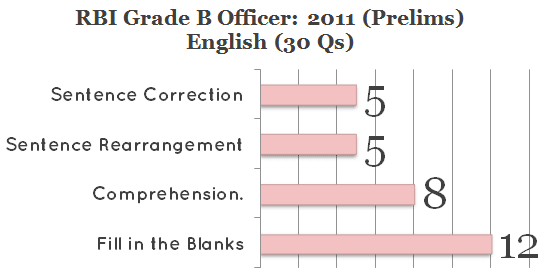
30 questions came from English portion in RBI 2011 exam.
Priority Areas of English Section
Reading comprehension
There are no secret tricks. Just one word: Practice.
Now where to find practice? Plenty of resources, if only you look for them
- Pagalguy forum has dedicated threads for it.
- Just google “GMAT reading comprehension” or CAT reading comprehension you’ll come across plenty of sites providing mock questions.
- You can also use previous years’ papers of UPSC, IBPS, Bank PO to practice.
Sentence arrangement/ Correction, Fill in the blanks etc.
- I feel the best way to master it = Pagalguy forum’s CAT thread for it.
- For grammar book, If you already have grammar book (R.S.Agarwal, A.P.Bhardwaj) etc. use it. If you don’t have any book, I suggest you go for objective general English by SP Bakshi (Arihant Publication).
Vocabulary
- will helps indirectly in the fill in the blanks + comprehension.
- In short, overall approach would be more or less the same as given in earlier “How to prepare English for APFC” article Click ME
Section #4: Logical Reasoning
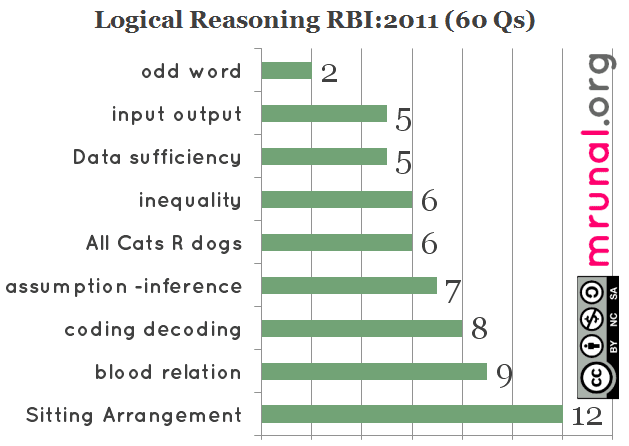
If you donot practice enough at home, the Logical reasoning questions can be “Sitters” (i.e. you waste lot of time trying to figure out blood relation and sitting arrangement etc)
How to approach LR?
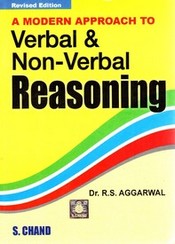
- Solve the sums given in this book: Verbal and Non Verbal Reasoning by Dr. R S Aggarwal
- Problem: the book has about 600 pages and you don’t have that much time.
- Well atleast do 10-10 questions from each variety. + ignore the “non-verbal” portion because it is not that important for RBI (although important for IBPS).
Priority areas for Logical reasoning
Following topics are important, because usually atleast 4 questions come from each of these.
- Blood relations. (generally a “case/parapgrah” followed by 5 questions)
- Sitting Arrangement . (generally a “case/parapgrah” followed by 5 questions)
- Coding –decoding
- Input output
- Inequality (x>y and y<z …)
- Data sufficiency
- Number series- find the next number.
- Assumption and inferences
- All cats are dogs. Syllogism (technique also explained in Mrunal.org/aptitude)
To sum up
- For General awareness: Revision important.
- Priority areas = Economy + Yearbook
- For aptitude: Practice important.
- Priority areas (already given above)
Essential booklist/Preparation sources for RBI Grade “B” officer’s Exam
Free
- NCERT Economy Class 11,12
- NIOS studymaterial on Economy
- Pagalguy.com forum (particularly for grammar, comprehension.)
- Mrunal.org
Not Free but recommended
- Indian Economy by Ramesh Singh (TMH Publication)

- Lucent’s General knowledge
- R.S Agarwal’s book on Verbal Reasoning
- Any one newspaper (Hindu / Indianexpress) [Free if you read online]
- Any one magazine. (Pratiyogita Darpan / CST/ Chronicle/ Wizard) [Pratiyogita can be read online for free, on its official site)
- (optional) Previous years’ Bank PO / IBPS paperset for practicing aptitude
- (optional) GS Manual for practicing Economy and Yearbook questions.
Not free AND Not recommended
- Mishra Puri
- Dutt Sundaram
- Uma Kapila
- Any readymade book from any jholachhap publisher/coaching class titled “RBI all in one guide/study material”.
Appendix:Topicwise Breakup of RBI 2011 Paper.
Here is the Breakup of questions from 2011’s RBI Grade “B” officer’s exam
You can download the the prelims (phase 1) papers of RBI 2011 and 2010 by clicking meSection 1: General Awareness
Economics
- meaning of least developed countries
- statement about India’s GDP
- persons associated with reserve bank of India
- reforms needed after Satyam scandal 2009
- International commodities responsible for cost push inflation
- features of special economic zone act
- definition of GDP
- components of human development index
- how to measure economic growth of a country
- contribution of agriculture sector in total GDP of India
- contribution of service sector in the total GDP of India
- how is India’s national income majored
- Fiscal reforms adopted by government of India
- component of current account and capital account
- What is the purpose of know your customer scheme?
- Name of the organisation responsible to promote micro, small and medium industrial sector in India.
- Why market borrowings of the union government have gone up in the year 2011?
- Which of the following, is not an example of core industry?
- What is the full form of DEPF scheme
- recently, coal Ministry of India has allocated some coal blocks in four states. Which of the following are not among those four states?
- Which of the following is an example of nontax revenue?
- Full form of MRTP act.
- Which of the following is not an industrial sector?
- Who among the following is a deputy governor of RBI?
- Which of the following acts, helps a bank in its day to day activities?
- Lack of access to financial services, is technically known as.
- Which of the following is not a function of NABARD?
- Banks in India required to maintain a portion of their demand and time liabilities with the reserve bank of India. What is the technical term for this portion?
- Example of major risks faced by the bank in their daily business.
- Which of the following schemes was launched by RBI in 2004, under which government of India stated that securities could be issued to absorb surplus or durable liquidity?
- What amount was allocated for raising credit to farmers in union budget 2012
- full form of MFI.
- What is the size of women’s self-help group development fund created by government of India?
- Which of the following statement is true about International monetary fund.
- Definition of bank rate.
- Which of the following term is associated with banking and finance.
- Which of the following is a millennium development goal?
- Which of the following countries got a new bailout package with the help of private sector?
- Goods and services tax will be implemented from which year?
- Full form of TIEA
- Which of the following, is not a credit rating agency?
- Who is the president of the World Bank?
- Which of the following is a contentious issue between WTO and India?
- Who is the head of National Manufacturing competitiveness council?
- Member of G8 among following
- major issue emphasised by Mohan in his UN speech
- what is Robin Hood tax.
- Features of 12th FYP
- the central banks of five developed countries came together recently and decided to provide unlimited dollar loans to banks in their areas. What was the purpose of this?
- Name of the payment and settlement system used by banks in India.
- Federal reserve is the central Bangkok which country?
- Why was FH Malegam committee constituted?
- The controller and auditor general of India recently got appointed an external auditor of which international organisation?
- The special drawing rights are provided by which international organisation?
- Indian citizen is allowed to invest overseas freely accept which country?
- Who got the Nobel Prize for economics in 2011?
Yearbook
- MNREGA definition
- statements from Census 2011
- scheme launched for school children
- name of government act related to sustainable growth.
- Which of the following is a woman empowerment program?
- Full form of AAY.
- Which of the following organisation of women in India,has arisen out of the confluence of three moments – labour movement, cooperative movement and the women’s movement is on Gandhian philosophy.
- Second Green Revolution will be launched in north-eastern states to increase production of which crop?
- Which of the following factors as now a check on migration of agricultural labourers from one place to another place in India?
- Which of the following is not a program launched by government of India?
- Name of the scheme launched to provide prenatal and postnatal care to mother and child.
- Name of the scheme for improving the desert areas.
- Name of the scheme to make Indian cities, free from slums.
International affairs
- Function of high IAEA.
- South China Sea dispute (why China raised objection against India).
- India entered into an agreement to purchase LNG from East Asian nations, under which policy?
- G-7 summit of 2011, was held in which city?
- Which of the following organisation gave warning tp the nations that there may be increased risk to global financial stability in the world?
- Which of the following agency did pollution survey and found that Indian cities are most polluted in the world
- Who represented in India in the first South Asia Forum meeting held in 2011?
Geography
- Sardar Sarovar dam is built on which river?
- Rashidpur Gas fields are located in which country?
- Which country is the largest producer of chemical fertilisers in the world?
Science and technology
- greenhouse gases are responsible for what?
Section 2: Maths / quantitative aptitude
Topic number of questions - Operation on Brackets e.g. 27^2×5-31+4=??
5 - Solve the Linear equations, find values of x,y and z and find relation between them (e.g. is x<y=z? etc)
5 - series of numbers is given, you’ve to find the next number.
5 - Data interpretation case based on Venn Diagram concept.
5 - Data interpretation case based on Radar graph.
5 - Data interpretation case based on huge table of yearwise animal population.
5 Total 30 Section 3: English grammar and comprehension
Comprehension. 8 Sentence Rearrangement 5 Fill in the Blanks 12 Sentence Correction 5 Total 30 Section 4: Logical reasoning
Topic number of questions Blood relation 9 Inference and assumption based on paragraph 3 Coding – decoding 7 Data sufficiency 5 All cats are dogs 6 Seating arrangement (two cases are given) 10 Weight arrangement (Abhishek is heavier than..) case 2 Inequality based statement-conclusions (i.e N<O<R and R>A) 5 Input output 5 Logical reasoning based on paragraph. 5 Find the odd words in the group 2 Total 57 Cut off for RBI Prelims 2010 (Phase I)
This is provided by my friend from Pagalguy Mr.CSL80, through RTI
Sectional Cutoffs
(minimum marks / sectional cut-offs) Number indicates correct questions.
Section SC ST OBC GEN GA 8 8 8 12 English 7 7 7 11 Quant 3 3 3 6 Reasoning 11 11 11 17 Total cut off score for selection to phase 2
SC ST OBC GEN 85 93 94 104 Highest marks scored by individuals in different category
SC ST OBC GEN 122 122 132 148 Previous phase I papers, Salary and Allowances for RBI Officers
provided by CSL80, Here is the PDF File: CLICK ME
![[Studyplan] CDS Maths Paper: Number System, Quadratic Equations, Surds, Indices, Linear Equation (Part 1 of 3) for UPSC Combined Defense service exam](https://mrunal.org/wp-content/uploads/2012/10/icon-plan-500x383.png)
![[Studyplan] MPPSC Mains GS1 and GS2: Priority Revision topics](https://mrunal.org/wp-content/uploads/2013/09/i-mppsc-500x383.png)
Phase 2 preparation link of March, 2012
https://mrunalmanage.wpcomstaging.com/2012/03/study-plan-rbi-officers-phase-2-exam.html
what will be cut off for OBC . I have done total 135
accuracy?
is there any hope
countdown starts for result.. (on unknown timer!)
will it come on monday?
may be or may not be
many people are predicting high cutoff marks but you need to remember one thing , there is sectional cutoff and differtial marking also. If cutoff goes high , sectional cutoff will also go high .
Last time sectional cutoff was
GA 12 with Differtial marking 1.60
Eng 11 with Differtial marking .75
Quant 06 with Differtial marking .75
Reasoning 17 with Differtial marking .75
any many people here who are expecting very high cutoff 120+ have answered around 30 to 35 questions in Reasoning and most of their attempts in GA.
with 35 correct Reasoning attempts you will score only 26.25 and with increased overall cutoff ,if cutoff for Reasoning goes up by 5 to 6 marks and say for example cutoff is 22 then just with 3 or 4 wrong answers , you are already out of the game buddy, so think twice before predicting very high cutoff marks , just answering 60+ in GA might not be good enough!
exactly buddy one needs to be sure about all the sections of the paper before concluding the cut-off or even their marks. and definitely cut off will surely not be more than 120 because as I have mentioned earlier that I had reviews of my friends and if not all 90% of them end up 90.
secondarily I have never met anyone who is specifically preparing for RBI- Grade b. Most of people try their luck (if not UPSC then RBI) So we can be sure that even in GK attempting 50-55 question is sufficient or should I say that attempting above that will only means guessing – which leads to negative marking.
and I do believe that there may b people who have attempted above 150 but ask them how many are sure of their attempts
attempting 150 is no big deal. if one attempts 20 wrong then his marks would come down to 125. again to an average student.
are u serious regarding RBI exam or its just another exam?
have u read the hand out and advertise correctly?
there is no differential marking this time.
in feb/2011 there were differential marking( as u you have stated)
in dec/2011 and aug/2013 exam- no differential marking.
yes buddy, i am damn sure, we are all PO qualifiers but we chose RBI assistant and we are not going anywhere else so RBI grade B is our only choice.
Stay assured whenever is ibps conducting test there will always be differtial marking because all of us here at office have scored more than we attempet in particular section because of differtial marking (since we don’t believe in guesswork).
See all po notifications , marks for each section is mentioned (differtial marking is maximum marks in each section * weighted marks for that section)
In RBI notification, nowhere it is mentioned that there will not be differential marking.
if in dec 2011, there was no differential marking then do you thing a job paying 12lack per annum will keep 6 as cutoff out of 30 for quant section, was last years quant so very tough .. rather than getting mad at me think twice.
so sir @simple guy you feel in ibps also such process is their ???
buddy.. cut off marks u r specifying is of Feb/2011 and not dec/2011 (which is not known or not available in any website).. cut off marks of feb/2011 is available (which had differential marking)
feb/2011- 50 GA questions x 1.6 = 80.
quant+eng+Reas= 160 questions x 0.75 = 120
Total marks- 200
total questions- 210
60 questions reasoning for 60 marks
30 english for 30 marks
30 maths for 30 marks
ga 80 for 80 marks
read the notice carefully and dont create panic. each question carry 1 mark for all sections
Read the handout that came with admit card(not add/notification)
it was clearly written.
you may get more marks than you attempt if normalization is done.. it is done now a days where more than one exam slots are there to bring all to a base level (eg- done in CAT)- due to varying difficulty level.
And differential marking is another matter- where every question is assigned different marks (say in XAT and in RBI-GrB-Feb/2011)
what is differential marking ??
plz explain.
Competitive exams are always easy but at the same time they are tricky.
@deepti
in ibps also it was like this 50 questions for 50 marks but all of us who have left PO jobs experienced the same thing.
@saurav
what you are saying is quite reasonable , be it differtial marking or normalization(i don’t know how normalization works) , but for assistant exam cutoff was 151 and people here predicting cutoff 140 , seemed a little strange.
anyway , there should be little bit panic when you are waiting for grade B exam , how can calculation be so easy like 140 attempts – 10 wrong=127.5 score . we have lot of 185+ scorers of PO and a few UPSC interview appeared candidates here at office and we think cutoff should not be more than 110. Let’s see who is right and who is wrong..
Hi,
I am an engineer working with TCS and am considering applying for RBI grade ‘b’ in 2014. I have worked in core banking for a year now. Although the notification states that person from any discipline can apply is there any pre-requisites for a non commerce background to fulfill to get selected if he clears the written? Do we have a disadvantage?
Hello sir i am post graduate. but i have diploma in management not degree, so am i eligible for grade b officer? plz reply
btw, when are the results expected to come out ?? what is the reason for such a delay ?
@karthik
what score are you expecting??
attempted 38 in GA, 26 in QA, 30 in ENG and 44 in Reasoning. accuracy more than 90% hopefully ..
Specially for us (GR-B aspirants) RBI office will be open on Saturday and Sunday.
hello friends i m selected in nicl exam but my father salary is 618000 i fill the form with OBC but i have old certificate. what i do plz help me . should i couldnt belong to OBC non cremy layer will they disqualify me from the interviwe
@BHA
yes u hav to issue new certificate if the previous one has period more than six month.if your father income is from government salary then don’t worry u r in non creamy layer.there are 2 test for this. One is ur father post and other is wealth test.
1:Constitutinal post-: Sones) and daughter(s) of
(a) President of India;
(b) VIce President of India;
(c) Judges of the Supreme court and of the
High Courts;
(d) Chairman & Members of llPSC and of
the State Public Service Commission;
Chief Election Commissioner; Comptroller
.& Auditor General of India;
(e) persons holding Constitutional positions
of like nature.
2:-SERVICE CATEGORY
A. Group AlClass 1 officers of the All India
Central and State Services (Direct Recruits).
Sones) and daugther(s) of
(a) parents, both of whom are Class I officers;
(b) parents, either of whom is a Class, I
officer;
(c) parents, both of whom are Class I officers,
but one of them dies or suffers
permanent incapacitation.
(d) parents, either of whom is a Class I
officer and such parent dies or suffers
permanent incapacitation and before such
death or such incapacitation has had the
benefit of employment in any International
Organisation like UN, IMF, World
Bank, etc. for a period of not less than 5
years.
(e) parents, both of whom arc class I officers
die or suffer permanent incapacitation
and before such death or such incapacitation
of the both, either of them has had
the benefit of employment ,in any International
Organisation like UN, IMF,
World Bank, etc. for a period of not less
than 5 years.
Provided that the rule of exclusion shall
not apply in the following cases:
(a) Sons and daughters of parents either
of whom or both of whom are Class-
I officers and such parent(s) dies/die
or suffer permanent incapacitation.
(b) A lady belonging to OBC category
has got married to a Class-I officer,
and may herself like to apply for a
job.
Group BIClas.•.•II officers of the Central & State
Services (Direct Recuritment)
Son(s) alld daugther(s) of
(a) parents both of whom are Class II
officers.
(b) parents of whom only the husband is a
Class II officer and he gets into Class I at
the age of 40 or earlier. .
(c) parents, both of whom are Class II officers
and one of them dies or suffers permanent
incapacitation and either one of
them has had the benefit of employment
in any International Organisiation like
UN, IMF, World Bank, etc. for a period of
not less than 5 years before such death or
permanent incapacuation;
(d) parents of whom the husband is a Class I
officer (direct recruit or pre-forty promoted)
and the wife is a Class II officer
and the wife dies; or suffers permanent
incapacitation; and
(e) parents, of whom the wife is a Class I
officer (Direct Recruit or pre-forty promoted)
and the husband is a Class II
officer and the husband dies or suffers
permanent incapacitation
Provided that the rule of exclusion shall
not apply in the following cases:
Sons and daughters of
(a) Parents both of whom are Class II
officers and one of them dies or suffers
permanent incapacitation.
(b) Parents, both of whom are Class II
officers and both of them die or suffer
permanent incapacitation, even
though either of them has had the
benefit of employment in any International
Organisation like UN, IMF,
World Bank. etc. for a period of not
less than 5 years before their death or
permanent incapacitation
empI9)Jees in Public Sector Undertakings etc.
The criteria enumerated in A &B above in this
Category will apply mutatis mutandi to
officers holding equivalent or comparable
posts in PSUs, Banks, Insurance Organisations,
Universities, etc. and also to equivalent
or comparable posts and positions under
private employment, Pending the evaluation
of the posts on equivalent or comparable basis
in these institutions, the criteria specified in
Category VI below will apply to the officers in
these Institutions.
1lI. ARMED FORCES INCLUDING PARAMILITARY
FORCES
(Persons holding civil posts are not included)
Son(s) and daughter(s) of parents either or
both of whom is or are in the rank of Colonel
and above in the Army and to equivalent
posts in the Navy and the Air Force and the
Para Military Forces; ,
Provided that:-
(i) if the wife of an Armed Forces Officer is
herself in the Armed Forces (i.e., the
category under consideration) the rule of
exclusion will apply only when she herself
has reached the rank of Colonel;
(ii) the service ranks below Colonel of husband
and wife shall not be clubbed
together;
(Hi) If the wife of an officer in the Armed
Forces is in civil employment, this will
not be taken into account for applying
the rule of exclusion unless she falls in
the service category under item No. II in
which case the criteria and conditions
enumerated therein will apply to her
independently.
INCOME/Wealth test
Sones) and daughter(s)of
(a) Persons having gross annual income of
Rs. llakh or above or possessing wealth
above the exemption limit as prescribed
in the Wealth Tax Act for a period of
three consecutive years.
(b) Persons in Categories I, II, III and V A
who are not disentitled to the benefit of
reservation but have income from other •
sources of wealth which will bring them
within the income/wealth criteria mentioned
in (I) above.
EXPLANATION THE MOST IMPORTANT:
(i) Income from salaries or agricultural land
shall not be clubbed;
(ii) The income criteria in terms of rupee will
be modified taking into account the
change in its value every three years. If
the situation, however, so demands, the
interrugnum may be less.
if u need further details then mail me at aku061986@gmail.com
if u r not fulfill the criteria mention above then u r in obc non creamy layer.
http://www.indiatimes.com/news/india/government-raises-obc-creamy-layer-income-limit-to-rs-6-lakh-78220.htmln
guys the result for Grade B is out
rbi grade b results out.
i’ve not cleared …
best of luck to those who cleared..
depressed deeply…
now going to focus on upsc mains.. how much I can..
anyway bye bye from this thread… sorry for if I hurt someone by any of my comments…
Got in. expected score 130
Congrats n all d best for next phase:)
cleared :) ..gen category
how much was ur expected score?
BTW congratulations and all d best for next phase
Not cleared…luks fwd to SEBI…greetings those who cleared
I m in too :)
congratulations and all the best for next phase:)
thanx , hw was yours ?
disappointed:(
congrats to those who have cleared..all d best for those who have cleared
got in cleared…….now rbi asst interview on 26th,tier 2 on 29 and grade b……..how to manage
I am in too….i am soo happy…yupieee
Hey !!!!! how much u attempted in each section. plz post here so we could figure out some idea about the individual cut off !!!!
Thanks and Regards
Thankeww Mrunal Sir…without ur guidance…this was not possible….Thankyou so much Mrunal Sir…:)
Hey !!!!! how much u attempted in each section. plz post here so we could figure out some idea about the individual cut off !!!!
Thanks and Regards
I hav attempted
GA-49
English-27
Reasoning-46
Maths-20 and got 135 Marks
disappointed. allthebest those got in
In
Thanks Admin
Result for RBI Officers Exam-2013, phase I declared click me
thanks to u sir i am qualified for 2nd phase.
Hi Aku,
Congrats!!!
What was your score and to which category do you belong?
@Rahul
well rbi has not declared marks yet but it will soon. i had attempted 160 question out of 200.
IN reasoning -51
IN aptitude – 24
IN GS——– 59
IN English—-26
cleared & what about phase 2. which books we needed ???
cleared….expected 130..ST cat…good news to cheer..after failing in UPSC pre!!!!