
- Prologue
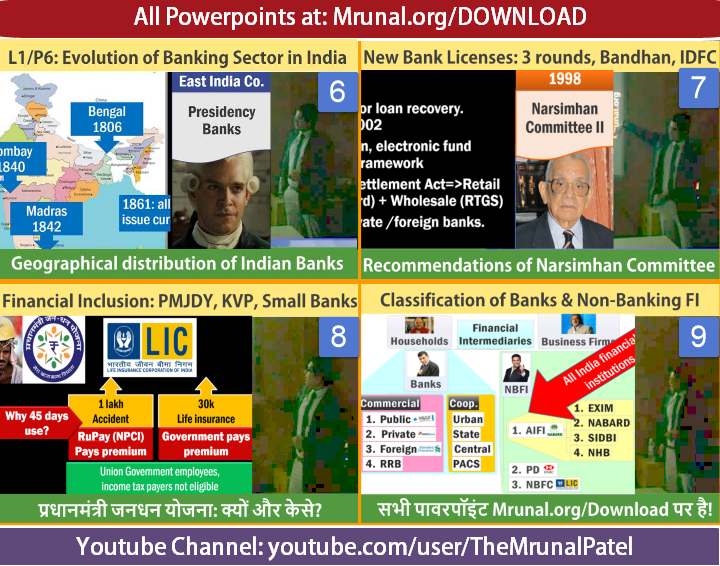
- L1/P6: Evolution of Banking sector in India
- L1/P7: Narsimhan Committee, 3-rounds of bank licenses
- L1/P8: Financial inclusion: PMJDY, KVP, Rupay, Small Banks-Payment Banks
- L1/P9: Classification of Banks and Non-Banking financial institutions (NBFI)
Prologue
- Third lecture was done on 30th January 2015, and uploaded on youtube. Total ~2:30 hours but I’ve split it into four parts.
- PowerPoint of the lecture, available at Mrunal.org/Download
- Medium of instruction- Hindi.
- English version not possible for the moment, because I’m required to teach at this batch, in Hindi/Gujarati only. Besides, same content is available in English-text articles and English PPTs on the site.
L1/P6: Evolution of Banking sector in India
- Indian and foreign banks in pre-independent India
- factors affecting location of banking industry
- Why was there no financial inclusion in British India, despite existence of Indian-banks?
- Why was RBI setup?
- Bank nationalization in Post independent India: Why, How, When?
- Problems created by Bank nationalization. How did it contribute to BoP crisis?
Youtube Link: http://youtu.be/XB9bJtb09lA
L1/P7: Narsimhan Committee, 3-rounds of bank licenses
- Recommendations of Narsimhan-I and Narsimhan-II Committees.
- Private bank licenses in 3 rounds.
- Bimal Jalan Committee’s “In-Principle” approval to (1) Bandhan Microfinance and (2) IDFC
- Bharatiya Mahila Bank (BMB) features, purpose and why is it a symbolic exercise without substance?
Youtube Link: http://youtu.be/7VCPyVXJQQk
L1/P8: Financial inclusion: PMJDY, KVP, Rupay, Small Banks-Payment Banks
- Define financial inclusion?
- Why do we need financial inclusion?
- Steps taken so far by various governments
- PM’s Jan-dhan Yojana- 6 pillars, salient features and criticism.
- Rupay card, what is payment gateway, how does it work? What’s the connection between Rupay card usage and 45 days?
- Kisan Vikas Patra- features, Shyamla Gopinath Committee and safeguards against Money laundering.
- Small Banks, Payment Banks: salient features-functions
Youtube Link: http://youtu.be/-MwlISnrVqw
L1/P9: Classification of Banks and Non-Banking financial institutions (NBFI)
- What’re financial intermediaries?
- What’re the difference between commercial and cooperative banks?
- Regional rural banks- origin, ownership, problems and amendment
- Cooperative banks: origin, classification, problems.
- AIFI (All India Financial institutions): EXIM, NABARD, SIDBI and NHB. origin, ownership, functions, past MCQs from UPSC
- Primary dealers: meaning, functions
- Non-Banking financial companies (NBFC): How are they different from Banking institutions, internal classification of NBFCs.
- Microfinance companies
- Leftover topics and the-end of Banking sector “static” portion
Youtube Link: http://youtu.be/xM3D0xaTesM
![[Summary] Budget & Economic Survey 2018 Gist for the UPSC IAS/IPS Interviews](https://mrunal.org/wp-content/uploads/2018/02/c-bes18-basanti-500x383.jpg)
![[BES171] Banking-Classification: Wholesale Banks, Cooperative Banks, DFI AIFI, MUDRA Bank, Islamic Bank, NBFCs & Indigenous Moneylenders](https://mrunal.org/wp-content/uploads/2017/05/c-bes171-evo-2-500x383.gif)
![[BES171] Banking-Classification: RBI Structure Functions, Nationalization, Scheduled Banks, Merger of SBI Associate Banks & BMB, Private Banks, SFB & Payment Banks](https://mrunal.org/wp-content/uploads/2017/02/c-bes171-cover-500x383.gif)
thanks a lot
thanks sir for this great video
thanks a ton!!!!
THANK YOU SOOOO MUCH SIR.:-)
Thanks a lot Sir . God Bless you…!!!!!
Like Always Only One Word GREAT.Thanks SIR
Thank you sir……..!!!!
saying thnk you to you SIR..is a very small thing for your selfness service…but dats d only thing i can do at this moment..you have revolutionized the way of teaching..specially ECOMNOMICS MADE EASY…THNX AGAIN..
sir are you going to uppdate other sector too or its just ecomony
sir i want to join spipa and also want to know that other state candidates are allowed or not???
Anyone who has joined byju test series from fdb kindly contact
Thanks to,
The GrEaT MRUNAlSIR………
Sir Can you provide Polity and world history lectures .
I m finding difficult to understand polity conceptually
thank u sir
Sir,very less information available on NABARD exam.
Please do a post,even if a smaller one regarding all the aspect of it covering paper,postings etc.
Thanks!
Thanks!!!!!
thanks for providing such a wonderful videos………
i am preparing for bank exam. i am from a small town i do go to coaching but no one teach like this thank u. u are awesome
Thanks a lot sir
hi,
I am notable to open files on online storage. Please somebody help me out and kindly tell me how to.
Thanks!
Thank you Mrunal Sir…
Thank u sir ji
awesome sir u r jewel of economy
Mrunal bro, there are geography notes also located in the your folder by some Ratanjali name, can we have you tube video for geography lectures as well..
It would be very fruiful because after listning and watching video , it is easy to grasp the things.
Please Suggest !!
Raj
Its not ratanjali… It is “rajtanil”… Well … She is a faculty member of PDPU. I think madam doesn’t take lectures in SPIPA. & pdpu class has no facility of video recording. So videos are not available. You can use her ppt files & the folder of ncert books. It will help you lot. … (Even madam says that its enough)… After completing it you can go for any one book “spectrum” or “khullar” or “Hussain.”…
Thanks Shalu !!
can you provide me the link to reach geography notes as i am unable to sort out….
You can’t download it using smartphone or tablet. You have to use laptop or desktop. And the data size is 3-4 GB (including ncert, NIOS & tamilnadu state board…for all the subjects- already bifurcated subject wise in zip folders.) better if you get it from a friend. … Or go to – mrunal/ download…
Have you seen? … Geo. Lectures are also available. Good luck.
sir, Please publish PIN january as soon as possible ….. waiting eagerly
somebody please tell …where are the marks of the grave in which cgl2014 has been buried?
Great sir!!!
What is ?Growth rate of industry & service sector at 12th plan
Respected Mrunal sir. Firstly I am very much thankful for the lectures you are delivering & making us available on Youtube.com. I am hugely getting benifited by your lecture. I just want to say as your posting your lectures including Economics your requested to also make available other subjects lectures on the Youtube so that students like me who can’t afford huge cost of UPSC exam coaching would be benifited. Thank you once again sir.
I have a question regarding UP-PSC . The current notification is for Review officer. Would there any other exam or posts out from UPPSC or I’ll have to apply here ? I mean is this equivalent to Civil Service at State level ? If anybody has an idea, please clarify .