
- Structure is Review Officer Exam?
- Brief Analysis of 2010’s paper (GA/GK)
- History
- Geography
- Environment related
- Polity
- Government Schemes
- Economy
- Science
- Aptitude
- Misc.GK / Person in News (PIN)/ Sports/ Award
- Hindi Grammar, Vocabulary Paper (60m)
- Piecemeal preparation =#Epicfail
- Free study material, Download links
Structure is Review Officer Exam?
- It is a non-interview exam, selection based on written score only.
- Exam has two stages: prelim + mains
- Prelim stage Contains two papers
| GA/GK+Maths & Reasoning | Hindi language |
| 140 MCQ | 60 MCQ |
| 2 hrs | 1 hr |
|
Hindi Vocabulary and grammar. Check the attached paper and you’ll get the idea. |
Brief Analysis of 2010’s paper (GA/GK)
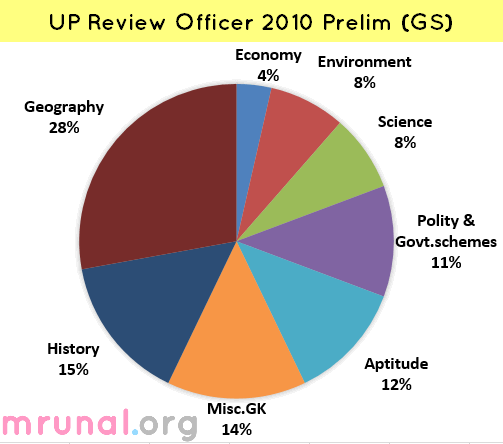
| Aptitude | 17 |
| Geography | 39 |
| Environment | 11 |
| Science | 11 |
| History | 21 |
| Polity+ Government schemes | 16 |
| Economy | 5 |
| Misc.GK/PIN/Sports etc. | 20 |
| Total | 140 |
- The structure/skeleton is similar to CAPF (Assistant commandant exam). Majority of questions from general studies and a few question from maths+reasoning.
- Topicwise breakup is somewhat similar to UPSC prelims of early 2000 -in the sense that major emphasis used to be on History and Geography.
- Question difficulty level bit easier than SSC CGL. But there is a sharp difference: SSC-CGL gives special focus on science, this one doesn’t.
- Economy is entirely current affairs based.
- History is GK based.
- Maths-reasoning is very basic level. (Walk in the park compared to CGL/IBPS).
Anyways, let’s see how to approach individual topics:
History
Can be further classified into:
| Ancient | Buddhism, Jainism, Harappa, Asoka, Maurya etc |
| Medieval | Delhi sultanate, Mughals etc. |
| Modern | British raj, freedom struggle. |
| Culture | Various religion, caves, paintings, classical music, dance |
In the review officer, the History MCQs are Mostly GK type. In terms of cost benefit ratio, priority order=Modern > Ancient > Medieval.
For Modern History (British Raj, Freedom struggle,) don’t waste time on NCERT because they don’t cover the GK related to various congress sessions, contribution of freedom fighters or dates etc. Therefore, directly prepare Modern History with any one of the following depending on your convenience:
- Lucent General knowledge book
- Spectrum’s Brief History of Modern India OR
- General Studies Manual (if you already have it. There is no need to specifically buy it for this exam)
Multiple revision is essential. Here are some demo questions on Modern Indian history/freedom struggle from earlier exam
|
|
Once that is done, prepare ancient and Medieval from Lucent’s GK book or from General Studies Manual,
but don’t waste time on minute details.
| Topic | Focus areas |
| Ancient |
|
| Medieval | Contribution of kings+ who defeated whom. |
| Culture | NIOS material given but do only if you’ve spare time. This exam usually focuses on major events rather than on culture as far as history is concerned. |
Demo Questions from earlier exam
| Ancient | Medieval |
|
|
Geography
Can be sub-classified into
| Priority | Geography type: | What does it contain (From Review officer exam point of view?) |
| High |
|
Mineral resources, rivers, mountain-passes etc. |
|
Mostly Economic geography including CENSUS 2011. | |
|
Overlaps with Physical +Indian.Types of soil, horticulture, cropping seasons, methods etc. | |
| Low |
|
stars-planets, Earth, weather, atmosphere, erosion, ocean-current etc. |
|
People-occupation, industrial-mining regions, climate-jungle etc. |
- high priority=Uttar Pradesh’s Geography, India’s geography, Agro related
- Low priority=physical and world.
What to prepare for Indian Geography
Example questions from earlier exam
|
|
They also asked some assertion reasoning type questions. Therefore first prepare following chapters from NCERTs
| Geography Topic | NCERT class | Chapter |
| Physical features | 6 | 7 |
| 9 | 1, 2 and 4 | |
| 11 | 1 and 2 | |
| River system | 9 | 3 |
| 10 | 3 | |
| 11 | 3 | |
| 12 | 6 | |
| Economic Geography | 10 | 1,5,6,7 |
| 12 | 7 to 12 | |
| Human geography | 9 | 6 |
| 12 | 1 to 4 |
+ Also prepare ch.30 from India Yearbook, it gives lot of info on various Indian states, their geography, wildlife etc. (You don’t need to specifically buy the latest edition for Review Officer, just use India 2011 PDF-its Free download link given @bottom)
Uttar Pradesh Geography
Another high priority area is Uttar Pradesh’s Geography (+ CENSUS 2011). Prepare following things:

- Physical geography of UP e.g. rivers, tributaries, hills, soil types, rainfall in various regions.
- GK related to districts
- Total # of many districts?
- biggest and smallest district in terms of area and population
- Which district was formed/renamed recently?
- Economic geography of UP
- Famous cities/towns for handicraft, manufacturing etc.
- location of mineral deposits
- thermal and nuclear power stations
- major crops and crop producing areas
- New initiatives regarding solar energy etc.
- +location of Divisional HQs of Railways, army etc.
- Important state / central government institutions, famous old colleges, important centers of freedom struggle etc.
but, Where to gather all this information?
- Uttar Pradesh State education board’ textbooks for social science/geography
- Arihant Publication has released a book called Uttar Pradesh Digdarshan

- Official websites of respective departments of UP State government.
Sample questions from earlier exam
|
|
UP: CENSUS related
Use internet to dig information related Census 2011, with specific reference to Uttar Pradesh. here is what I got from UP government’s official site
| Population (As per census 2011 Provisional data) | 19,95,81,477 |
| (a)Males (As per census 2011 ) | 10,45,96, 415 |
| b)Females (As per census 2011 ) | 94, 985,062 |
| Decennial Growth rate (2001-2011) (As per census 2011 ) | 20.09 percent |
| Sex Ratio (As per census 2011 ) | 908 per thousand |
| Density (persons per sq. km.) (As per census 2011 ) | 828 per thousand |
| Child Population (0-6 years) (As per census 2011 ) | 29,728,235 |
| Child sex ratio (0-6 years) (As per census 2011 )) | 899 per thousand |
| Total Literacy rate- | |
| Persons | 69.72 percent |
| a)Male Literacy | 79.24 percent |
| b)Female Literacy | 59.26 percent |
| Districts | 75 |
| Cities & Towns | 689 |
| Development blocks | 820 |
| Nagar Nigams | 12 |
| Members of Lok Sabha from U.P. | 80 |
| Members of Rajya Sabha from U.P. | 30 |
| Members of U.P. Legislative Assembly | 404 |
| Members of U.P. Legislative Council | 100 |
Here are some demo questions from earlier exam:
- According to the census 2001, Female : Male Ratio in Uttar Pradesh was
- 878 females per thousand males
- 898-females per thousand males
- 918 females per thousand males
- 928 females per thousand males
- Based on 2001 census which one of the following statements about Uttar Pradesh is not correct?
- Rural population is 79-21 per cent of the total population of the state
- Male literacy rate is 68-8 per cent
- It ranks twelfth (12th) in India in terms of density of population
- The district with lowest population is Mahoba
Geography World
sample questions
|
|
Source for World Geography preparation
| NCERT class | Chapter # |
| 7 | 7-10 |
| 8 | 1, 3, 5 and 6 |
| 12 (fundamentals of Human geography) | 1 to 4, 6 to 10 |
After that Lucent’s GK book depending on time left
Geography; Agriculture
| NCERT Sub. | Class | Chap. |
| Geo. | 8 | 4 |
| 10 | 4 | |
| 11 | 6 | |
| 12 (Fundamentals of Human Geography) | 5 | |
| 12 (India) | 5 | |
| Sci. | 7 | 3,9 |
| 8 | 1 | |
| 9 | 15 |
Geography: Physical
Official syllabus mentions
“World Geography, and Geography and Natural Resources of India.”
- Official syllabus doesn’t talk about physical geography. Even in earlier exam, barely 1-2 questions from topics associated with physical geography. So, There is not much point in preparing this topic in detail.
- Still if you have time and want to prepare, then go through the NCERTs. (download folder @bottom, already contains separate zip file for physical geography).
Environment related
Some questions from earlier exam:
|
|
For the foundation /base material is NIOS (free download links @bottom).
also do following NCERT chapters
| NCERT Sub. | Class | Chap. |
| Geo. | 6 | 8 |
| 7 | 1 to 6 | |
| 8 | 2 | |
| 9 | 5 | |
| 10 | 2 | |
| 11 (india) | 4 and 5 | |
| 11 (Physical) | 15 and 16 | |
| Sci. | 7 | 7, 16-18 |
| 8 | 7 and 18 | |
| 9 | 14 | |
| 10 | 14 to 16 |
+ GK related to wildlife parks, national sanctuaries of India and the animals found in it via Lucent GK/ Internet (with specific emphasis on Uttar Pradesh).
Polity
Let’s check some questions from previous paper
Which one of the following is nor a Directive Principle of State Policy?
|
The idea of Fundamental Rights in the Indian Constitution has been borrowed from the
|
Which of the following are covered by the 73rd (seventy-third) Amendment?
Select the correct answer from the code given below :
|
The Vice-President of India :
Select the correct answer from the code given below
|
For preparation:
- Read Indian polity by M.Laxmikanth. For Hindi medium, the same book is available under the title “Bharat ki Rajyavyavstha, M.Laxmikanth”.
- India Yearbook chapter number 3 and 20. (You don’t need to specifically buy the latest edition for Review Officer, just use India 2011 PDF-its Free download link given @bottom)
Here are some tips on how to Laxmikanth’s book efficiently and get a good grip over the polity within a short period of time?
Don’t study the book in a linear fashion (that is chapter 1,2,3,4…sequence)
Instead I suggest you read the book in following direction:
- First you read the chapter on President, Vice President and immediately move to the chapter on governor. Then read on Emergency provisions.
- Read chapter on PM and cabinet, then move to CM and state council of Ministers.
- Chapter on “Parliamentary system” and then directly to parliament, but after budget topic is done pause this chapter and move to on CAG. Then come back and resume the chapter on parliament.
- Once parliament is finished, move to State legislative assembly.
- Supreme Court and then High court, tribunals.
- Attorney Gen =>Advocate General
- UPSC =>State PSC
- Finance Commission =>Planning Commission=>Nat.Development council
- Now Centre State relation and Interstate relations.
- Election Commission=> chapter on election, Anti-defection
- All the National Commissions on Women, SC, ST,OBC, CVC, Lokpal and so on.
Once ^this is done. Move to
- Citizenship, Fundamental rights, DPSP, duties.
- Amendment of Constitution=> preamble
- Jammu Kashmir => Scheduled and Tribal Areas.
- UT, Panchayati Raj, municipalities
After ^this is done. Read whatever chapters are remaining. Ultimately
- Appendix for union-state-concurrent list, table of precedence etc.
- the mock MCQ questions given in Laxmikanth
UP related Polity
also memorize the number of seats of UP’s Vidhan sabha, Vidhan Parishad,
and seats in Rajya-Sabha, Lok Sabha.
Government Schemes
Sample questions from earlier exams:
|
|
Most of the Government schemes are covered in my following articles (click on the following links)
- [Economic Survey Ch13] Human Development (Part 4 of 4): Physically Disabled, Elderly, Nomadic, Denotified Tribes, Drug junkies and Beggars
- [Economic Survey Ch13] Human Development (Part 3 of 4): Women and Child Development, Saksham, Priyadarshini, Dhanlaxmi & yes ofcourse SABLA
- [Economic Survey Ch13] Human Development (Part 2 of 4): SC, ST, OBC, Minorities: welfare schemes, 12th FYP targets
- [Rights issue] Education: Government schemes, organizations, SABLA, NPEGEL, Jalmani, Bal Shree, mock questions
- [Public Health] Current Affairs 2012-13: Government schemes, Policies, Yearbook stuff (Part 1 of 3)
Economy
In earlier exam, they asked all Economy questions from current affairs only. For example:
|
|
- go through the economic survey articles on Mrunal.org/economy
- +magazine issues but don’t waste lot of time in mugging up numbers (because economy is not a major portion of this exam)
Science
Some questions from earlier exam:
|
|
As you can see this is very basic level Science. Just use NCERTs class 7 to 10
| Sci.Subtopic | NCERT Class | Ch.No. |
| Physics | 7 | 4, 13 to 15 |
| 8 | 11 to 16 | |
| 9 | 8 to 12 | |
| 10 | 10,12 and 13 | |
| Chemistry | 7 | 5,6 |
| 8 | 3 to 6 | |
| 9 | 1 to 4 | |
| 10 | 1 to 5 | |
| Biology | 7 | 1 and 2, 10 to 12 |
| 8 | 2, 8, 9 and 10 | |
| 9 | 5 to 7 and 13 | |
| 10 | 6 to 9 and 11 |
Aptitude
Maths/Quantitative aptitude
Let’s look at some samples from earlier exam
|
|
As you can see very basic level questions are asked. So maths becomes a “no-excuse, must-be-prepared”
understand the theory/concepts from the sources mentioned in following table.
| Number theory |
|
|
| Algebra | Linear equation |
|
| Avg and Ratios | Wine-Water mixture (Alligations) | Can be solved without formula. read this article click me |
| Simple Average | Just practice sums from your quantitative aptitude book. | |
| Ratio-Proportion-variations | For ratio-proportion NCERT Class 8 Chap 13. | |
| Partnership | Can be solved without formula. read this article, click me | |
| STD |
|
All of them can be solved effortlessly, with just one Universal STD formula.Explained in various articles of Mrunal.org/aptitude |
| Mensuration | Area, Volume, Perimeter |
|
| % | Profit, loss, market price, discount |
|
| Simple interest (SI), compound interest (CI), population growth |
|
Maths ignore these topics
- coordinate geometry
- logarithms
- trigonometry
- Geometry theory except the area, volume, perimeter (AVP).
- quadratic equations
Above topics are important for SSC-CGL, CDS and CAT but rarely asked in other exams- particularly in State PCS recruitments.
Reasoning
- in the earlier exam, they’ve asked very basic level rasoning questions, from number-sequence series, coding-decoding, direction based test + non-verbal reasoning.
- the Recommended Book is as usual: RS Aggarwal’s Modern Approach to verbal and non-verbal reasoning. Then the question is, how to prepare reasoning in systematic manner in the given time? Do it in following manner:
Chart based
- This includes: Direction sense test, Sitting arrangement (rectangle, circular, building, lecture schedules etc.) and blood relations.
- I club them together because in all of them you’ve to make rough diagram / chart / table to solve it.
- Here is the order in which they should be prepared:
| Sr.No | Topic | RS Aggarwal Chapter No. |
| 1. | Direction Sense Test. | 8 |
| 2. | Sitting arrangement: circular | 6 |
| 3. | Sitting arrangement: rectangle | 6 |
| 4. | Sitting arrangement: “table” based e.g. lecture schedules, job-car-cloth color, building-car-newspaper etc. | 6 |
| 5. | Blood relations | 5,6 |
coding n series
| Sr.No | Topic | RS Aggarwal Chapter No. |
| 1. | Coding-decoding | 4 |
| 2. | Alpha-numeric sequence puzzle | 11 |
Analogy, odd man
| Sr.No | Topic | RS Aggarwal Chapter No. |
| 1. | Analogy | 2 |
| 2. | Oddmen out | 3 (chapter title is “Classification”) |
- Also do practice the non-verbal (image based) questions given at the end part of his book.
- Once this is done, get an overview of other chapters of the books, depending on time left.
Misc.GK / Person in News (PIN)/ Sports/ Award
Your primary focus area should be those static topics (History, polity, geography, science) because
- cost: benefit ratio of static portion is good
- You don’t need to tick 100% questions to clear the prelims
- There is no end to Misc.GK/PIN etc.
But that doesn’t mean, you should totally skip Misc.GK because many of such questions in review officer can be solved by following the conventional news coverage. Observe the questions from earlier exam:
Sports |
Person in news |
|
|
Awards |
Books |
|
|
Places in News |
institute-location |
|
|
- I’ve published Person in News compilation from 2012 to March 2013 click me
- Copy paste it in MS Word file.
- After that, goto library, read whatever competitive magazine you get (CST, Pratiyoigta, Chronicle, Wizard) and note down important names/details.
- Continue updating the details in the MS Word file and revise it often.
Hindi Grammar, Vocabulary Paper (60m)
- So far in this article, we saw how to approach General studies + aptitude=total 140 questions.
- But apart from that, you’ll have to face a separate Hindi paper for 60 questions. The 2010’s prelim paper given @bottom. Go through its question.
- You’ll see that MCQs are based on Grammar and vocabulary of Hindi.
- Also observe that “instruction page” of the question paper doesn’t mention anything about negative marking (=meaning you should tick all answers)
- Do the class 10 guide/digest/grammar book from UP State education board. If you’ve nothing, use IGNOU’s foundation course. (free download link @bottom)
- Similarly go through Hindi grammar book/dictionary for list of idioms-phrases, synonyms-antonyms.
Piecemeal preparation =#Epicfail
- Your reading-revision should be on continuous basis until you get your dream job or permanently retire from giving competitive exams.
- But, often candidates pause their preparation in between the exams.
- for example, suppose they gave SSC CGL / SBI PO in May 2013, then for June-2013, they just wait for result, don’t study anything, thinking “result aane do, baad mein dekhenge.”
- Even if they had real difficulty in English / reasoning portion of such previous exam, still they don’t do anything…“apnaa number lag hi jaayega, why should we bother?”
- Until result is announced, they remain in the ‘vacation mood’, waste time in loitering around with friends, spending days in marriage functions of distant relatives, watching (fixed) cricket matches, surfing facebook, youtube, etc.etc.etc.
- If this candidate fails in those above exams, then he’ll not study at all, until some new exam notification comes (for example this UP review officer etc.) He’ll not even try to analyses what went wrong and why did he fail in the earlier exam……“meri koi galti nahi thi”
- Even for new exam, he’ll start serious reading only after receiving the hallticket. He already has good collection of books/magazines but he never bothers to touch them.
- He lives in overconfidence, “I’ve prepared this GK/aptitude already in the last exam, so I know everything, bas exam ke 2-3 week pehle ek baar dekh lungaa.”
- These type of candidates never succeed in any exam. They get stuck at one stage or another, because India’s population is so high, there is always someone more desperate and hardworking for that job.
So, never underestimate the level of competition, whether it is IAS recruitment or clerk’s recruitment, whether they’ve 30 vacancies or 300 vacancies: Continuous reading, revision and practice is essential.
Free study material, Download links
UP Review Officer Question Papers
Courtsey Mr.csl80 for providing these question papers and inputs.
| Paper | Download |
| Uttar Pradesh Review Office 2010 Prelim GS paper | Just goto following link and download whatever you need from the online folderhttps://files.secureserver.net/0fXHELf3EHlGfF |
| Uttar Pradesh Review Office 2010 Prelim Hindi paper | |
| Uttar Pradesh Review Office 2008 Prelim GS paper | |
| Uttarakhand Review Officer Question Papers (for extra practice) | |
| Official Notification contains info on mains syllabus etc. |
NCERT Downloads
Go to following link: https://mrunal.org/download
you’ll find the material organized in various folders. Click on individual folder and download zip files. Here is the description about the contents of individual folder:
| Folder | Comment |
| History | Not much important for UP review Officer because questions are GK type.Contains NCERT history chapters from class 7 to 12, in three zip files: ancient, medieval and Modern
+NIOS Culture material. |
| Science | Contains class 7 to 10 NCERT Science in three zips: physics, chemistry, biology.+NIOS Science material. (although there will be lot of overlapping) |
| EnB | Contains selective chapters from class 6 to 12 from science and geography textbooks that are relevant for Environment and biodiversity.+NIOS material for environment and biodiversity EnB. |
| Economy | Contains NCERT class 11 + NCERT 12 Macro economics+NIOS economy material. |
| Geography | Contains NCERT class 6 to 12 in five zip folders: physical, India, World, Agro and glossary.+NIOS material on geography (although lot of overlapping) |
NCERT Maths Textbooks
| Mathematics Class 8 | Download |
| Mathematics Class 9 | Download |
| Mathematics Class 10 | Download |
IGNOU Hindi foundation material
Click ME to download Hindi material
India yearbook
- Earlier government used to upload free PDF files for India yearbook (e.g. India 2010, India 2011 etc.)
- But for the Review Officer prelims, you should prepare a few static topics for it, from MCQ point of view. so, just download the India 2011 edition click me
And read chapter following chapters
- 1.Land and the People
- 2.National Symbols
- 3.The Polity (for polity)
- 20 Justice and Law (for polity segment)
- 30. State and UT (for geography related questions)
Cutoffs for Review Officer (Prelim 2010)
courtsey again Mr.Csl80 for this information.
- GENERAL:148
- SCHEDULE-CASTE:133
- SCHEDULE-TRIBE:118
- OTHER BACKWARD CLASS:147
HORIZONTAL CATEGORY
- PHYSICALLY HANDICAPED:130
- EX-SERVICE-MEN:116
- FEMALE:136
![[Studyplan] CDS Maths Paper: Number System, Quadratic Equations, Surds, Indices, Linear Equation (Part 1 of 3) for UPSC Combined Defense service exam](https://mrunal.org/wp-content/uploads/2012/10/icon-plan-500x383.png)
![[Studyplan] MPPSC Mains GS1 and GS2: Priority Revision topics](https://mrunal.org/wp-content/uploads/2013/09/i-mppsc-500x383.png)
Big battle tomorrow !
sir plzzz ajj ki paper ki answer key …..kab takk upload ho sakti hai…….
Answer keys please Mrunal!!
HOW MUCH WOULD BE THE CUTOFF OF UP REVIEW OFFICER EXAM 2013 OUT OF 200 ?
1). MORE THAN 160
2). 159-150
3). 149-140
4). 139-130
5). 129-120
6). 119-110
7). 100-109
8. LESS THAN 100
129-120
i think ashish is right, even it can get lower guys
i think 149-140 because paper was tough as compare to last one
120 -129
bheri difficult question paper :(:( not on the expected lines at all …
howzzz the exam ….difficult or esay from last one ….what would be the expected cutt off….guyzzzz share ur thought …..
it was difficult one..as ques were factual and that too from the 2008 2009 2010 n even from census 2001 which is weird..no current affairs were asked..2010 ques paper was somewhat balanced one but it was not..
gs paper was difficult….
can anybody tell me will there be negative marking in review officer exam
There is no negative marking..
cut off will be 150 in my view rest all you inform me if any idea best wishes to everyone
Hi Mrunal
Can you also provide approach for Main exam for RO?
Thanks in advance!
sir ..plz bata to do …ki keyss kab tak upload hogi …hogi bhi ya nahii ……authentic nahi hotti na kissii aurr ki so cant trust on anyone …….guyzzzz kitnaa jaa raha sab ka …score approxx….& what would be expected cutoff……guyzzzz….share viewssss
expected cut off would be 129-120 i guess…guys ho sake to hardest question share karo…and respective answers will be invited from one who knows it exactly…coz google even can’t help in some of the question…(GOOGLE INTELLIGENCE<UP INTELLIGENCE):D
Q.From which of the following coasts the mean sea level of India measured?
(a)Mumbai
(b)Chennai
(c)Cochin
(d)Vishakhapattanam
Mumbai is d answer …
@arunesh hahaha even i do agree that GOOGLE INTELLIGENCE<UP INTELLIGENCE
@aanchal…fact is fact…hahahah
Guys i think that last time 2010 cut off for General was 148 against the vacancies of
Review Officer (Samiksha Adhikari) : 10 posts
Assistant Review Officer (Sahayak Samiksha Adhikari) : 32 posts,
And since now vacancies are more this time about 348 then we can expect a drop of about 25-30 marks at leastin the cut off marks.
Therefore my take is that cut off for RO/ARO would be around 120-125 for General. What u people say.
We can start here a discussion on the correct answers and calculate our marks accordingly. What say guys… !! :)
where we should find answer key of RO exam. it is not available anywhere
anybody knows about the main exam pattern of RO\ARO then share it
c- Cochin
Any reference ?
Nidhi its Mumbai
Q.Who said,”The constituent assembly was the congress and the congress was India” ?
(a)Austin
(b)C R Attlee
(c)Winston Churchill
(d)Lord Mountbatten
Granville Austin
Lord Mountbatten said that “The constituent assembly was the congress and the congress was India”
Austin is the correct ans.(source google search in books)hope you find
it
please send the UPPSC-Review officer-2013 answer key and expected cutoff
Sir,
Please provide me the strategy to encounter all the questions asked by the uppsc examination as per the section. Please Sir analyse and also provide previous question paper of uppsc lower subordinate exam.
cut off list for general would be 120 to 125 within i m sure about that guys
@mansi and what about girls
mansi plz dnt mind..but kisi insider se pata chala h kya??if the cutoff is 120-125 den m in..othrwise pata nai:-(
guys share mains exam pattern of RO\ARO if anybody knows no patn and slbs given in adv of uppsc
Syllabus for (Main Exam)
1. General Studies (Like Preliminary Exam.)
Time-Two hours, Questions-120 MM-120
2. General Hindi and Drafting
Part-1(Conventionnal)
Time-2½ Hours, MM-100
(1) Heading of Given Passage, Precis and explanation 21 Marks
of the under lined parts. 3/6/12
(2) Precis in Tabular Form of any given Govt. Letter 15 Marks
(3) Correspondence 24 Marks
(i) Official / Demi official letter
(ii) Office Memo/Memo/Circular
(iii) Communique/Annotation & Reports/Reminder
(4) Definition Vocabulary (Administrative and Commercial)
(i) English to Hindi (five words) 10 Marks
(ii) Hindi to English (five words) 10 Marks
(iii) Idioms and Phrases (only 5) 10 Marks
(5) Computer Knowledge 10 Marks
Part-2
General Vocabulary (Objective Type)
Time-½ Hours, MM-60
(1) Opposites (6 words ) 12 Marks
(2) Sentence and Correction in framing (6 sentences ) 12 Marks
(3) One word for several words (6 words ) 12 Marks
(4) Same usage and same nature words (6 words ) 12 Marks
(5) Derived by a noun & Adjective (6 words ) 12 Marks
3. Hindi Essay
Time- 3 Hours, MM-120
There will be three question in this paper. Selecting One heading (A/B/C) from each question Essays will have to
be written (in given words Limit)
(1) (A) Literature and Cultures words limit 600 40 Marks
(B) Social Field
(C) Political Field
(2) (A) Science, Ecology and Technology words limit 600 40 Marks
(B) Economical Field
(C) Agriculture and Commerce
(3) (A) National and International Events words limit 600 40 Marks
(B) Natural Calamities – Earth Stumbling, Cyclone, Earthquake, Flood, Drougt etc.
(C) National department Plans (120+160+120=400
THANK YOU MR IDEALIST .
IT HAS LONG SYLLABUS
cut off can well touch 160 coz many UPPSC aspirants who took geography as optional did exeedingly well ….
R u one of them?
hell no :(
is there negative marking in ro exam.. plz let me know.
@suchita no
thanks aanchal.
cut off expected…… sir ..replay something…or u also waiting commission’s answer key….
is there any sectional cut off
hi guys it is past now think about lower subordinate exam any study plan for the exams
Same here but please tell me do you have any update regarding exam date of the same?
Thanks!
8th december
Thanks Meghna.
the cut off list for girls would be near about 115
hi guys……….plz send me the answer key for ro exam…..anu.a.single@gmail.com…….
lzz tell me is there any separate cut off for girls ?/
mrunal sir plz upload the answer keys n expected cutoff
i think he’s also waiting for official keys ……may be thinking that if official key would be available than why they’ll provide unofficial …..may be after Diwali official key may be available ……& cutoff would be around between 110-115 for gen. ….think so ….
Expected cut-off of RO exam for females?