
- 3 Theories of Ethics (V-C-R)
- T1: Virtue Ethics
- T2: Conduct Ethics
- T3: Rights Based Ethics
- Case study: Sardar & ICS
- Case study: Ethical justification?
- Descriptive Questions (200 words each)
In the previous part (E1/P1), we looked at the types of judgments and pre-conditions for ethical scrutiny. In this part, we shall look at various theories of ethics, their merits and demerits.
3 Theories of Ethics (V-C-R)
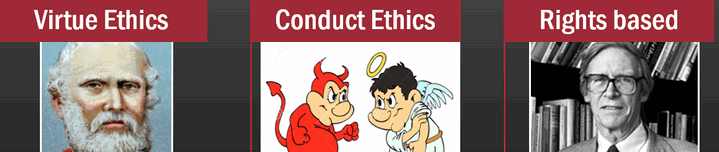
| 1. Virtue Ethics | We judge a person’s virtue rather than his ‘conduct’ |
|---|---|
| 2.Conduct Ethics | We focus on ‘conduct’ rather than ‘person’. Further
|
| 3.Rights based Ethics | We give ‘rights’ to an individual. By xyz action, whether ‘rights’ of Mr.ABC are violated or not? On that parameter we’ll evaluate the action |
T1: Virtue Ethics
Focus more on virtues of the agent rather than consequences of his actions.
| Plato | Gave four Cardinal virtues of a “good man”: Wisdom, Courage, Temperance, Justice. |
| Aristotle |
|
T2: Conduct Ethics
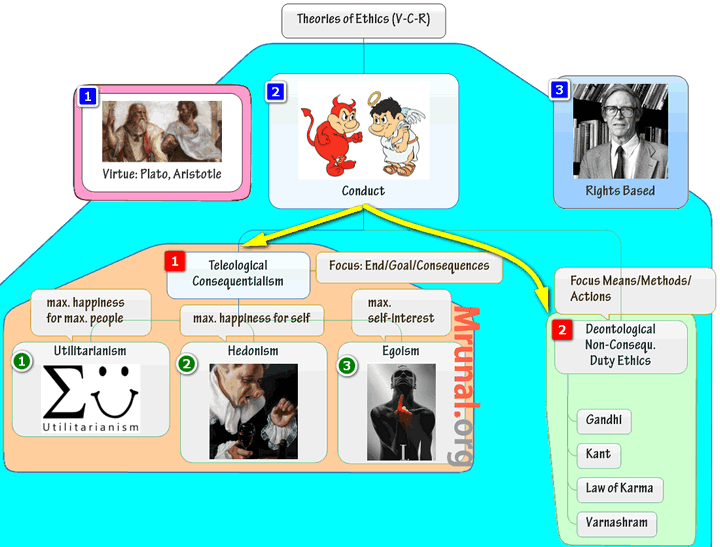
| Teleological: Consequentialism | Deontological: Non-consequentialism |
|---|---|
| Examples: (1) Utilitarianism (2) Hedonism (3) Egoism | Examples (1) Varnashram dharma (2) law of Karma (3) religious scripture |
| Focus on “End/Goals/Consequences” |
|
| We’d have gained independence sooner, had we used violence against the British, and sooner we gained independence, faster we’d have become a 1st world country, so, use of violence is right, because end goal is noble. | Gandhi: We don’t want to gain independence through the use of violence. Because even though self-rule is a noble goal, violence is not the right ‘mean/instrument’ to achieve it. |
In both 1 and 2, we are focusing on the ‘end’. |
Kant: ‘Piracy’ as a ‘process’ is wrong. Because it violates the ‘right to property’. Anyways, we’ll discuss Kant in detail, in separate lecture on Syllabus topic #5: Moral Thinkers. |
| It’s ok to lie, to save someone’s life. | Difficult to justify because by lying we’re violating the other person’s ‘right to knowledge’. |
| — | Gives motivation to work, even when the result is uncertain or far away. e.g. Lord Krishna advising Arjun to fight in the war against the Kaurav. |
Anyways, it’s not important to get into finer nuances of each and every thinker and theory, we just have to see its application in case studies. So, while solving a case study, try to see it through the glasses of various theories.
T2A: Utilitarian Theory

Utilitarianism: if lynching makes 99 people happy and one person unhappy, is it good?
- Utilitarianism says you should work for greatest happiness for greatest number of people.
- A lynch mob kills a person believing a committed a crime.
- In this case say 100 people’s happiness minus 1 dead guy’s unhappiness = 99 units of happiness. So, is it an ethical action after all it led to maximum happiness for maximum people?
- Thus, in traditional “Act Utilitarianism” theory, lynch mob is justifiable.
- But, What if we make a rule out of above case I.e. “it is ok for people to kill other people.” If this rule is held valid then people will fear coming out of their home => economy & society will collapse=> not maximum good for maximum people.
- Therefore, by application of ‘Rule utilitarianism‘, we can prove “lynch mob” is ethically wrong.
| Altruism | You should put other people’s happiness before your own happiness. |
| Utilitarianism | You should strive for maximum people’s happiness, you’re also part of that crowd. So, your own happiness also matters as a unit. |
| Hedonism | You should maximize your own pleasure. |
| Merits | Demerits |
|---|---|
|
|
You’ve to keep the merits and demerits of each theory in mind, to ensure its proper application in case studies. E.g. if a case study involves minority rights or feminism, it may not be right to bend the utilitarianism principle to justify your stand.
T2B: Hedonism
- Hedonism says maximize your own pleasure/happiness.
- Among Indian philosophical schools, Charvaka school (Lokayatmat) advocates the same.
| Hedonism | Strive for Pleasure in all forms. Pleasure is the only truth of life. |
| Epicureanism |
|
| Gandhism | opposite of Hedonism because it preaches Complete control over senses, Bramhcharya. |
| Merit | Demerits |
|---|---|
|
|
| Promotes consumerism: boost to economy, employment generation. If everyone pursues ascetic lifestyle, who’ll provide food to the families of Chinese workers in apple factory? |
|
Moral Skepticism
According to Sophists (Greece) and Charvaka (Ancient India)- Ethical studies have no logical foundation because
- There are no fixed / objective criteria to separate moral act from immoral act, therefore, men are incapable of pursuing moral path
- If men pursue moral path, it’ll not be in their best ‘self-interest’.
- External forces determine a man’s action, so rarely a man has free will to choose his own action.
And this thought process leads to next theory of ethics – Egoism
T2C: Egoism
Egoism says maximize your own self-interest. Because (1) it is in human nature to avoid pain (2) it is irrational for a man to ignore his self-interest.
| Hedonism |
|
| Egoism |
|
- If parents sacrifice personal comforts for better education for children, if businessman gives part of his income in philanthropic causes, if a soldier sacrifices his life for protection of the nation -how does Egoism interprete them?
- Egoism says in all such actions are unconsciously selfish. e.g. philanthropy – hidden objective of gaining fame and respect. Although hidden motives are difficult to verify.
| Merit | Demerit |
|---|---|
| Egoism can lead to happiness for others also e.g. Mukesh Ambani’s decision to run a refinery at Jamnagar is driven by his own self-interest of profit generation but it also generates employment for lakhs of people. Capitalism works parallel to this. |
|
| You’re running a mobile company with profit motive, but at the same time you’re doing a social service by helping people in their need to ‘communicate’ with others. |
|
| If everyone tries to maximum his own self-interest, still there will be resistance by others, so ultimately an ‘equilibrium’ will be established wherein its win-win for all. | If everyone tries to maximize his own self-interest, it’ll lead to disaster. e.g. Prisoner’s dilemma |
The demerits of egoism encouraged Mathematician John Nash (movie: A beautiful mind), to work on “Game theory”. He died in 2015, May. So consider that homework, for some ethical case study involving game-theory.
Summary of Conduct Ethics
| Theory | Thinkers | Meaning | Merits | Demerits |
|---|---|---|---|---|
| Utilitarianism |
|
Maximum happiness for maximum no. of people |
|
|
| Hedonism |
|
Maximum pleasure for yourself |
|
|
| Egoism |
|
Maximum self-interest | Capitalism, trickle down | Prisoner’s dilemma |
T3: Rights Based Ethics
- We give ‘rights’ to an individual. By xyz action, whether ‘rights’ of Mr.ABC are violated or not? On that parameter we’ll evaluate the action.
- In China, a person from rural area can’t move to Shanghai without permit. So, his right to self-development is violated.
- In N.Korea, ordinary citizens are denied internet service, so their right to knowledge id violated, although the State may justify it saying internet-ban is necessary for maintenance of law and order or to prevent the brainwashing of the North Koreans by Western powers.
- When “rights” are given, it imposes accountability on the government. e.g Freedom of expression =>Media => Check on corruption.
- Right to education => enlightened citizenry =>they exercise RTI and thereby make government answerable.
- Human rights: ensures feudalism doesn’t come back.
- So, How do we judge an action using rights based theory? Our thinking of rights based ethics begins with the liberalism.
| Negative Approach | Positive Approach |
|---|---|
|
|
John Rawls
Leading thinker of this school is John Rawls. As such not much point doing Ph.D on him, all you should remember is he tried to reconcile between Liberty (capitalism) and Equality (Communism)
| Liberty | give maximum liberty to people without encroaching on other people’s liberties. |
| Equality |
|
For Case studies, keep in mind- rights based approach should be used for major themes only e.g. speech, health, education. For trivial individualist things, e.g. ‘lying, stealing’ better to apply other theories for your answer.
Case study: Sardar & ICS
During the British era, ICS (Indian Civil services) officers were responsible for arrest and persecution of Sardar Patel and many other freedom fighters. Yet, after independence, Patel decided to continue ICS service under a new name “IAS” and retained those ICS officers in it, despite the opposition by the other members of Constituent assembly. Discuss the ethical dilemmas that Sardar Patel would have faced before arriving at this decision.
Case study: Ethical justification?
Is following course of action ethically justifiable? Yes / No and Why?
- It is ok to remove organs of a convict on death row without his consent, IF we transplant them to needy children from poor families.
- It is ok for government to run opium farms, provided they sell it to foreign countries use the money for benefit of the poor.
- We should legalize prostitution because it’ll lead to less exploitation of the women in the hands of pimps and policemen.
- Government should ban cigarettes and alcohol from movies since it influences young audience to begin smoking and drinking.
- Women in armed forces should be posted only in the desk jobs, since they’re physically less fit to serve in frontline field posts.
Descriptive Questions (200 words each)
- Discuss in brief, major theories of Ethics. Which of them, in your opinion, answers the moral Dilemma better than others?
- Utilitarianism, though logically consistent, has internal-contradictions. Do you agree? Justify your stand?
- Define “Betrayal”. Narrate a historic example of betrayal and discuss the underlying ethical currents.
- Moral value of an act is not wholly dependent on its consequences. Discuss with a historic example.
- A universal theory of Ethics is impossible to frame since the moral choices depend on culture, religion, region and time-period. Do you agree, Justify your stand.
- According to Charvaka and other moral sceptics- Ethics has no logical foundation and perception is the only source of knowledge. Do you agree, Justify your stand.
In the third part (E1/P3) we’ll look at values, role of family-society-Edu. Institutions in inculcating human values and ethics in public and private relations. Visit Mrunal.org/Ethics for more study material on Ethics.

![[Ethics] Leadership- Newzeland PM Jacinda Ardern resignation to keep work-life balance and overstress](https://mrunal.org/wp-content/uploads/2023/01/NZ-500x383.png)
![[Ethics WMD] Leadership Qualities- Mahua Moitra, Boris Johnson, Gotabaya Rajapaksa, Weekly Mrunal Digest from Jul week2-2022](https://mrunal.org/wp-content/uploads/2022/07/mahua-moitra-500x383.webp)
![[Ethics WMD] Attitude towards women- nonconsensual image, porn, right to privacy, abortion Weekly Mrunal Digest from Jul week1-2022](https://mrunal.org/wp-content/uploads/2022/07/pervert-500x383.jpg)
Thanku very much Sir.
you are really god mrunal..
What a great effort sir, thanks sir
(very special- summery of conduct ethics)
Thanks a ton Dear Mrunal Sir for fulfiling our requests to help in GS- IV theory portion and You are here with so comprehensive plan to help us.
To say the truth, no other book or material is so easily understandable and retrievable as your notes.
You are no less than an IAS officer who spares his precious time to help us.
Sir GS- IV is easy to score more as compared to other GS papers. So plz be benevolent enough to help us cover the entire Paper GS- IV as per your plan.
NOTE: I have used – “Cover” because it is not possible for any one any time to complete any paper entirely.
My friend’s opinion about IAS officers…
I’m copy pasting it….with removing some very controversial statements.
……….. ..
” sare k sare ias bevkuf hote he. Kyunki unki recruitmeent direct hoti he. Unko office k kam mein Toh jara sa bhi tappa padta nai he…” (Tappa padna means- samjh aana..a code word…)
“…Sab niche k officers ko puch puch k krte he. Waise bhi unhe koi kam Toh hota nai, Bas sign karke final decision lene hote hai… Wo bhi wo log P.a. ko puch k krte h.
Are…. Isliye Toh agr unse koi kam karvana ho to unke PA ko phodo. Wo karva dega……
Experience Toh mangta he na yar. Bina experience k wo ate he Toh for kya kr payeg…. ek Toh bahar k hote he Toh yahan ka kuch ata-pata hona ni h….
Niche k officers ne duniya Dekhi he.. Dhire dhire aage aaya he. Isliye use pata hota he ki kam kaise karte hai.
Are training lene se kuch nai hota…
jab do ias milte he unki Bas 1 Hi bat hoti hai.- tu konsi betch ka tha- kitne marks aaye the- kahan se tha… Bas… deka he maine
Mai janta hun coz mai govt. Me kam karta hun. ….Jitna ham bole utna Hi krta h. Puch puch k.
Thik hai Bhai Tu ban ja ias fir tu bi yehi karega. Des sudharne ka chaska nikal jayega…. Tujhe kyun des sudharna hai yar. Govt. Me ja maje kar. Itni mehnat karke des ko kyun de Rha h…”
……….
Friends …. Before you call me a fool to talk with this person. … Let me tell you… I was very tired after continuous study. So I was just chatting with him for some relaxation…. But i ended up before he ruin my mood……. He was my best friend in college. & now working in state govt.@ lower post. but going to prepare for state-psc. Class -1 exam….(failed in last attempt) . Not telling you directly… But he believes in cu***ption…and I afraid that he would crack the exam as he works so hard & cracked almost all the exams he appeared in.
Pata nai des mein aise kitne log hoge Jo govt. Job SIRF apne faayde k liye lete hai…. des sudharo nai Toh koi baat nai. Bigado Toh mat yar…….
………
If anybody of you is preparing for state/union civil services “just for your own benefits”…. Than f**k you…
……….
No commnets plz. Dont waste your time here on discussing about this mater…prepare well for exam… I generally don’t comment here…. But I think you understand why I posted this. .. I couldn’t resist myself.
………
Thanks.
…….
All the best.
Dear Mrunal Sir,
Please kindly notify me of new posts by email.
Thanks Mrunal for the effort!
keep it on Mrunal Sir…….
please increase the frequency of your posts…..
The case study you mentioned is good but i want to know your prespective as to how one should approach and write descriptive answer with support from theories explained above, even in descriptive questions too. As in ethics how one should decide what is right and wrong and choose to answer using which theory…. a bit of confusion, if you can clear it. :-)
Mrunal sir reading your archived economy ,diplomacy articles …. Feeling good… Thanks… Ethics articles are nice to read… Keep motivating.
Thank u so much Kavan and Mrunal sir for the awesome article..Its very easy to understand and helps a lot of people like me who can’t afford coaching…Real great work hat off…:)
Hello Mrunal sir, Kavan
Thank’s for the article.
A correction and a question :
Correction: Jeremy Bentham is single name, not two different person.
Question: Teleology derived from ‘Teleos’ is used in the concept of in distributive justice by Aristotle. So, should it not be under virtue ethics?
about economics and ethics sir…
Sir I couldn’t get the concept of Epicureanism
Please explain in more detail if possible.
Thanks
Case Study Justification:
Guys please refine..
1. It is not ok to remove the convict organs as it violates his right to liberty.
2. Constructing opium farms to help people cannot be ethically justified as the goal may be noble but means are not correct.
3. Legalising prostitution should be ok as it would save prostitutes against exploitation and also helps govt to regulate the activity and collect taxes.
4. Banning cigarettes /alcohol in films is against freedom of expression. There are other ways to affect young minds development by giving them e.g their right to education, right to health
5. Confining women to desk jobs/ clerical position is unethical as it is against their right to equality.
for the 3rd point if prostitution is legalised then there should be a law even to control the diseases caused from it so before legalising prostitution proper sex education must be given at schools which presently is not given and awareness campaigns should be taken out.. so point should not only be from the perspective of people who are exploited in prostitution but its after affects should also be given a careful study..
hi abhinav..
i have a doubt regarding 4th point
freedom of speech and expression has limitations under our constitution under heads of (1)security of state (2)friendly relations with foreign states (3) public order (4) decency and morality (5) contempt of court (6) defamation (7) incitement to an offence (8) sovereignity and integrity of india. I believe that consumption of intoxicating drugs which are injurious to health is morally wrong( plus though non-enforceable, but our DPSP also says the same). And hence to correct any morally worng thig could be ethically justified.
point 3. it could be taken the other way round since India lags in sex education and acceptance of prostitutes for it hurts religious sentiments of people and thus thinking about utilitarian theory ie, happiness for a large number of people it need to banned in public also due to its side effects on young and dignity of women would be deliberately hurt.
Thanks a lot sir ..
For giving a path to us in paper 4 ..pls continue on other topics of this paper ..
Thanks
Case study
Sardar Patel would have faced following ethical dilemmas:
Thoughts in favour of termination.
1.Egoism-These officers got him arrested.They should be sacked.
2.Jingoism-These officers had done anti-national activities by acting against the freedom fighters.
3.ICS was used by British to exploit the countrymen.It could prove to be a threat to the newly earned freedom of India.
Thoughts against the termination:
1.Terminating the service would be unwise when the country is at its nascent stage of freedom especially when partition of the country had caused great disruption.The country can’t afford similar events.Rather ICS should be used wisely.
2.Forgiveness is a virtuous value.These officers should also be forgiven and given another chance to work for their country.
Great work !! Thank you..
regarding sardar patel question:
Addressing the first batch of IAS, patel told them that -“Perhaps, you are aware of a saying regarding the Indian Civil Service—that, it is neither Indian nor civil, nor imbued with any spirit of service… Your predecessors had to serve as agents of an alien rule, and even against their better judgment, had sometimes to execute the biddings of their foreign employers”
this implies sardar patel believed that though the ICS officers were having free will and knowledge of what they are doing but their actions were not voluntary. And hence their actions could not be termed unethical.
Further,it was the rule utilitarianism which was prevelant during the british era which means that there were a fixed set of rules about handling of indians and for treatment of freedom fighters.However, sardar might have a view that with the independence,the era of act utilitarianism could have emerged in which each case would be judged on its own merit. this act utilitarianism mixed with the inate indianness of the upcoming IAS officers could not lead to same situation as that of ICS.
plz provide your views mrunal sir and friends…
idk about right and wrong but your answer seems quite rational.
I am not sure about utilitarianism. It’s greater gud of most ppl.but not necessarily by the majority. All the examples of democracy n the mob are majority taking decision for themselves. That’s mass hedonism. Mar ke mazaa aa raha ek ko …Sab mar rahe…This is mass hysteria n mob mentality…no body is benefiting. If police has to torture n kill a person to save many….that’s utilitarianism. I think the decision of (greater good) should be taken by an objective party. Or whatever majority decides is for their greater gud. I hope sm1 gets what m confused about. Gangrape is not justified by utilitarianism because their is no good in it for anybody. Even if 4 guys think it is. Majority decision is not always good for majority.
Sardar Patel’s Ethical dilemma :
On the negative side
a) Anti-patriotic as ethically they have all knowledge of indian people during colonial period, despite that they didnt do anything to liberate india except fulfilling their personal motives.
b) Supported British interests
c) Maltreatment with the freedom fighters
d) Must take revenge
e) ICS officers think themselves as ‘Mai-Baap ” (kings) of indian public
f) they may continue to follow their way of working which will work against the very spirit of our freedom, keeping india poor
On the positive side:
a) they didnt do anything out of FREE WILL , but out of compulsion and being forced to do so.
b) it was their involuntary actions, done to keep their jobs intact. Most of the decisions came out of governors or higher British officials
c) Despite all their shortcomings, they did balance their moral duty towards the empire as well as the feeling of nationalism by helping indian freedom fighters in whatever way they could.
d) these are Indian Intelligentsia, very good adminstrators, britishers controlled whole of india through them, hence in free india their services can help India in achieving many of its goals as they will work under Indian constitution now ( poverty, illetracy, development , disease)
e) will enforce the rights given to people under new constitution
f) most important was the need of the time as religion based riots were tearing the country apart, hence their services will be indispensable.
Thank you very much Sir.
Sir, We will be more benefited if u post answers for the given cases in separate post.
Sir! Please provide model answers for the questions to make it complete.
Case Study : Sardar & ICS
During British Era, Freedom fighters were considered as terrorists and system destabilize rs by colonial administration during many years. But Britishers were in the process of exploitation of our country for the benefit of their own country and themselves also. they have used ICS officers as a means to strictly suppress the freedom fighters at that time from the ground level. But Sardar patel have observed the potential of ICS cadre which could strengthen our newly born democracy from Village level. He dealt with many issues after independence with maturity and skill ful persuasion keeping his ego out of equation many times. Even other members opposed it just by seeing what happened and what ICS did to them without recognizing the gross benefits of ICS if once it could operate at its full potential for the welfare of poor.
Case study: Ethical Justification?
1. yes, it is ethically justifiable. We could use organs of “Dead” corpses for the children. its maximum happiness for the maximum people.
2. No, if government itself follows the wrong means for the benefit of poor, poor will also try drug trafficking or other things for the welfare of themselves. government should represent the country’s ethical behavior.
3. No, legalizing prostitution we led to the exploitation of women more, it won’t reduce it. Several person would forcibly put women under prostitution for further exploitation of them. it effects society alot in moral sense.
4. yes, it should be. movies are the medium, which would effect the masses alot. people try to imitate their favourite hero’s in many ways as we see it , why advertisement companies put Movie figures as ambassadors for their products. movies have strong effect on the younger generation. its not violation of freedom of expression, its subject to morality and decency and public health.
5. No, Some of the Women in Syria, formed a group to fought with ISIS terrorist group while many men fleeing back. it’s not good discriminate them on the basis of the above cause.
Great! Excellent work! Thanks a lot.
No person can be GOD…simply thank him or gift him…
Regarding the 1st case study, the ethical dilemma is- emotional experience vs future larger benefit of public.
Sardar focused upon the theory of Utilitaranism – focus on maximum happiness for maximum people.
He focused on the benefits of the IAS service for the larger public, i.e. better administration and overall protection of human rights at large.
kindly review my answer guys and mrunal sir…
the answers of the question statements-
1. acc to theory of deontological conduct of ethics, its the means which holds more importance than the ends. Its unethical to remove organs of the woman without her consent even if it holds a nobel cause of charity.
2. acc to theory of deontological conduct of ethics, its unethical to construct opium farms for profit as it will lead to increased consumption of opium in the world which is harmful and profits earned on cost of human health is unethical.
3. acc to theory of rights based ethics, legalising of prostitution is not ethical as it hampers the right of life and personal liberty of women and also it puts a negative impact in the society leading to increasing rates of crimes.
4. acc to theory of utilitarianism, banning ciggretes and alcohol from movies will serve maximum benefit to maximum people as it will avoid youth to get negative messages from the movies and their would be reduction in the number of cases of youth involvement in consumption of alchohol etc, and commiting crimes. also, acc to theory of rights based ethics , this action of banning ciggretes and alchohol from movies do nit hamper the latter’s rights as messages can be conveyed even without such displays.
5. acc to rights based ethics, giving women desk jobs only on the misconception of their physical fitness is hampering their rights to equality and is thus unethical.